Get Full Government Meeting Transcripts, Videos, & Alerts Forever!
Get email alerts on the Budget topic
No spam. Unsubscribe anytime.
South Portland board weighs closing one elementary school in FY27 budget and two reconfiguration paths
Summary
Finance director presented a FY27 budget that proposes closing one elementary school and offers two options — grade-span reconfiguration (primary/intermediate) or keeping K–4 with one closure — to address a structural deficit, prompting questions about timelines, class sizes and legal and transportation implications.
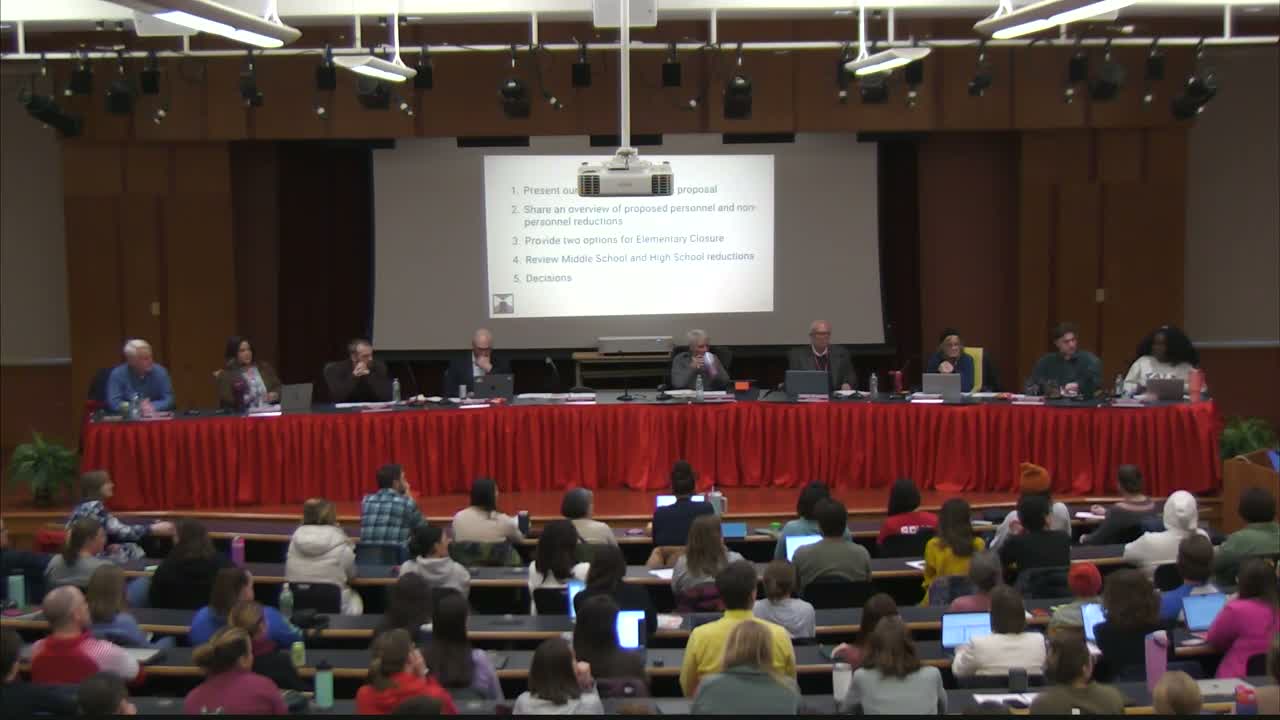
The South Portland School Board on March 23 reviewed the superintendent's proposed FY27 budget, which includes personnel and nonpersonnel reductions and a recommendation to close one elementary school to narrow a multi‑million dollar shortfall.
Finance Director Abigail Ketchin told the board the proposal would reduce district costs in multiple areas and that closing one elementary school produced roughly $378,000 in savings in the administration's modeling. "We are proposing to close one elementary school," Ketchin said, adding the FY27 package includes both personnel reductions and operational cuts and that the overall budget increase would be 3.3 percent — "which works out to about $257 additional per year" for the average local taxpayer under current assumptions.
Why it matters: district leaders said declining enrollment, lingering COVID funding cliffs and rising debt-service obligations mean the district cannot sustain current staffing and program levels. Ketchin flagged an anticipated increase in debt service tied to an athletic field bond and said FY28 may carry additional principal and interest payments. The proposed FY27 budget also includes a roughly $250,000 placeholder to cover IEP‑related overtime and mandatory meetings.
Two options, same goal: Assistant Superintendent Johanna Prince described two models for handling elementary grades if a closure moves forward. Option A would reconfigure the district into primary sites (preK–1) and intermediate sites (2–4); Option B would keep remaining schools as K–4 and close one building while keeping preK seats concentrated at two campuses. "There are pros and cons to both models," Prince said, noting Option A could increase grade‑level collaboration and operational efficiencies while Option B would minimize transitions for some young learners.
Class-size and equity trade-offs: Prince said district policy currently caps K–2 classes at 20 and grades 3–4 at 24; both proposals increase average class sizes in model projections, and administration cautioned averages hide local variation. Board members repeatedly pressed the administration for more granular modeling on redistricting scenarios, transportation routes and the likely distribution of students by neighborhood under each option.
Process and legal questions: Board members and public commenters pressed for timing clarity and for assurances that any closure or reconfiguration would comply with federal civil‑rights requirements. A parent asked whether the district had assessed Title VI risks; the administration said legal review is required and that a definitive answer was not available at the workshop. The board repeatedly emphasized that a formal vote on any closure or on adopting a final budget would take place in a future public meeting.
Next steps: the administration said it could meet a compressed schedule if the board chose Option A for fall implementation but acknowledged the timeline would be tight; the school board scheduled follow‑up meetings and will take formal action at a later public session.
The workshop also included a lengthy public‑comment period in which staff, students and families urged the board to preserve particular positions and oppose rushed implementation; the board adjourned after agreeing to continue deliberations at upcoming meetings.