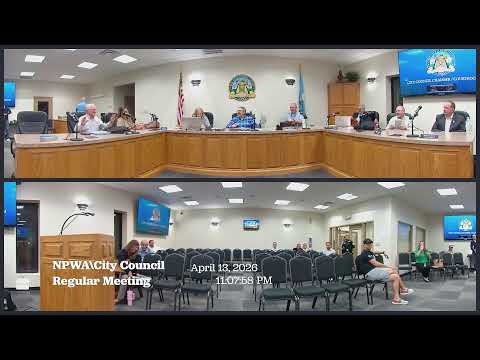
Council reviews variance to allow poly pipe in Town Center Plaza; engineers and residents debate inspection and long-term performance
Loading...
Summary
Council heard a technical presentation on allowing dual-wall polyethylene/poly pipe instead of reinforced concrete for Town Center Plaza storm sewer. Staff and the design engineer cited industry acceptance and ~15% installed-cost savings; council and residents pushed for stronger inspection and code amendments rather than a site-by-site variance.
Newcastle planning staff and the project’s civil engineer presented a variance request on April 13 asking the council to allow use of dual‑wall polyethylene poly pipe rather than reinforced concrete pipe (RCP) in the Town Center Plaza storm sewer installation.
Planning staff (Janae Greenlee) explained the request and placed it in the context of a pending code update: the city’s ordinance currently lists RCP as the allowed material; the proposed variance would allow a new, heavily specified poly product at this location while staff pursues a broader ordinance amendment. “We are working on our subdivision regulations to allow this specific poly pipe where it’s specified and installed per the manufacturer and engineering details,” Greenlee said.
Sean McGraw, the project civil engineer, told council the product is not a generic plastic but a dual‑wall, watertight, rock‑backfilled installation designed for use under pavement when installed and inspected to specific standards. He said the city could expect roughly 15% savings on installed, fully loaded storm‑sewer costs because the pipe nests for easier transport and weighs far less than concrete pipe. McGraw also said ODOT and other nearby cities have accepted the material with required bedding and compaction specifications.
Several council members and members of the public raised concerns about inspection capacity and long-term performance. One commenter pointed to existing residential installations in Newcastle that were not inspected properly and warned that improper compaction and bedding could lead to deformation or failure. “If we allow this, we need to be sure it’s inspected and built to code, not installed improperly and then blamed on the homeowners,” a council member said.
Council discussion focused on whether to grant a one-off variance for this project or require a code amendment that would set uniform standards for all future installations. Staff said WSB (the city’s contract engineer/inspector) would inspect the work and the developer has committed to contract inspection; the applicant said ODOT would have to update permits where the pipe crosses ODOT right-of-way.
Council did not take final action on an ordinance change at the meeting; they approved the specific agenda item (the variance for this project) after Q&A, and several council members asked staff to draft recommended ordinance language so the city could adopt a consistent standard rather than rely on variances.