Council continues review of 77-acre Riverview Villages PUD after wide public opposition on density and traffic
Loading...
Summary
Newcastle council heard a multi-hour presentation and extensive public comment on a 77-acre Riverview Villages PUD that would add mixed-use housing and a town center. Residents pressed officials on density, traffic, utilities and HOA accountability; the council continued the item for revisions.
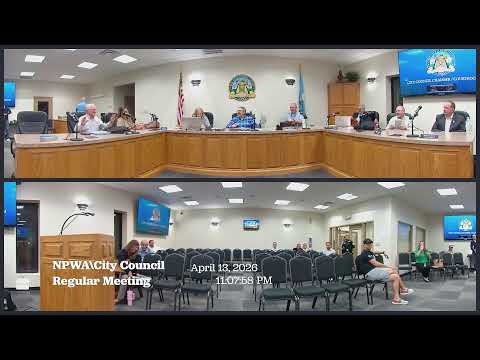
The Newcastle City Council on April 13 heard a lengthy staff and developer presentation on Riverview Villages, a proposed 77.33-acre planned unit development that would create mixed-use village center, multifamily and small-lot single-family housing, and then postponed a final decision to allow the developer to revise the plan.
Planning staff described the proposal as a mixed-use neighborhood with a central town center and a range of housing types. Janae Greenlee, planning staff, said the project would include about 263 lots — roughly 234 village single-family lots, nine multifamily lots and 20 commercial-mixed lots — and requested reduced lot sizes, narrower local streets and other PUD-specific exceptions to the city’s current subdivision standards.
“The proposal seeks to add diverse housing options with boutique commercial uses while keeping commercial intensity off the neighborhood edge,” Greenlee said. She told the council staff recommends careful review of setbacks, parking and utility provisions in the final plat and PUD handbook.
The applicant’s attorney, Sean Reager, framed the plan as a deliberate, design-driven alternative to full commercial development allowed under current CC-2 zoning. “This is not big-box commercial,” Reager said. “It’s a walkable town-center concept intended to layer lower-intensity commercial at the frontage and residential neighborhoods behind.” Civil engineer Dean Colleda and developer Russell Clark also answered technical questions about sewer, lift stations and traffic mitigation.
Council members pressed the applicant on a long list of technical and policy issues — traffic impacts on Highway 37 and Riverfront Drive, where residents enter and exit the neighborhood; the location and sizing of the proposed lift station and sewer mains; on-site parking and how narrow local streets would accommodate service and emergency vehicles; and whether utility easements and sidewalks would be placed where the city can maintain them. Engineer Dean Colleda said the proposed lift station is designed to serve Riverview Villages and could be upsized by developer agreement to accommodate future adjacent development, but that any cost-sharing for upsizing would be negotiated when final design proceeds.
Residents who live immediately north and adjacent to the site gave extended public testimony opposing the plan in its current form. Randy Smith, who said he lives at 3675 Deep Swell Circle, said neighbors were sold a different long-term vision for Riverview when they bought their homes and said the PUD changes that expectation: “We were told phase 2 would look like the first phase; this is different,” he said. Several neighbors asked for a larger landscape buffer, taller setbacks adjacent to existing homes, and fewer driveways tying directly to Riverfront Drive.
Other residents raised technical concerns. Brianna Roach, who said her property borders the development, questioned maximum unit calculations under PUD rules and warned the plan could yield far more dwellings than the presentation implied: “By my calculation, depending on how structures are placed, the PUD could allow hundreds more units than you’ve discussed,” she said.
Developer Russell Clark acknowledged the public’s concerns and said the team has revised the design repeatedly during the review process. “We’ve moved multifamily away from the north edge, added sidewalks and increased street widths since the earlier concept,” Clark said. He told council the team is willing to explore larger lots along the northern boundary, alternate access arrangements and clearer utility easement locations.
After more than three hours of presentation and public comment, council members said several fixes could make the project more acceptable: adding a substantial buffer (or larger lots) along the northern edge adjacent to Riverview Estates; limiting the number of access points that feed onto Riverfront Drive; clarifying parking and utility easement locations so the city would not be required to maintain private parking areas; and either increasing dedicated park/open-space percentages or explaining the proposed in‑lieu fee. Several council members also requested that the PUD include clearer language about the architectural review process, the make-up of the applicant-controlled Architectural Review Board, and a timetable for HOA turnover and maintenance guarantees.
Councilmember (Chair) speaker 1 summarized the decision: after notation of requested changes and a staff review, the council voted to continue the PUD to a future regular meeting so the applicant can return with specific revisions and updated exhibits. The motion to continue passed on a roll call vote.
What happens next: the developer will be asked to prepare a revised PUD and preliminary plat that responds to the council’s list of concerns. Any revised proposal is likely to return to planning commission for an updated recommendation before the council takes a final vote. The council’s continuance leaves the project alive but unfinished; neighbors said they will continue to monitor materials and attend follow-up hearings.