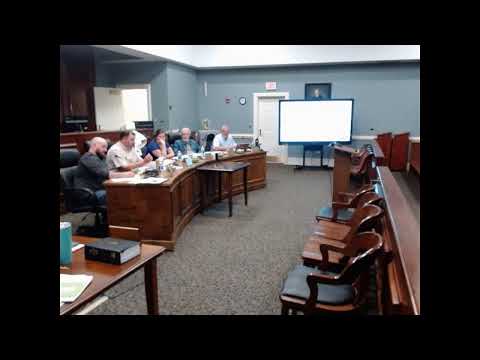
Nelson County Board delays vote on proposed 58¢ real-property tax rate after public hearing
Loading...
Summary
After a staff presentation showing a 2026 reassessment that raised taxable values by 31.5%, the Nelson County Board of Supervisors heard public concerns about affordability and decided to continue the tax-rate decision to a joint work session on April 22 to review state budget developments and additional numbers.
Nelson County’s Board of Supervisors paused a decision on a proposed real-property tax rate of 58¢ per $100 of assessed value after a public hearing where residents warned the increase would hit fixed-income households and renters hard.
Candy, the county presenter, told the board the county’s 2026 reassessment covered 16,613 parcels, was certified by the Department of Taxation on Dec. 31, 2025 and is effective Jan. 1, 2026. She said total real-property values rose 26.6% from 2025 to 2026 and taxable values rose 31.5%. The county’s advertised rate of 58¢ represents a 17.33% effective increase compared with the lower, equalizing rate of about 49.5¢, and would generate roughly $3,600,000 in new recurring real-estate tax revenue if adopted, Candy said.
The reassessment and the proposed rate spurred multiple public comments. A Rockfish Orchard representative said rapid valuation increases — which he blamed in part on nearby short-term rentals and commercially operated vacation properties — were making ownership unaffordable for young families and fixed-income residents and urged reassessing how short-term rentals are valued. "We're basically kicking the can down the road, and I think we're doing it expensive, both our young families as well as some of our more fixed income residents," the speaker said.
Donna Small, who gave a Nellis Ford address, told the board, "A 58¢ tax rate is close to our high 18% interest. We all expect a reasonable increase but not 18%." Steven Bain said the proposed 57¢–58¢ range (he estimated it would raise about $3.4 million annually) was not justified without tighter expense controls and suggested a 52¢ alternative plus new revenues such as an admissions tax or a higher transient-occupancy tax. Paul Davis and other commenters described retirement and fixed-income pressures and urged the board to weigh hardship when choosing a rate.
Board members said they were reluctant to set a final rate before conferees in Richmond complete their work on the state budget. One supervisor noted the state budget process could yield roughly $3.4 million in school-related relief that would change the county’s Local Composite Index (LCI) picture and thus affect budget needs. Members discussed alternatives including staging smaller annual rate increases, pursuing more frequent reassessments, and expanding targeted relief programs based on income.
Candy also clarified that about $4,000,000 of carryover funds in the county budget are one-time monies earmarked for capital outlay ($2.3 million), nonrecurring contingency (~$415,300), miscellaneous carryforward (~$730,000), and a portion of EMS vehicle costs (~$688,000), and therefore are not a recurring revenue source for ongoing operations.
Rather than vote on the advertised rate tonight, the board moved to adjourn and continue the meeting for further discussion and a joint work session with the planning commission on 04/22/2026 at 5:00 p.m. The motion was seconded and an affirmative voice vote was recorded. The board asked staff to provide more detailed budget scenarios, including how lower rates (for example a 52¢ alternative) would change revenues and to explore options for targeted tax relief.
Next steps: the board will reconvene on 04/22/2026 for a joint work session with the planning commission and will revisit the advertised tax rate after staff provides requested analyses and as further information from the state budget conferees becomes available.