Lifetime Citizen Portal Access — AI Briefings, Alerts & Unlimited Follows
Subcommittee adopts H‑1 substitute for House Bill 5607, sends Medicaid and behavioral‑health package to appropriations
Loading...
Summary
The House Appropriations Subcommittee adopted the H‑1 substitute to House Bill 5607, the DHHS Medicaid and behavioral‑health spending package for FY 2026‑27, after a fiscal overview by House Fiscal Agency staff and member questions about provider‑tax treatment, a $300 million savings assumption and direct‑care wages. The substitute was adopted 5–2 and reported to Appropriations 5–2.
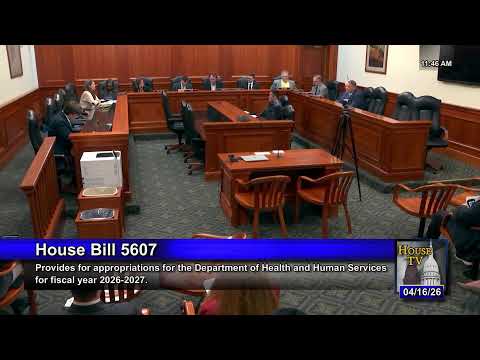
Chair Van Werkom convened the House Appropriations Subcommittee on Medicaid and Behavioral Health and the panel adopted the H‑1 substitute for House Bill 5607, advancing the DHHS Medicaid and behavioral‑health budget recommendation to the full Appropriations Committee.
Kent Dall, senior fiscal analyst at the House Fiscal Agency, gave the subcommittee a line‑by‑line overview of the recommendation, saying the package totals about $22.9 billion gross and $5.9 billion in general fund support for FY 2026‑27. "Looking at gross, 22,900,000,000 gross, over year to date, that's 5,900,000,000 general fund," Dall said, and he noted the plan represents roughly a $1.0 billion gross increase and $148.9 million general‑fund increase over year‑to‑date while reflecting a net reduction of 44.5 FTE positions.
Dall walked members through major changes: traditional Medicaid caseload adjustments ($617.6 million gross; $159.1 million GF), actuarial soundness adjustments both branches accepted, retention of provider‑tax boilerplate in sections 18.33 and 18.34 rather than moving those revenues into Part 1, and the House’s decision not to include the executive’s tax proposals that would have offset roughly $780.4 million in general fund. He also described behavioral‑health additions the House included: about $32.9 million gross (roughly $30.0 million GF) and 150 FTEs for the Southeast Michigan State Psychiatric Hospital, separate line items for adult and child psychiatric beds, and line‑item and distribution changes for opioid‑recovery funding.
On policy language, the House added several new and revised boilerplate provisions: requirements for managed‑care network adequacy reporting tied to direct‑care worker wages and compliance, new language to dedicate up to 1% of the autism line to an independent contractor for fraud detection and quality control, and expanded reporting and dashboard requirements for the rural health transformation program (section 18.03), including quarterly myHIN expansion reports and transparency on grant awards and expenditures. Dall also highlighted changes requiring the department to pursue generic and biosimilar utilization in the state single preferred drug list and a provision directing a 15‑year lookback to identify potential Medicaid cost‑savings.
Representative Rogers pressed HFA on how the provider‑tax revenues are being shown and how the House arrived at a $300 million general‑fund savings assumption — double the executive’s $150 million. "It's confusing how the money is still flowing through that since we've completely restructured that piece," Rogers said. Dall and the chair explained that the provider‑tax revenues and associated federal match remain authorized in boilerplate sections 18.33 and 18.34 (so the appropriations authorize the expenditures even if they are not listed in the gross totals in Part 1) and said the House included additional top‑line efficiencies and boilerplate changes that the subcommittee expects will yield the higher $300 million savings assumption.
Another member asked about the direct‑care wage treatment and the workload implications of new federal reporting requirements alongside reductions in FTEs and IT investments. HFA answered that the House included wage increases for direct‑care workers for FY 25 and FY 26 (moved into this budget) though not at the level the governor proposed, and that federally required IT projects are funded while the House seeks efficiency elsewhere. Members voiced concerns about reduced FTE counts concurrent with expanded reporting and monitoring duties.
Representative Robinson raised concern about removing a $17.3 million gross multicultural integration allocation and said the subcommittee should continue conversations about that program’s work and return on investment.
On procedural motions, Vice Chair Green moved to adopt the H‑1 substitute for House Bill 5607; the roll call recorded five yeas and two nays and the substitute was adopted. Representative Roth then moved to report House Bill 5607 as substitute H‑1 to the House Appropriations Committee; the roll call again recorded five yeas and two nays and the bill was reported. The chair thanked House Fiscal Agency staff Kevin Korstra and Kent Dall for their work and adjourned the meeting.
What’s next: the substitute H‑1 to HB 5607 will be considered by the full House Appropriations Committee; members and staff indicated further stakeholder meetings and follow‑up on boilerplate implementation will be needed.