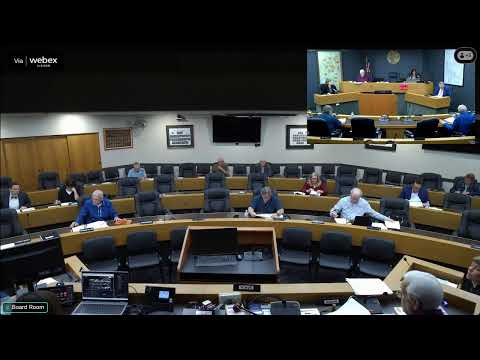
LaSalle County board weighs using $9.1M iFiber payment to shore up trust as bonds come due
Loading...
Summary
County advisers and board members debated using roughly $9.1 million in iFiber proceeds versus issuing bonds to 'perpetuate the trust'; Bernardi Securities said outstanding trust bonds will require planning through 2029 and that issuance typically costs about 1% of the borrowings.
John Vazetti of Bernardi Securities told the LaSalle County Board on June 11 that the county's 2019 bond series issued for the trust will have its final principal payment on Dec. 1, 2029 (which falls in the county's FY2030) and that the county completed a $1,795,000 principal payment, leaving an outstanding balance the report lists as $7,400,000 after the recent payment (previously shown as $9,195,000). Vazetti, who said Bernardi has worked with LaSalle County since 2004, described the firm's annual disclosure report and its role in informing potential secondary-market investors.
The disclosure report, Vazetti said, is posted to the Municipal Securities Rulemaking Board's EMMA website and must be filed within 210 days of the Nov. 30 fiscal-year end. He summarized the county's legal debt margin (2.875% of equalized assessed valuation) and cited a 2024 EAV he used for his examples (about $3.8 billion), which produces a statutory debt capacity well above the county's current trust obligations.
Board discussion focused on whether to apply a roughly $9.1 million iFiber payment to the trust, or to pursue alternative financing. One member summarized the arithmetic: "So basically, we're sitting around $3,000,000 short on the estimate that came out in that report," and other members repeated that placing $7 million to $7.5 million into the trust could carry the county through the coming bond payments based on current estimates. Vazetti cautioned that some estimates—such as those in the Glixman study—are actuarial and subject to change.
On timing and cost, Vazetti said that while state law allows issuance as quickly as 60 days, practical factors often extend the process; "Having done work in this county for nearly 15 years now, it takes about 9 months," he said, while others suggested faster timelines are possible in special circumstances. He also estimated total issuance costs at roughly 1% of a bond issue to cover underwriting, rating and legal work.
Several board members urged caution about using one-time iFiber proceeds as an ongoing fix. One member warned that if iFiber money is left outside the trust "successive administrations could take part of that iFiber money or all of it and use it the way they want," creating future vulnerability. Others proposed a hybrid approach: use part of the iFiber funds now and plan for short-term monitoring, annual levy adjustments and a possible bond later if claims or liabilities grow.
The board set next steps: further discussion at a committee-of-the-whole meeting Monday and referral to the full board meeting in May for formal direction. Several members urged a decision within one to two months if the board intends to use the iFiber proceeds for the trust. The discussion ended with no formal vote on financing during the open session.
Why it matters: the trust pays for liabilities the county faces; choosing to use a one-time windfall, to borrow, or to fund claims incrementally affects taxpayer levies, debt service costs and the county's long-term fiscal flexibility.
Next steps: the board scheduled committee discussion Monday and will revisit the item at an upcoming full-board meeting, where formal action may be taken.