Agency staff credit voluntary federal conservation agreements for successful reintroductions of pygmy rabbit and fisher; island marble efforts constrained by O(
Loading...
Summary
Presenters told the wildlife committee that conservation benefit agreements (formerly SHA/CCAA) administered by the U.S. Fish and Wildlife Service and facilitated by WDFW have enabled reintroduction and habitat work on private lands — citing pygmy rabbit and fisher successes and noting staff capacity limits for island marble butterfly work.
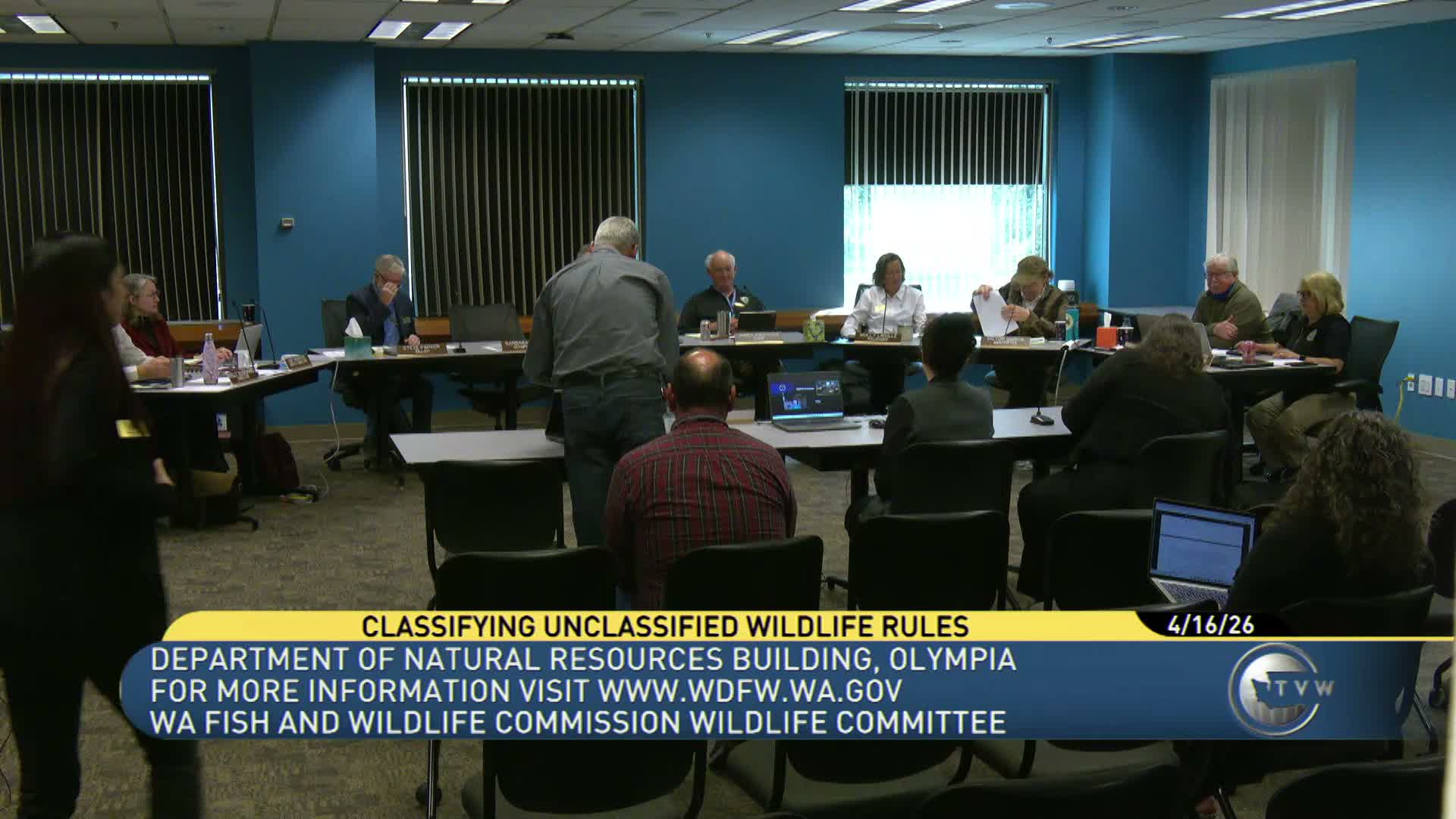
Julia Smith, the department’s endangered species recovery section manager, and Hannah Anderson, a wildlife diversity division manager, told the committee the department has played a facilitation and implementation role in voluntary federal agreements that incentivize private landowners to provide habitat and monitoring for at‑risk species.
"These agreements are federal agreements. They're administered by the U.S. Fish and Wildlife Service. WDFW is a facilitator, a partner, and implementer," Julia Smith told commissioners, explaining that safe‑harbor agreements (SHAs) and candidate conservation agreements with assurances (CCAAs) have now been rolled into conservation benefit agreements (CBAs).
Why it matters: private lands make up roughly 58% of Washington; staff said recovery of many threatened or endangered species is not feasible on public land alone, and conservation agreements provide regulatory assurances that reduce landowners’ perceived risk of hosting listed or recovering species.
Examples and outcomes
Pygmy rabbit: Hannah Anderson reviewed the Columbia Basin pygmy rabbit history — state listing, emergency federal listing for a distinct population, captive breeding and early safe‑harbor agreements signed in 2006. She said the department now covers about 140,000 acres under agreements that allow landowner baseline surveys, monitoring access and, where needed, capture for recovery work. "We've been reintroducing a federally endangered species in a predominantly privately owned landscape for over 20 years, and it is successful," Anderson said.
Fisher: staff described a reintroduction program that began in 2008 and a CCAA that enrolled private forest lands. The department holds an umbrella permit for the fisher CCAA and has enrolled landowners via certificates of inclusion; staff said more than 3.5 million acres of forest land are enrolled and that the approach reduced administrative burden for participating landowners. Department staff credited the CCAA and reintroduction work with helping keep fisher out of a proposed federal listing for Washington.
Island marble butterfly: Julia Smith said this CCAA focuses on creating and protecting host‑plant patches (field mustard), managing deer predation (for example, with deer fencing) and monitoring. Since 2019 the island marble agreement has enrolled 23 partners and covers more than 1,000 acres at 17 sites. Smith warned that staff capacity limits implementation: "The main limitation is staff capacity," she said, noting that landowners require technical help to plant and manage habitat patches and that both the department and the Fish and Wildlife Service have faced staffing cuts.
Funding and obligations
Commissioners asked whether landowners receive payments and whether agreements transfer with property title. Staff said agreements generally provide regulatory assurance rather than direct payments; some development has been funded with grants (including Service section 6 grants) but implementation and permit‑holding responsibilities often fall to the department. Agreements are voluntary and can transfer with the property if the new owner is willing to participate, staff said.
Commissioners praised the program and urged the department to publicize success stories to build support. "These stories need to be shouted from the rooftop," Commissioner Woody Myers said, adding that showcasing positive outcomes could help secure more funding.
Next steps: staff said they are maintaining existing agreements and reporting commitments while pausing or slowing development of new agreements until capacity or funding improves. The department is updating an expiring pygmy rabbit SHA to a conservation benefit agreement and is beginning outreach to enroll additional landowners.