Get Full Government Meeting Transcripts, Videos, & Alerts Forever!
Agency staff credit voluntary federal conservation agreements for successful reintroductions of pygmy rabbit and fisher; island marble efforts constrained by O(
Summary
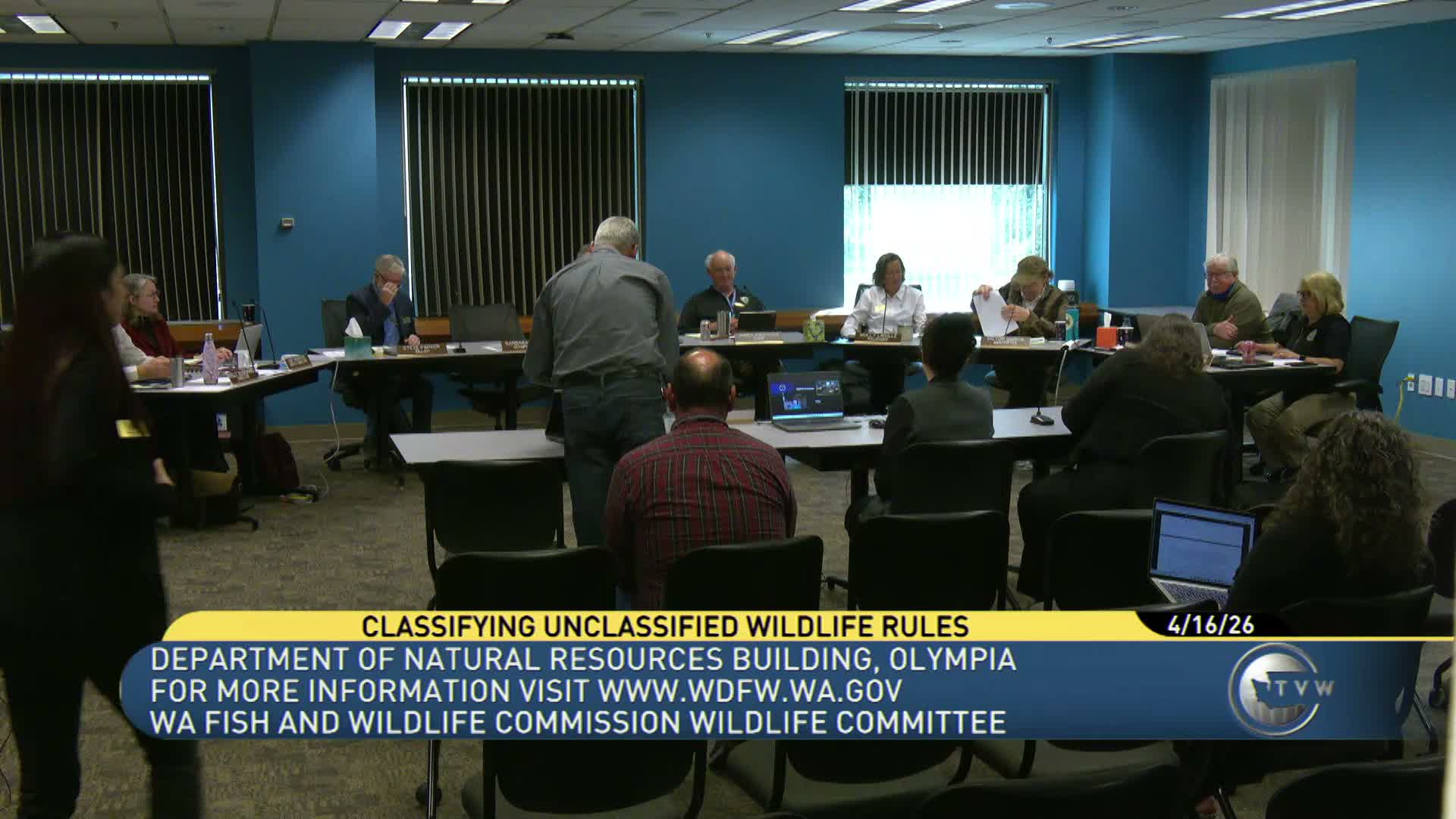
Presenters told the wildlife committee that conservation benefit agreements (formerly SHA/CCAA) administered by the U.S. Fish and Wildlife Service and facilitated by WDFW have enabled reintroduction and habitat work on private lands — citing pygmy rabbit and fisher successes and noting staff capacity limits for island marble butterfly work.
Julia Smith, the department’s endangered species recovery section manager, and Hannah Anderson, a wildlife diversity division manager, told the committee the department has played a facilitation and implementation role in voluntary federal agreements that incentivize private landowners to provide habitat and monitoring for at‑risk species.
"These agreements are federal agreements. They're administered by the U.S. Fish and Wildlife Service. WDFW is a facilitator, a partner, and implementer," Julia Smith told commissioners, explaining that safe‑harbor agreements (SHAs) and candidate conservation agreements with assurances (CCAAs) have now been rolled into conservation benefit agreements (CBAs).
Why it matters: private lands make up roughly 58% of Washington; staff said recovery of many threatened or endangered species is not feasible on public land alone, and conservation agreements provide regulatory assurances that reduce…
Already have an account? Log in
Subscribe to keep reading
Unlock the rest of this article — and every article on Citizen Portal.
- Unlimited articles
- AI-powered breakdowns of topics, speakers, decisions, and budgets
- Instant alerts when your location has a new meeting
- Follow topics and more locations
- 1,000 AI Insights / month, plus AI Chat