Get Full Government Meeting Transcripts, Videos, & Alerts Forever!
Get email alerts on the Species Classification topic
No spam. Unsubscribe anytime.
Wildlife committee reviews plan to classify 108 unclassified species; staff say coyote rules likely unchanged
Summary
Staff told the Washington Pacific Wildlife Commission wildlife committee they are reviewing about 108 unclassified species to recommend placements (protected, game, or deleterious), and stressed classification alone would not immediately change hunting seasons; commissioners asked for clear public fact sheets amid concern about coyotes and other flashpoint species.
At a meeting of the Washington Pacific Wildlife Commission’s wildlife committee, staff described progress on a multi-month project to review roughly 108 species currently labeled as “unclassified” and recommend how to formally classify each one.
"I passed out a handout that has a list of, I think, a 108 species that are currently in the list," said Mick Cope, the department program manager, describing the inventory that staff are still refining. He told commissioners the majority of candidates are reptiles, amphibians and small mammals and that recommendations will be vetted with enforcement partners and legal counsel.
Why it matters: classification changes determine which regulatory bin a species occupies — for example, whether it is designated protected wildlife, classified as a game animal, or treated as a deleterious exotic — and that in turn determines the subsequent rule processes the agency will use.
Staff emphasized that classification is only the first step. "The classification really is the outcome of the process," Cope said. If a species is recommended as a game animal, the department would then follow the normal season‑setting process through separate WACC actions. He told the committee he expects it will take "a couple of months" before staff can present a clear, workable timeline for recommendations.
Questions quickly focused on coyotes, which have drawn public attention. Commissioner John Lemkeland asked whether designating coyotes as game would require setting a hunting season. "With coyotes specifically, there's already kind of a season on the books," said Anise Audi, the agency’s game division manager. "It is a year‑round season with no bag limit, but there are restrictions ... so I think coyotes, as far as we're concerned, is pretty much set up for classification as a game species. No real change is required." Audi added that some game species can also be listed as "season closed" and that, in general, seasons and bag limits are recorded in the WACC rules the department maintains.
Commissioners pressed how staff will collect data to support recommendations. Woody Myers and others pressed staff on reporting and harvest surveys; Audi said small‑game surveys and some harvest reporting already capture coyote take, and that the department collects baseline information for many of the species on the list. Cope and Audi said there may be a few species that require extra data collection, but that for the majority staff believe they already have sufficient baseline information to make recommendations.
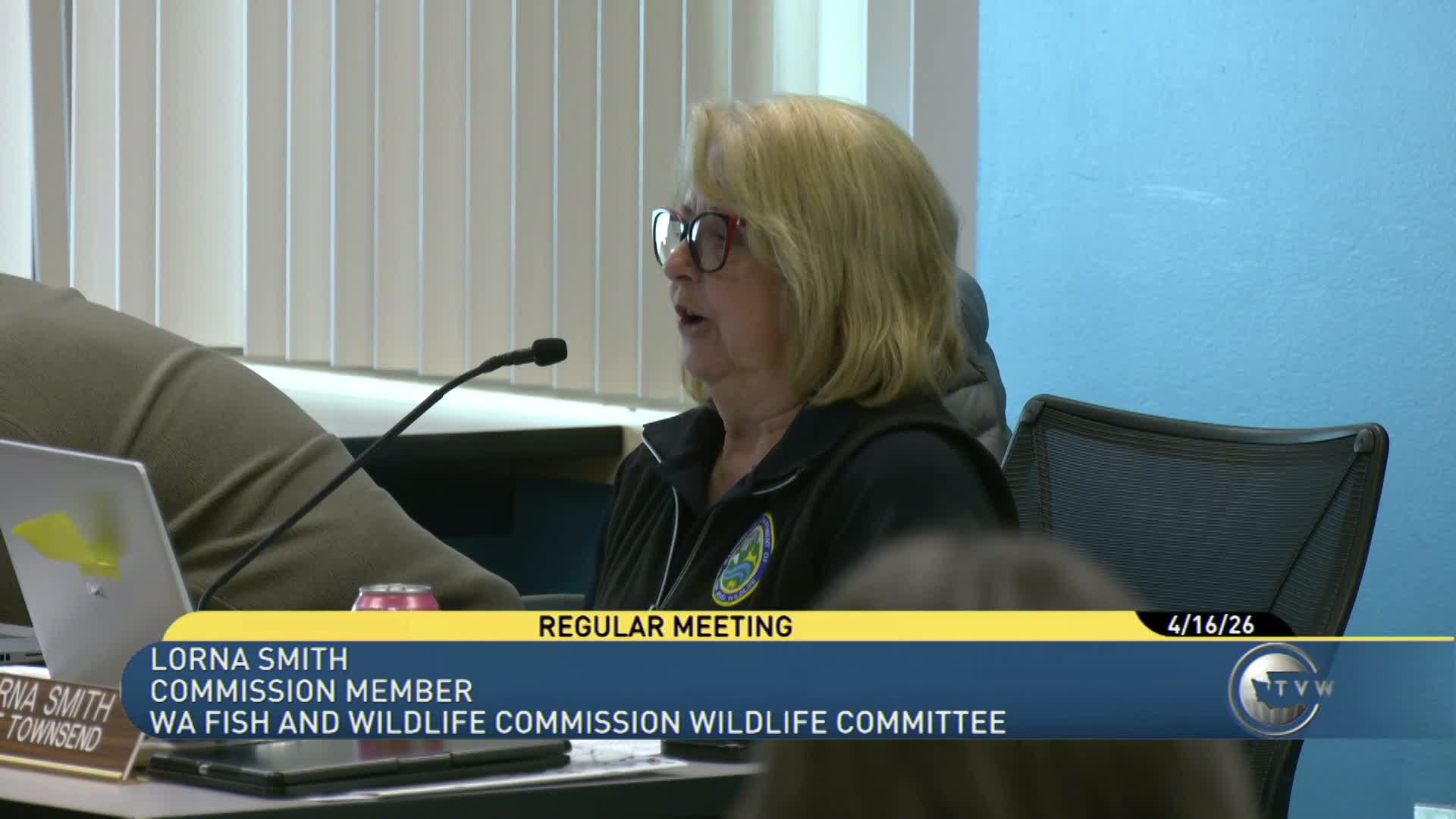
Several commissioners urged clear public communication. "I think we all agree on that and that's why I brought up the idea of fact sheets," Chair Lorna Smith said, noting the potential for public confusion on species like coyotes, skunks and marmots. Commissioner Steve Parker and others recommended a deliberate, well‑paced rollout so landowners and the public understand what classification does — and what it does not — change.
Staff also identified special cases: marmots may land in either category (protected or game) depending on the terms the department designs, and in some conflict situations removal rules or damage exceptions would still apply. Commissioner Victor Garcia asked why an introduced species, the European wall lizard, was on the list; staff answered that some unclassified species may be proposed as deleterious (non‑native) while others will remain unclassified for now (notably most invertebrates are not proposed for classification).
The committee did not vote on any proposal. Cope said the department will continue to refine the list, coordinate with enforcement and legal teams, and return to the commission before any rule package is filed. "We're not gonna roll forward a rule proposal without bringing the commission back into the fold," he said.
Next steps: staff will work on the list, prepare clearer timelines and fact sheets for commissioners and the public, and expect to report back in the coming months; no final rule or season changes were adopted at the meeting.