Get Full Government Meeting Transcripts, Videos, & Alerts Forever!
Get email alerts on the Public Comment Policy topic
No spam. Unsubscribe anytime.
Middletown board weighs formal public‑comment policy; solicitor to draft options
Summary
After a lengthy public and board discussion, Solicitor Esposito recommended time, place and manner rules consistent with the Pennsylvania Sunshine Act and agreed to circulate several draft policy options for the board and public to review.
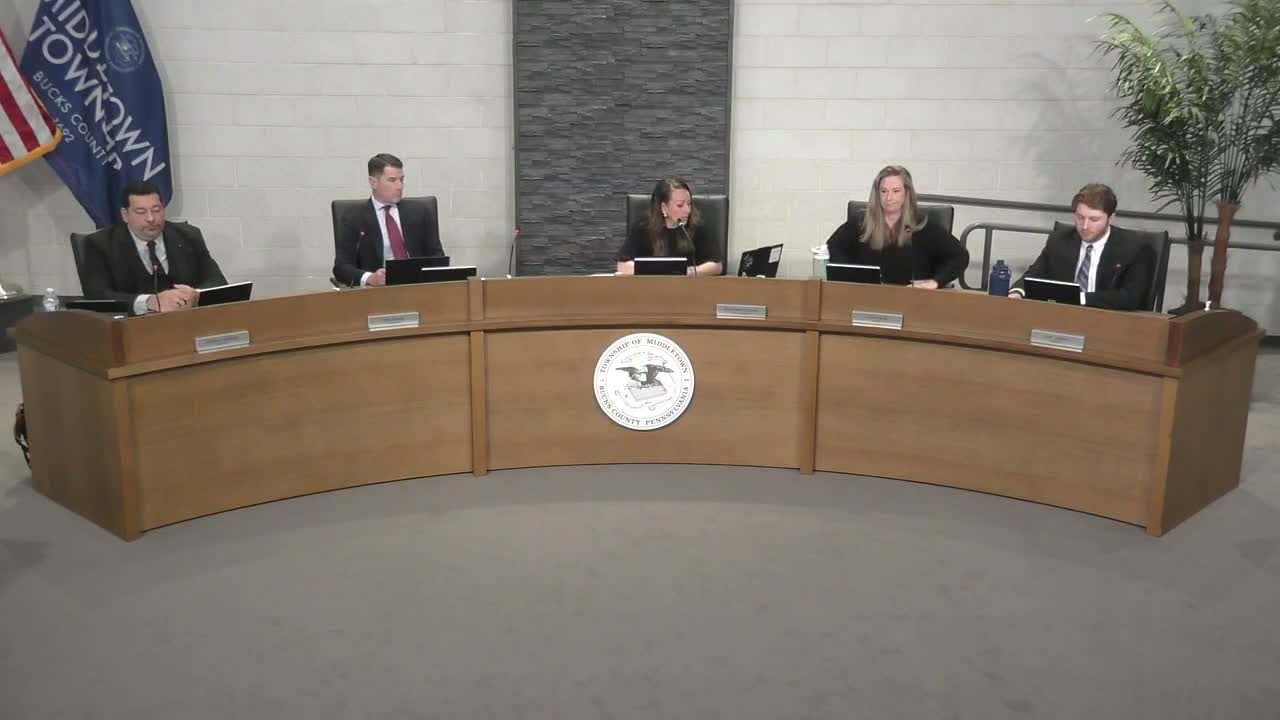
Chairwoman Hannah opened a focused discussion on drafting a public‑comment policy, asking staff to summarize legal constraints and common practices.
Solicitor Esposito told the board that authority for public comment in townships is grounded in the Pennsylvania Sunshine Act and that municipalities may impose reasonable, content‑neutral limits on the time, place and manner of speech. “The most common time limit that we see is 3 minutes,” he said, noting some municipalities allow up to five minutes and that restrictions must be applied consistently.
Board members and residents debated several recurring choices: whether to allow public comment at the start of meetings on agenda items or during each agenda item, whether residents should be prioritized over nonresidents, and whether to require sign‑in sheets (physical or digital) to organize speakers. Supervisor (functional label) said sign‑in sheets and time limits might make meetings more manageable and more attractive to attendees; public commenters said they valued the existing conversational call‑and‑response style and warned that strict limits could chill participation.
Resident Eric Bruno urged caution about imposing address disclosure requirements and cited court rulings that support protecting a speaker's address from disclosure. Several board members suggested a hybrid approach: time limits for non‑agenda items, prioritizing resident taxpayers, and using a sign‑in process while maintaining some flexibility for the chair to extend time when debate remains productive.
No formal policy was adopted. The board asked Solicitor Esposito to prepare several draft policies (option A, B and C) reflecting the range of feedback for discussion and public review at a future meeting.
The discussion will continue when staff circulates the solicitor's memo and draft options; no vote was taken tonight.