Get Full Government Meeting Transcripts, Videos, & Alerts Forever!
Get email alerts on the Transportation History topic
No spam. Unsubscribe anytime.
Presenter outlines how Cleveland Southwestern interurban shaped Medina County
Summary
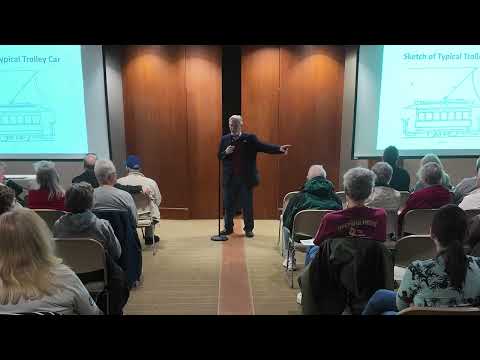
At a Medina City Council–area event tied to America's 250 programming, a presenter and author described how the Cleveland Southwestern interurban railway connected Medina County farms and towns to Cleveland markets, boosted dairy and freight revenues, and left a lasting regional legacy; proceeds of his book benefit the Northern Ohio Railway Museum.
A presenter speaking at a Medina America 250 event outlined how the Cleveland Southwestern (the “Pioneer Route”) interurban electric railway reshaped Medina County’s economy and daily life, connecting farms, merchants and leisure sites to Cleveland and other regional markets.
The presenter, an author who completed his dissertation at the University of Akron, said the interurban network provided frequent passenger and freight service and “enabled unprecedented connectivity between cities, towns, and rural” areas. “Transportation is our civilization,” he told attendees, arguing that electric traction reduced the “friction of space” and expanded economic opportunity.
He cited operational details to illustrate the system’s scale: by 1908 the Pioneer Route accounted for about 227 track miles; in the southern division locals and limiteds ran multiple times daily (locals in some sections 13 times per day), average limited speeds were about 26.8 mph, locals about 18 mph, and maximum speeds between stops could reach roughly 50 mph. Fares the presenter quoted included Cleveland–Worcester at $1.00 one-way ($1.82 round trip) and Cleveland–Medina at about 50¢ one-way (95¢ round trip). He also described generous baggage allowances typical of the era.
Agricultural and dairy shipments were a central theme. The presenter said the Cleveland Southwestern hauled roughly 20,000 gallons of milk daily in 1915 and, by 1919, moved large monthly quantities of eggs and butter into Cleveland. Those flows, he said, helped the Medina County Creamery grow rapidly (the presenter cited $300,000 paid to Medina County farmers for cream in 1911) and increased local farm incomes.
The talk also covered local route controversies: merchants and developers pushed different alignments through Medina (examples included competing North Court and South Court proposals and debates over West Liberty vs. West Smith routing). The presenter described how municipalities sometimes held special elections or imposed franchise conditions that affected where lines ran and how profitable they proved.
On governance, he emphasized the light state regulation that permitted speculative private investment: roughly 85% of the Cleveland Southwestern’s right-of-way was private rather than public, which enabled rapid expansion but also exposed companies to financial risk when population and ridership growth lagged expectations. After World War I rising costs, shifting revenues and expanded public road spending (including early gas-tax funded improvements) accelerated the system’s decline; the presenter noted the Southwestern reorganized in 1924 and sold off properties over time.
Beyond commerce, the presenter described cultural impacts: interurban lines chartered excursion cars, promoted amusement parks and community baseball leagues, and facilitated social mixing between urban and rural residents. He also pointed to surviving physical traces (substation foundations, repurposed buildings) and to museum work preserving artifacts.
“All the proceeds of this go to the Northern Ohio Railway Museum,” the presenter said, and he invited attendees to visit the museum for hands-on exhibits and short rides when available. He closed by thanking the event organizer, Barb, and offering to take questions.
No formal council motions or votes were recorded in the presentation.