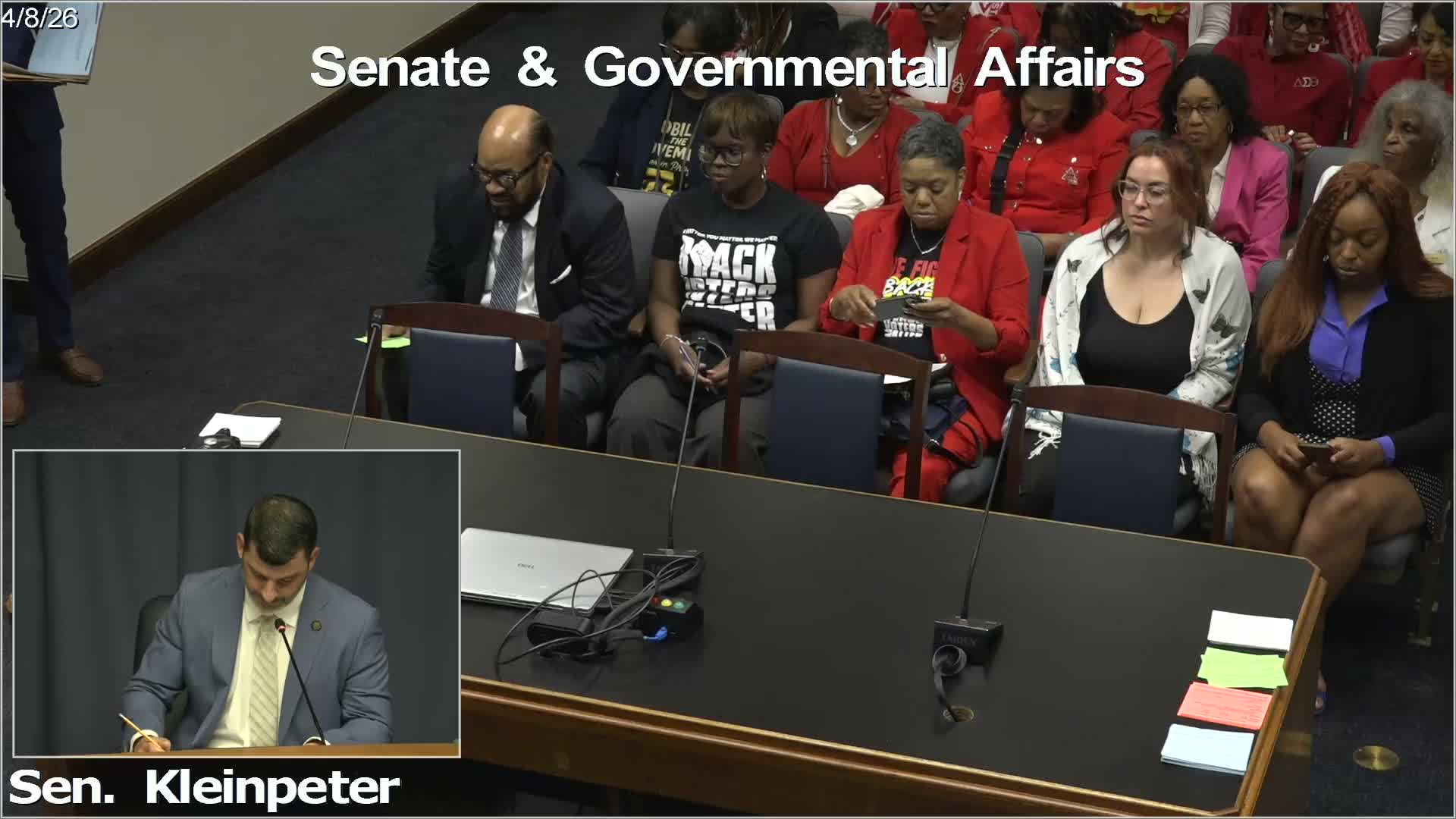
Sen. Royce Duplessis’s Louisiana Voting Rights Act fails to get committee approval after hours of testimony
Loading...
Summary
Sen. Royce Duplessis introduced SB 365, the Louisiana Voting Rights Act, arguing it would restore state-level preclearance and create a nonpartisan commission to prevent discriminatory voting changes. After extensive proponent testimony and questioning about structure and costs, a motion to report the bill favorably failed on a 3–4 roll call.
Sen. Royce Duplessis opened the Senate and Governmental Affairs Committee hearing on April 8 by calling SB 365 the Louisiana Voting Rights Act and saying, “every Louisiana voter deserves a fair shot at the ballot box and an equal voice in their government.” He told the committee the bill would create a state-level preclearance commission and require jurisdictions to seek review of changes that could restrict voting access.
Supporters from across the state urged the committee to pass the bill. Regina Barrow, president pro tempore of the Senate, told members, “Voting is the only equalizer,” and representatives of the ACLU, NAACP and other civil‑rights groups described recent voter‑access changes and court rulings they say have weakened federal protections. ACLU counsel Sarah Whittington said SB 365 would act as “the last seat belt when our democracy is at risk” while the state and federal cases remain unsettled.
Senators pressed the sponsor on scope and mechanics. Duplessis said the measure does not expand any individual’s voting rights but instead establishes a preclearance‑style review at the state level to prevent discriminatory effects from new laws or changes to polling operations. He described the proposed commission as an expert, nonpartisan body that, as drafted, would be housed in the Office of Inspector General and publish an annual list of covered jurisdictions based on objective criteria, including court orders and disparities in registration and turnout.
Committee members also questioned fiscal impacts. Senator Carter cited the legislative fiscal office’s estimate for FY27 of $772,763 and asked whether that amount was significant; several speakers including Senator Katrina Jackson and others argued the cost was modest compared with ongoing litigation and potential savings from avoiding lawsuits. Duplessis acknowledged the bill would create a right of action but said specifics about court venue would be spelled out later.
Many witnesses offered personal accounts: 10‑year‑old Caitlin Peoples testified she has seen family members punished while trying to help people vote and said, “This voting rights bill matters because it helps protect people like my mother.” Advocates from the League of Women Voters, Together Louisiana, Vote and the Power Coalition recounted problems they say include polling‑place closures, roll purges and confusing procedures that disproportionately affect communities of color.
At the close, Senator Carter moved to report SB 365 favorably to the floor. The roll call yielded three yes votes (Senator Carter, Senator Jenkins, Senator Sellers) and four no votes (Senator Faizi, Senator Miller, Senator Reese, Senator Womack). The motion failed and SB 365 remained in committee.
What’s next: the bill did not advance; supporters said they will continue outreach and may revise details about commission structure, the right of action and administrative placement before further consideration.