Lifetime Citizen Portal Access — AI Briefings, Alerts & Unlimited Follows
Senate labor committee reports bill to modernize Louisiana workers’ compensation as amended
Loading...
Summary
The Senate Committee on Labor reported Senate Bill 408 as amended after adopting a 17-item amendment package. The bill creates a new Louisiana workers' compensation medical claims database, ties reimbursements to Louisiana-specific benchmarks, and phases in electronic billing and reporting with multiple guardrails and review steps.
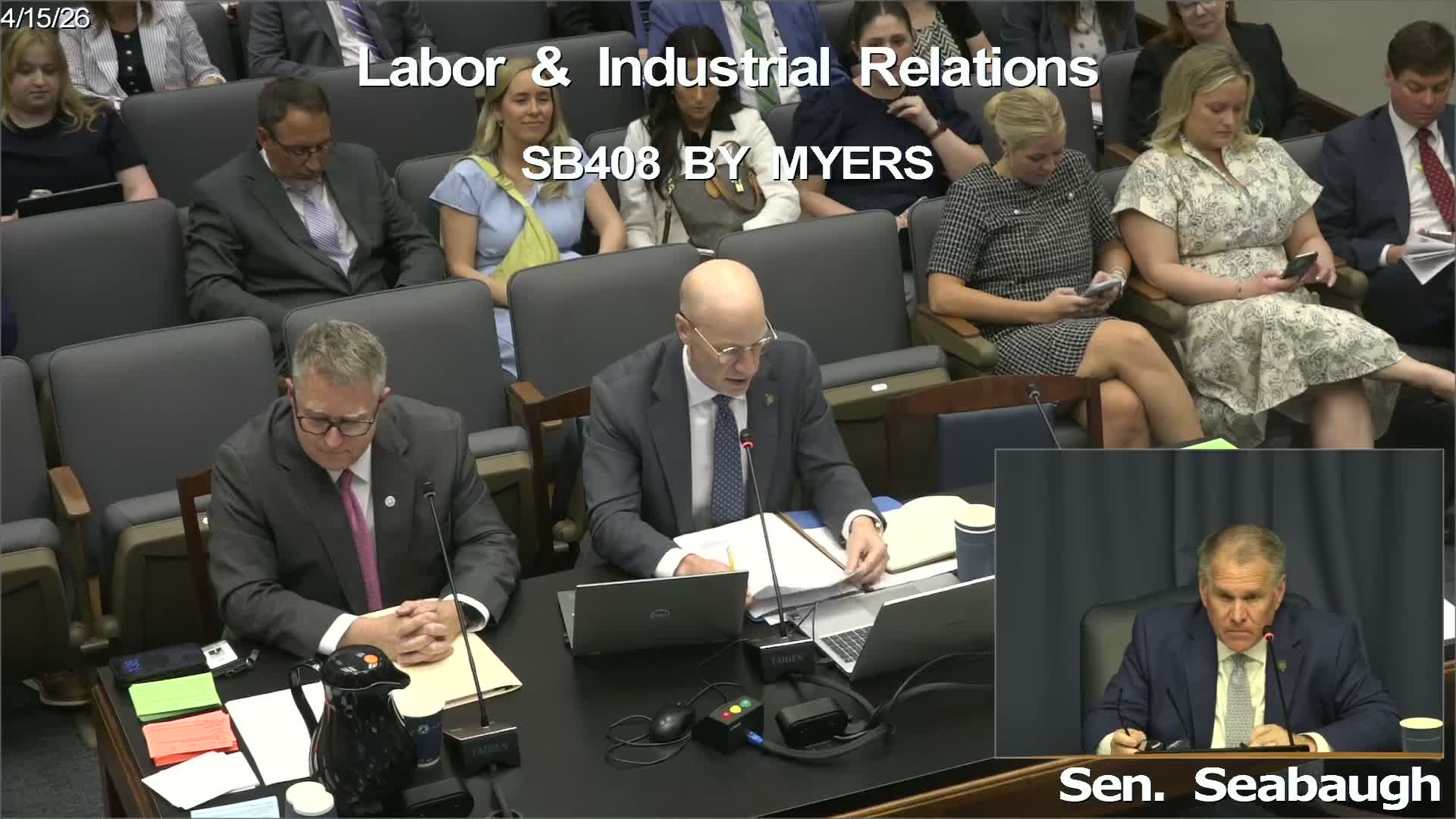
Senate Committee on Labor members on April 15 voted to report Senate Bill 408 as amended, a wide-ranging package the sponsor said will modernize Louisiana’s workers’ compensation medical system.
The sponsor told the committee the measure advances four goals: speed injured workers’ recovery and return to work, create a fair and predictable fee schedule, address outliers and abuse, and modernize reporting and billing to current standards.
“At the core of this bill is modernizing our workers’ compensation system,” the sponsor said, adding that staff and stakeholders worked extensively to craft the amendments. The committee adopted amendment set number 2007, which the chair said was placed on the bill.
The bill would require payers to report core medical and pharmacy claims data into a new Louisiana workers’ compensation database and would tie professional-service reimbursements for CPT-coded services to the 70th percentile of the PMIC medical fees directory. For hospital and ambulatory surgery services, reimbursements would be based on the 70th percentile of paid amounts in the Louisiana database for the most recent 24 months. Sponsor materials say those benchmarks are intended to reduce subjective “by report” payments and lower disputes between providers and payers.
The amendment package also preserves the existing law until the committees review and approve any agency-proposed fee schedule and creates guardrails limiting individual classification or code changes to no more than 5% in a 12-month period absent demonstrated access-to-care problems or legislative approval. The package establishes a fallback reimbursement rule for items not covered by the new fee schedule and tightens electronic-billing definitions.
Stakeholders who testified broadly supported the measure but noted concerns. “LOA is broadly in support of this bill,” Don Caffrey of the Louisiana Orthopedic Association said, while signaling questions about facility fees and the dispute process. Patrick Robinson of the Louisiana Association of Business and Industry said the data collection and dispute-resolution changes are “long overdue” but warned the proposal’s physician-reimbursement increases need careful review in a state that already pays among the highest workers’ compensation medical costs in the country.
The amendments include a nonsurgical prior-authorization process that treats certain requests as approved if a payer fails to timely deny them, with five-business-day response windows and an avenue for the Office of Workers’ Compensation Administration to confirm authorization when denials do not occur. The adopted changes also moved the effective date for full electronic billing to July 1, 2027, and set other implementation deadlines: data reporting to begin January 1, 2027; dispute rules by March 1 and final rule timelines through mid-2028; and a quality-and-outcomes program to begin by January 1, 2031.
Undersecretary Blackwood of Louisiana Works told the committee that LA Works is prepared to carry out the data gathering and rulemaking the bill envisions. “Louisiana Works is ready and able to carry out the mandates created by this bill,” Blackwood said.
Senator Talbot moved to report the bill as amended; with no objection the committee reported SB 408 favorably. The committee did not record a formal roll-call vote in the transcript; the chair characterized the action as taken by unanimous consent.
What happens next: the measure will move forward according to legislative procedure and agencies will later submit any proposed fee schedule to the House and Senate labor committees for approval before reimbursement changes take effect.