Lifetime Citizen Portal Access — AI Briefings, Alerts & Unlimited Follows
Escambia County, Pensacola leaders agree to pursue RFI, design work for Bay Center renovation and new multipurpose event center
Loading...
Summary
County and city leaders heard feasibility studies showing a 71M renovation to the Bay Center plus a roughly 84M flexible event center (55,000 sq ft) could attract conventions and amateur sports; officials agreed to pursue a market RFI/RFP, advance design work and negotiate a public‑private option for an auxiliary ice facility. (No final funding vote was taken.)
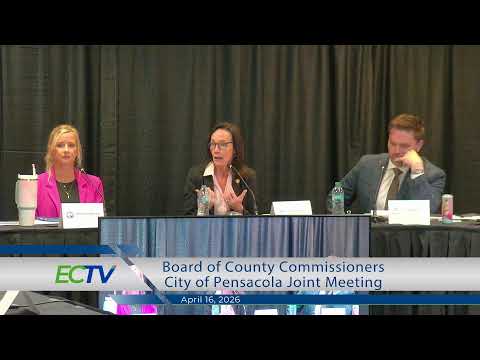
Escambia County and Pensacola leaders on April 2026 met in a joint session to review feasibility work and signaled agreement to move forward with design and market testing for a renovated Pensacola Bay Center and a new, flexible 55,000‑square‑foot event center.
Consultants from WT Partnership and Legends/CSL presented a multi‑building, campus approach that they said would boost tourism and local businesses. WT Partnership framed the project as a district activation tied to downtown and waterfront connectivity; Legends and CSL outlined a program that includes Bay Center renovations, a separate event center and the option for an auxiliary facility that could include a second sheet of ice.
"This is a huge community project and a once in a lifetime project for all of us," the Chair said in opening remarks, urging officials to agree on next steps. WT Partnership emphasized that a competitive convention product depends on nearby hotel inventory and walkability; Bill Krueger of CSL said 90% of surveyed groups prefer a headquarter hotel within one to two blocks of exhibit space and that a multipurpose event center is more likely to be financially self‑sustaining if it includes equipment and storage for sports events.
Presenters gave high‑level cost estimates: roughly $71,000,000 for Bay Center renovations (including an estimated $15,000,000 in deferred maintenance), about $84,000,000 for the event center and roughly $29,000,000–$30,000,000 for an auxiliary ice/event building. Michael Capps of Legends summarized the aggregate scenario by saying the total outlay could be in the order of $190,000,000, with consultants projecting early‑year economic returns they described as roughly $80,000,000 annually from direct and indirect spending.
Ted Ent, representing area hoteliers through the Escambia County DMO, told the joint session his group "never asked for a dime" and argued that new or renovated event facilities should leverage existing and planned hotel inventory and downtown assets rather than require immediate hotel subsidies. He added that local hoteliers and restaurateurs support a multipurpose model that brings visitation to both sides of the bridge.
Elected officials focused discussion on three interlocking issues: (1) programming (convention trade shows vs. amateur sports, or a hybrid multipurpose model), (2) funding and procurement (how to structure public incentives and private participation), and (3) transportation and parking infrastructure. Several commissioners and consultants recommended pursuing federal financing and grants (including TIFIA and USDOT programs) and preparing enabling infrastructure and pedestrian/bike connectivity to maximize downtown benefits.
There was no formal vote. Instead the board reached consensus on several procedural next steps: to task staff and administrators with preparing a procurement approach (an RFI/RFP or bundled market solicitation that lays out alternative scenarios and an upper public funding limit), to advance design work and phasing so the project does not lose time to construction‑cost escalation, and to continue negotiating public‑private options for an auxiliary ice facility. Commissioners also flagged the need for a congestion/parking study (one speaker said a $500,000 study had been requested) and for coordinated city–county grant work.
What happens next: staff were asked to work with the county and city administrators, procurement and legal teams to define project objectives, confirm site control and zoning clarity, and prepare the market solicitation and design scope. The meeting adjourned with direction for administrators to return to governing bodies with proposed language and a project schedule for a future agenda.
(Reporting note: the meeting recorded no binding vote or final appropriation; all financing and procurement decisions remain subject to later public hearings and formal votes.)