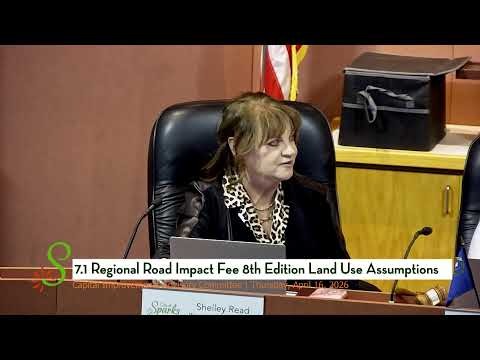
Sparks advisory committee recommends council adopt RTC's updated regional road impact fee
Loading...
Summary
The City of Sparks Capital Improvement Advisory Committee voted unanimously to recommend City Council approve the Regional Transportation Commission's eighth-edition Regional Road Impact Fee update, which includes modest fee decreases, updated VMT assumptions and administrative changes to the GAM. RTC staff said the business-impact review found no significant burden on local businesses.
The City of Sparks Capital Improvement Advisory Committee voted unanimously to recommend that the Sparks City Council approve the Regional Transportation Commission's proposed eighth-edition Regional Road Impact Fee update, including revised land-use assumptions, a 10-year capital improvement plan and edits to the general administrative manual.
Jeff Wilbrecht, engineering manager at the Regional Transportation Commission (RTC Washoe), told the committee the RIF program makes new development pay for its share of regional road capacity and is based on a land-use forecast from the Truckee Meadows Regional Planning Agency and RTC's travel-demand model. "As new development comes into our community, we assess impact fees that pay for regional road improvements," Wilbrecht said, describing the method that converts projected vehicle-miles-traveled (VMT) into a dollar-per-VMT fee schedule by land use.
Wilbrecht said the proposed eighth-edition updates include revised definitions for certain land uses (for example, logistics and data centers), clarifications on roles and procedures to be consolidated in the general administrative manual, and adjustments to capital-cost and VMT assumptions. He said the overall fee schedule would decline by about 2.5 percent for many land-use categories. "When you apply the cost per VMT, you get to roughly $6,100 per unit [for a single-family home]," he said, citing the program's per-unit example based on an estimated 17.2 VMT per single-family unit.
Amber Sosa, City Engineer for the City of Sparks, introduced RTC staff and invited questions. Committee members asked technical questions about why projected VMT decreased from prior projections; Wilbrecht attributed the change to updated household-survey assumptions incorporated in RTC's 2050 regional transportation plan the travel-demand model uses. He also explained that fee calculations divide the capital cost assigned to a service area by the VMT growth in that area, which is why the dollar-per-VMT can differ between the North and South service areas even when total capital shares differ.
Wilbrecht pointed to the business-impact statement required by Assembly Bill 444 (AB 444), saying RTC's review concluded the update "is really not expected to impose any direct or significant economic burden on businesses." He outlined the next steps: advisory-group review (this committee and planning commission), action by the Sparks City Council and the Reno City Council and Washoe County Board, followed by a 30-day public-notice period before any new fees would take effect.
During discussion a committee member praised the RTC and its technical advisory process. After a short exchange the committee moved, seconded and voted to forward the recommendation to the Sparks City Council; the chair called a voice vote and announced the motion passed unanimously.
Votes at a glance: The committee approved the meeting agenda (voice vote) and approved minutes from the July study session and prior meeting (voice vote). The committee then voted unanimously to recommend the Sparks City Council approve the RTC RIF eighth-edition update (land-use assumptions, capital improvement plan, fees and GAM updates).
The advisory committee adjourned and took a brief recess before the planning commission meeting.