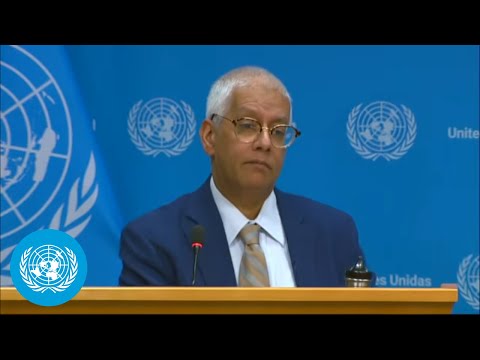
UN briefing: $12 million CERF allocation, rising civilian toll and urgent funding gaps
Loading...
Summary
At a United Nations press briefing, spokesperson Farhan announced a $12,000,000 allocation from the Central Emergency Response Fund and highlighted rising civilian casualties, damaged infrastructure, and urgent gaps in humanitarian funding across multiple crises.
Farhan, a United Nations spokesperson, told reporters that the Emergency Relief Coordinator, Tom Fletcher, allocated $12,000,000 from the UN Central Emergency Response Fund (CERF) to support life‑saving activities in health, water, sanitation and hygiene, and food security in the affected country.
The spokeswoman said authorities reported that between Feb. 28 and Apr. 8 large‑scale air strikes caused more than 2,360 civilian deaths, including 257 women and 220 children, and tens of thousands of injuries, damaging homes, schools and health facilities and cutting off people’s access to central services. Farhan cautioned that these figures come from UN and partner reporting and reflect fast‑moving field estimates.
On Gaza, Farhan said UNRWA facilities reduced operating hours on electrical generators as mechanical systems approached critical failure. Partners screened over 72,000 children last month, identifying about 2,700 with acute malnutrition and organizing counseling and recreational activities for roughly 4,700 children in the first week of the month. "These activities help girls and boys cope with ongoing displacement," Farhan said.
Farhan quoted the emergency relief coordinator as describing the situation in one affected country as "an atrocities laboratory," citing sieges, denials of food, the use of sexual violence as a weapon, and attacks on schools and hospitals. He also said drone strikes have killed about 700 people so far this year, and more than 130 humanitarian workers have been killed over the past three years.
The briefing also flagged a severe funding shortfall in the Central African Republic: OCHA reports that only 18% of the $264,000,000 humanitarian response plan is funded, forcing 60 organizations to reduce their footprint in areas with the highest needs. In the Fakaka region, the World Food Programme is providing assistance to more than 22,000 Sudanese refugees monthly while aid actors say they aim to reach 1.3 million people this year if funding materializes.
Farhan closed by noting an upcoming WFP briefing: Jean Martin Bauer, the World Food Programme's director of food security and nutrition analysis, will brief the room on the World Hunger Map. "What he's doing is sounding out partners in the region," Farhan said, adding that Bauer will be better placed to report concrete accomplishments after consultations.
The briefing emphasized calls for immediate de‑escalation, respect for international humanitarian law, unimpeded humanitarian access and stepped‑up funding to prevent further loss of life.