Get Full Government Meeting Transcripts, Videos, & Alerts Forever!
Get email alerts on the Air Monitoring topic
No spam. Unsubscribe anytime.
Senate committee hears hours of testimony on bill to require fence-line air monitors at high‑risk facilities
Summary
Senate Bill 356 would require ~117 high‑risk refineries and chemical plants to install open‑path fence‑line monitors, weather stations and public alerting when acute thresholds are exceeded; supporters said it would improve community safety while industry warned about false alerts and technical limits of fence‑line data. The committee did not report the bill.
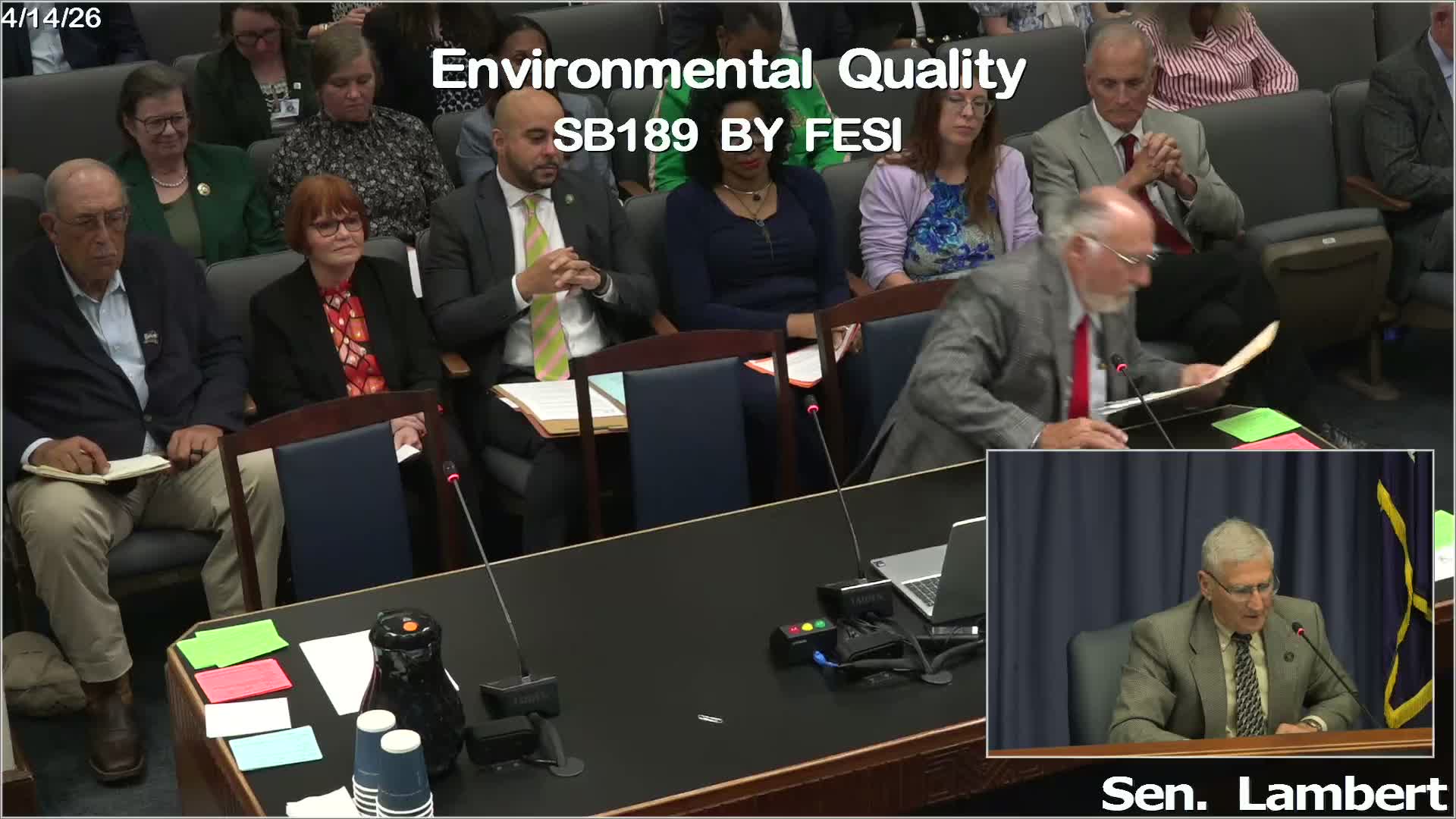
Senator DuPlessis on April 14 brought Senate Bill 356 to the Senate Committee on Environmental Quality, asking lawmakers to require real‑time fence‑line air monitoring and automatic public alerts at the state’s highest‑risk petroleum refineries and chemical manufacturers.
"It is a real time fence line air monitoring in community alert systems bill," DuPlessis said, telling the committee the proposal targets facilities that emit more than 50 pounds per year of any of the 17 listed toxic air pollutants and would cover "approximately a 117 facilities." He said costs would be borne by facility owners and that the bill has no state fiscal note.
Technical witnesses and public health advocates described how the systems work and why they say states should require them. Vicki Booth, an environmental epidemiologist who co‑authored slides for the sponsor, summarized the bill’s narrowed scope and technical design: "This legislation reduces the covered facilities by 75%, focusing on the highest risk, 99 chemical manufacturers and 18 petroleum refineries," and described open‑path monitors, on‑site weather stations and public websites with real‑time and historical data.
Community advocates described incidents they say demonstrate the need for faster public notice. Dr. Beverly Wright, founder and executive director of the Deep South Center for Environmental Justice, said: "At its core, this bill is about something simple but critical, giving communities the information they need to stay safe." Multiple residents and former industry staff recounted leaks, hospitalizations and shelter‑in‑place orders they tied to indirect or delayed public notification.
The record includes several cost and capability details presented by witnesses: Booth said typical capital costs start near $250,000 for a small system (four monitors, shelters, data logger and weather station) and can approach $630,000 for large refinery deployments, with maintenance roughly $25,000 per year; witnesses said the bill narrows earlier proposals to prioritize the most toxic pollutants and highest‑risk facilities.
Industry representatives and trade groups opposed the bill as written. Patrick Riley of the Louisiana Chemistry Association told the committee that "fence line monitors pick up contributions from many sources other than the facility they are attached to" — traffic, river barges and upwind operations — and warned that automatic public alerts based on short averaging periods "cannot reliably tell the public what it is claiming to tell them." Damien Watt of LAMOGA added a scientific objection to the bill’s metric, saying: "For the vast majority of compounds on this list, health effects are associated with chronic long term exposure and not a single 1 hour peak," and argued the bill’s one‑hour alerting threshold could misalign alerts from actual long‑term risk.
Committee members questioned both sides about source attribution, false alerts and validation. Supporters noted that the bill requires summary reporting and validation steps (data are "preliminary until validated every 90 days," Booth said), and that open‑path systems include meteorological data to help determine upwind or downwind sources. Opponents emphasized operational and legal concerns about automatic public alerts and the bill’s 50‑pound coverage threshold.
After extended testimony from community members, scientists, denominational and environmental groups and industry representatives, the committee took no motion to report the bill. The chair announced the bill "will stay in committee."