Lifetime Citizen Portal Access — AI Briefings, Alerts & Unlimited Follows
Sandy Stodgrass outlines Bruce’s Law, warns of carfentanil surge in Alaska
Loading...
Summary
At a legislature "lunch and learn," Sandy Stodgrass, director of AK Fentanyl Response, recounted her son’s fentanyl death, described the federal "Bruce’s Law" and a presidential declaration, and urged a three-part strategy — prevention, enforcement and treatment — as carfentanil appears in Alaska.
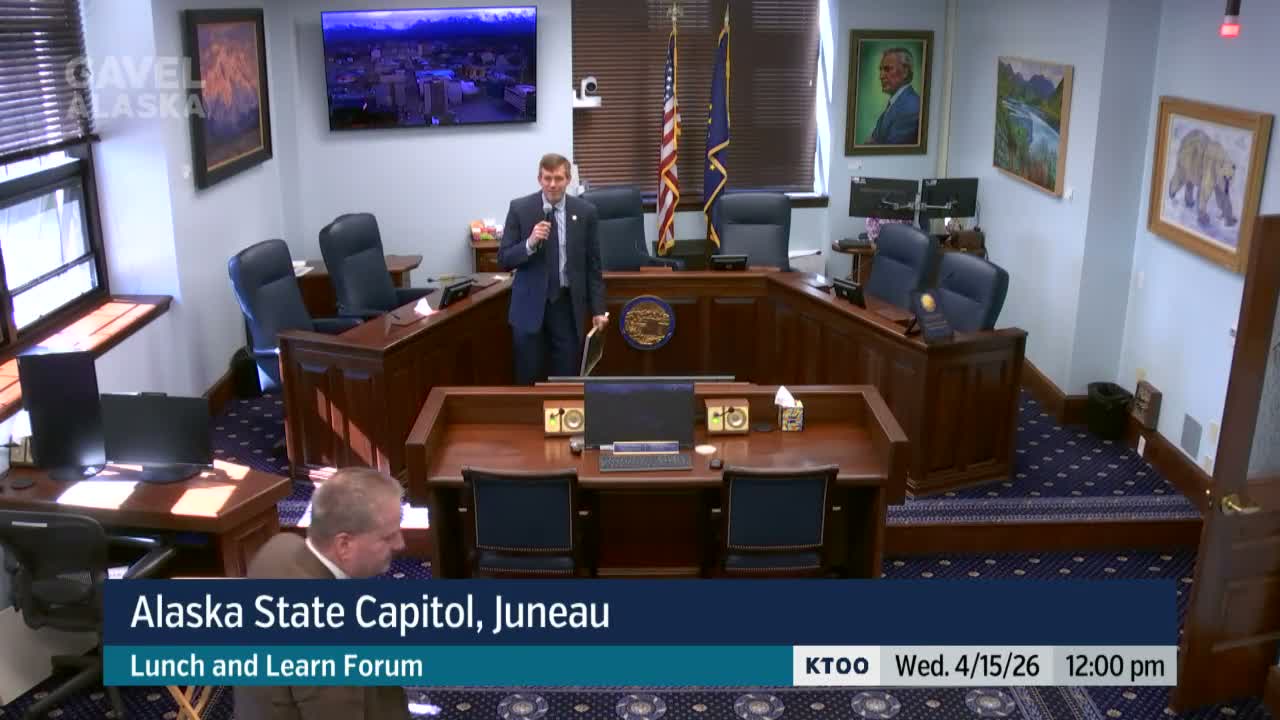
Sandy Stodgrass, director of AK Fentanyl Response and mother of a son who died of fentanyl poisoning, told lawmakers at a legislature lunch-and-learn that federal and local measures provide new tools but that prevention, enforcement and treatment must act together to stop a rising tide of fentanyl and carfentanil deaths.
Stodgrass, introduced by state Sen. Bill Wachowski, recounted finding her son Bruce dead in Anchorage in October 2021 and said that experience drove her to found the Alaska Fentanyl Response Project and to advocate for federal legislation known publicly as "Bruce's Law." She said the law was signed in the Oval Office and that the president later issued an executive order declaring fentanyl a weapon of mass destruction.
"You can never die from an illicit drug if you never try an illicit drug," Stodgrass said, summarizing the prevention message she takes into schools. She asked lawmakers and school officials to host in-person presentations she delivers statewide.
Why it matters: Stodgrass and speakers in a documentary shown during the event cited both local and national statistics to frame the crisis. She said nearly 2,000 overdoses were recorded in Alaska in 2023, with about 1,200 in Anchorage, and cited DEA figures she said show about 281 fentanyl-related deaths nationwide per day and roughly 22 high-school‑aged fatalities per week. Stodgrass used the analogy that such losses would be treated like a daily airliner crash if they involved another hazard, urging faster and broader response.
Stodgrass described how illicit fentanyl is distributed in many forms — counterfeit pills, powders and combinations with other drugs — and said counterfeit pills stamped like prescription drugs commonly contain fentanyl. A speaker in the documentary described large seizures of counterfeit pills and noted that pill presses and overseas purchases can produce large quantities that reach Alaska.
The presenter warned that carfentanil and xylazine, which she said have appeared in Anchorage, are far more potent than fentanyl: "If you think about fentanyl as a poison, it's about 10 grains of salt," she said, adding that carfentanil could be lethal at "2 to 3 grains." Stodgrass cited a recent federal prosecution in which a defendant pleaded guilty and received a 30‑year sentence in a carfentanil case.
Stodgrass told the audience that law enforcement in Alaska increasingly investigates overdose deaths as drug‑induced homicides and noted the state passed a law the previous year creating second‑degree murder charges for some drug‑induced homicides. She said those investigative and prosecutorial changes complement prevention work but are not substitutes for treatment and outreach.
In a question-and-answer exchange, a lawmaker asked where Stodgrass had presented recently; she said she had spent the previous day at Begich Middle School delivering eighth‑grade health classes alongside DEA and U.S. attorney representatives. She described traveling to rural communities, said cartels deliberately target remote Alaskan villages where illicit drugs command higher prices, and described pilots and local carriers reporting suspicious passengers as an important part of interdiction.
Stodgrass closed by asking for help from legislators, schools, law enforcement and parents and invited attendees to arrange AK Fentanyl Response presentations via her website. "If anyone wants to learn about fentanyl — have an AK Fentanyl presentation — I will go," she said.
The session included a short documentary segment with first‑responder accounts of overdose response and family testimonials. No formal legislative action or vote occurred at the meeting; the presentation concluded with a request for outreach and training in schools and communities.