State officials outline how Alaska declares and funds disaster response
Loading...
Summary
Department of Military and Veterans Affairs staff walked the committee through the state's emergency operations plan, the SEOC at Joint Base Elmendorf-Richardson, statutory declaration thresholds and authorities, the disaster relief fund and supplemental budgeting, and FEMA cost-sharing and assistance programs.
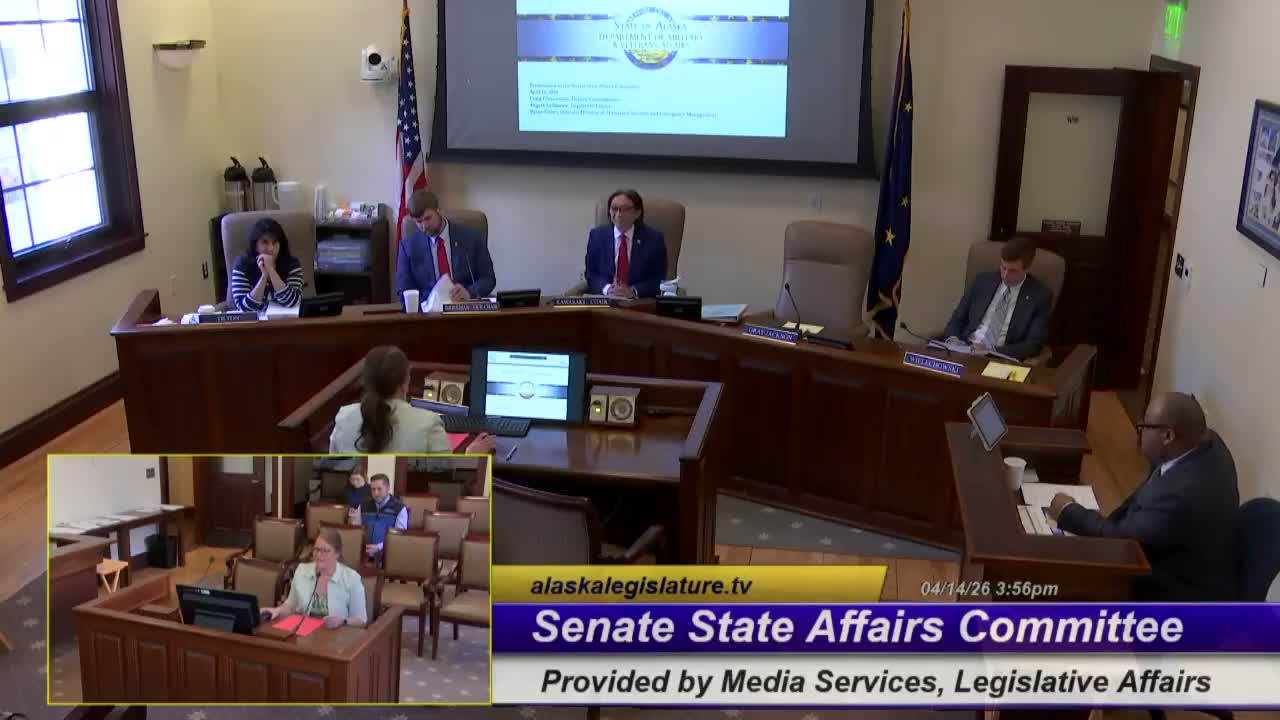
Department of Military and Veterans Affairs officials briefed the Senate State Affairs Committee April 14 on how Alaska manages disasters, when a governor may declare a state disaster, and how state and federal funding flows for response and recovery.
Angela LaFlamme, legislative liaison for the department, described the state's emergency operations plan and said the State Emergency Operations Center (SEOC) is co-located with Alaska National Guard operations at Joint Base Elmendorf-Richardson. "The SEOC serves as the state's single point of contact for integrated state disaster emergency response," she said, and noted the plan follows national frameworks so Alaska remains eligible for federal reimbursement.
LaFlamme explained the process from incident to declaration: local communities initially respond and notify the SEOC, which collects assessments and may recommend a state disaster declaration to the governor if the incident exceeds local capacity. Under state statute she cited, an incident must meet the disaster definition in AS 26.23 to qualify for a declaration; initial state declarations open certain authorities for 30 days unless the legislature extends them. She described two primary assistance streams: individual and family grants (housing and personal property repair/replacement) and public assistance for infrastructure repair and replacement.
On funding mechanics, LaFlamme said state law allows the governor limited immediate funding authority (she cited a $1,000,000 threshold) using the disaster relief fund while the state works through financing plans and seeks federal reimbursement when a federal disaster is declared. She noted many recovery projects can remain open for years and cited long-running recovery from the 2018 Cook Inlet earthquake and recent typhoon responses as examples. On federal cost-sharing, she described the common FEMA public-assistance split (roughly 75/25 federal/state) and said the state tracks expenditures closely to maximize eligible reimbursement.
Committee members asked how rental and temporary housing works for displaced residents; LaFlamme said temporary housing grants can provide up to 18 months for homeowners and three months for renters, with flexibility in catastrophic situations to extend support as communities recover.
No formal action resulted from the briefing; LaFlamme and staff answered member questions and provided follow-up context about open disasters and reimbursement timelines.