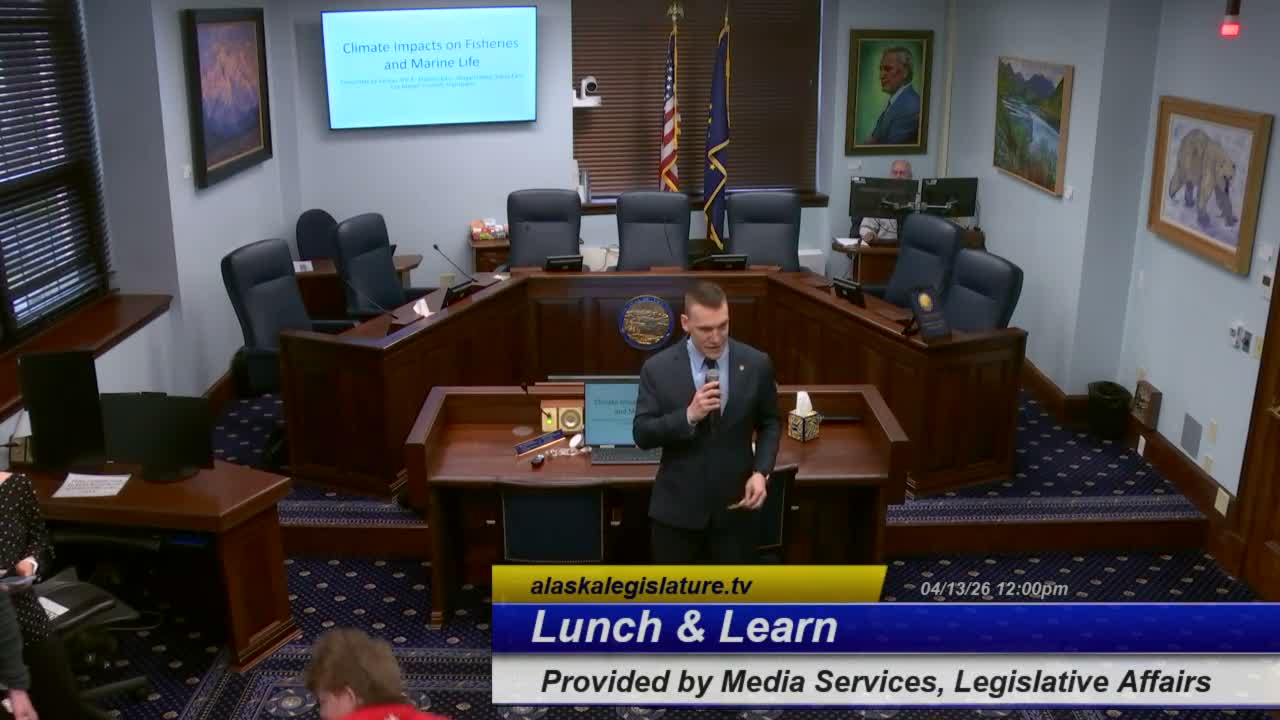
Alaska youth tell legislators climate change, acidification and bycatch threaten salmon and fisheries
Loading...
Summary
Students from Alaska Youth for Environmental Action told legislators in Juneau that warming, ocean acidification, bycatch and pollutant bioaccumulation are destabilizing salmon runs, threatening subsistence practices and jeopardizing a roughly $5 billion industry that employs tens of thousands of Alaskans.
Students from Alaska Youth for Environmental Action briefed legislators in Juneau on how a changing climate is disrupting salmon runs, increasing ocean acidification and raising risks from bycatch and pollutant buildup in Alaska's fisheries. The presenters framed their remarks around scientific projections, local observations and the cultural impacts on Indigenous subsistence communities.
A presenter opened by noting that "air temperatures are rising at unprecedented rates globally" and said Alaska is warming faster than the global average. The group cited regional modeling that projects larger temperature increases under a business-as-usual RCP 8.5 scenario than under a lower-emissions RCP 4.5 path, and warned those changes would warm freshwater ponds and streams that salmon depend on.
The students tied those physical changes to biological thresholds. "Coho for example have an upper lethal thermal limit between 23 and 25 degrees Celsius," a presenter said, adding that growth ceases near 20 degrees Celsius and that rapid warming could outpace the species' ability to adapt. They also cited state agency reporting that Chinook rearing numbers are declining across regions of Alaska.
On ocean chemistry, a student explained that when the ocean absorbs carbon dioxide it forms carbonic acid, lowering carbonate availability needed by shell- and bone-forming organisms. The presenters said colder Alaskan waters and coastal upwelling can increase the local vulnerability to acidification, which in turn threatens juvenile stages of commercially important species.
The students highlighted human-health and cultural consequences: one presenter said bioaccumulation of mercury and other contaminants released from thawing permafrost and of PFAS from firefighting foams and wastewater could concentrate in seals, whales and fish consumed by Alaska Native communities. "This is Aqtaqsit, a deeply sacred site for all Tlingit people," Mazelle Joseph said, describing local erosion and glacier retreat that have disrupted traditional harvesting places and ceremonies.
The group also raised fisheries management concerns. A presenter described how trawling and pollock operations can produce substantial bycatch of Chinook and chum salmon and cited the North Pacific Fishery Management Council's assessments of trawling impacts on benthic habitat. They referenced a media report alleging large salmon losses as bycatch in pollock fisheries.
Presenters cited economic context for the warnings: they repeated figures that Alaska's seafood industry contributes roughly $5,000,000,000 in annual economic activity and employs about 58,700 people, and referenced NOAA estimates of recent profit declines in parts of the industry.
During a Q&A, legislators and other attendees asked about the metric behind a risk map, local community impacts and the students' statewide AYA work, including youth-made films documenting climate impacts. The presenters encouraged engagement with Statewide AYA and described plans for future outreach and screenings.
The host thanked the young presenters for their briefing and closed the session, saying the office would continue to follow youth research and statewide AYA activities.