Get Full Government Meeting Transcripts, Videos, & Alerts Forever!
Get email alerts on the Fy27 Capital Budget topic
No spam. Unsubscribe anytime.
Senate Finance Committee advances FY27 capital budget, adopts two amendments and rejects $25 million port appropriation
Summary
On April 14 the Senate Finance Committee advanced Senate Bill 214 (FY27 capital budget), adopting two technical amendments and rejecting a $25 million amendment to fund the Don Young Port of Alaska after debate that prioritized K–12 deferred maintenance and statewide asset lists.
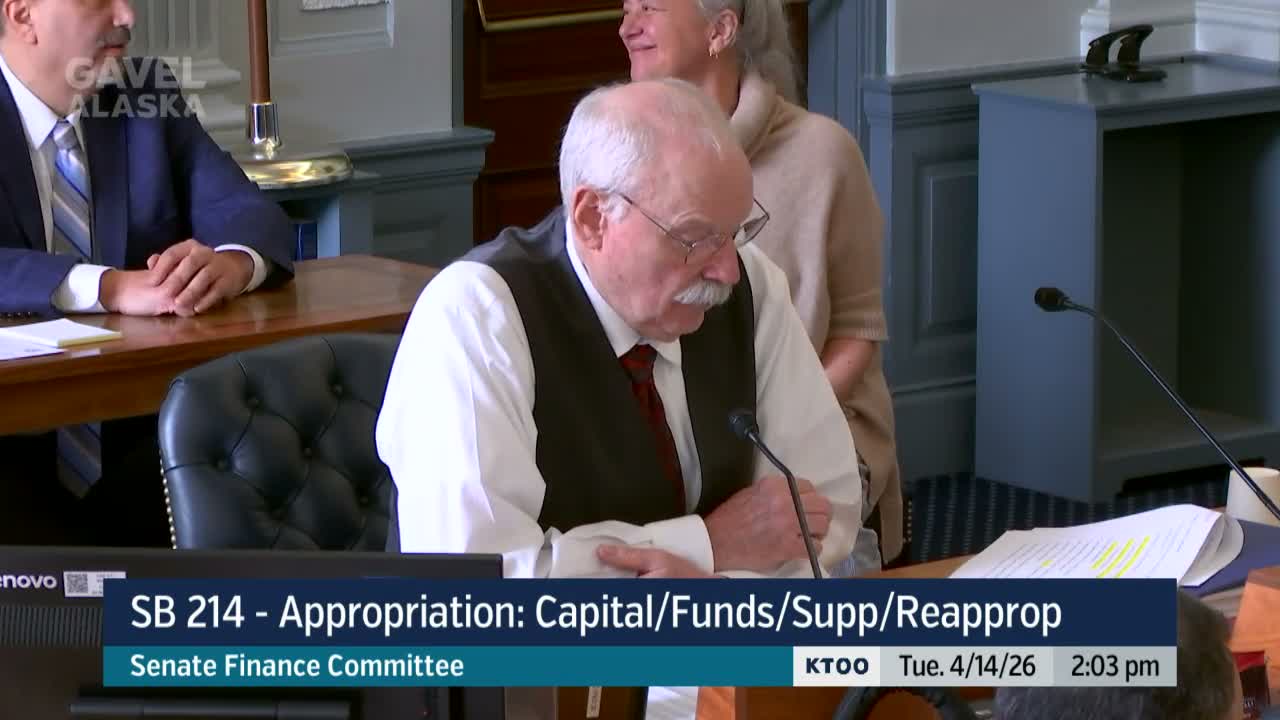
Senator Stedman, chair of the Senate Finance Committee, called the panel to order April 14 and led a line‑by‑line consideration of Senate Bill 214, the governor’s proposed FY27 capital budget, followed by amendments and votes.
David Scott, staff to the committee, summarized the bill’s major allocations, saying “the CS in front of the members today has $17,130,000 towards the university” to cover the top nine University of Alaska projects (the top three at UAF, UAA and UAS). He told members the judiciary’s deferred maintenance package includes $3,700,000 for four Anchorage projects, and the K–12 major maintenance list in the proposal contains $45,329,000 that reaches 15 projects after a reduced request for a large school renovation in Galena.
Why it matters: committee staff emphasized that the bill follows agency‑compiled priority lists — the university “Red Book,” DEED’s CIP list and judiciary requests — and that the capital envelope cannot fund every need. The committee discussed tradeoffs between statewide assets (for example, Mount Edgecumbe High School) and the large backlog of K–12 deferred maintenance projects the panel is prioritizing.
Committee action and votes: the panel considered three formal amendments. Amendment 1, moved by Senator Hoffman and explained by David Scott, extended the spending window for National Petroleum Reserve–Alaska (NPRA) impact grants to align with operating budget timing; the committee adopted amendment 1 without objection. Amendment 2 changed Mount Edgecumbe’s house‑district impact designation to a statewide designation, a technical change supporters said was appropriate because Mount Edgecumbe is a state asset serving students from across Alaska; amendment 2 was adopted.
A third amendment proposed a $25,000,000 appropriation to the Don Young Port of Alaska. The amendment’s sponsor argued the port is the state’s largest cargo facility and that rising tariffs and surcharges are driving up costs for Alaskans. “A full shipping container that used to cost $9.50 now costs $75.50,” the sponsor said, urging immediate action to offset surcharges.
Opponents urged caution. Senator Hoffman said the committee faces finite revenue and must prioritize school construction and deferred maintenance, warning that diverting capital funds would shrink the committee’s ability to move down the long list of K–12 projects. Chair Stedman likewise emphasized following agency lists and the need to protect funding for deteriorating school buildings.
After debate the committee rejected the $25 million port amendment and then voted to report Senate Bill 214 (finance version G) from committee with individual recommendations. The committee also directed Legislative Finance and Legislative Legal to make necessary technical and conforming changes before the bill proceeds.
What was funded or prioritized: committee staff highlighted specific line items in the substitute, including $17,000,500 to start rebuilding Stebbins School (destroyed by fire in 2024), a suite of Mount Edgecumbe projects (including $10,206,000 for a dining hall renovation and smaller dorm and equipment repairs), a $5,265,000 allocation to the Renewable Energy Fund, and several workforce training investments: a $3,000,000 driving‑range/CDL training site in Wasilla, $2,000,000 for a pipeline training center in Fairbanks, $1,680,000 for Kenai Instruction Service Center, and $3,000,000 for AVTEC modernization in Seward. Scott also described use of SPAR (Spill Prevention and Response) funding to address emergency tank‑farm repairs on DEED’s list.
Next steps: the committee will reconvene (the chair announced a 9 a.m. meeting the following morning) and the bill will proceed to the next stage with the committee’s recommended changes and technical edits.