Get AI Briefings, Transcripts & Alerts on Local & National Government Meetings — Forever.
Alaska DOT outlines 10-year pavement plan, data-driven asset tracking and material changes
Loading...
Summary
DOT&PF presented a new 10-year pavement plan that ties asset-condition data to funding, highlighted use of lidar, cameras and AI for statewide asset inventories, and described shifts to harder aggregates and polymer-modified asphalt to reduce thermal cracking and studded-tire wear.
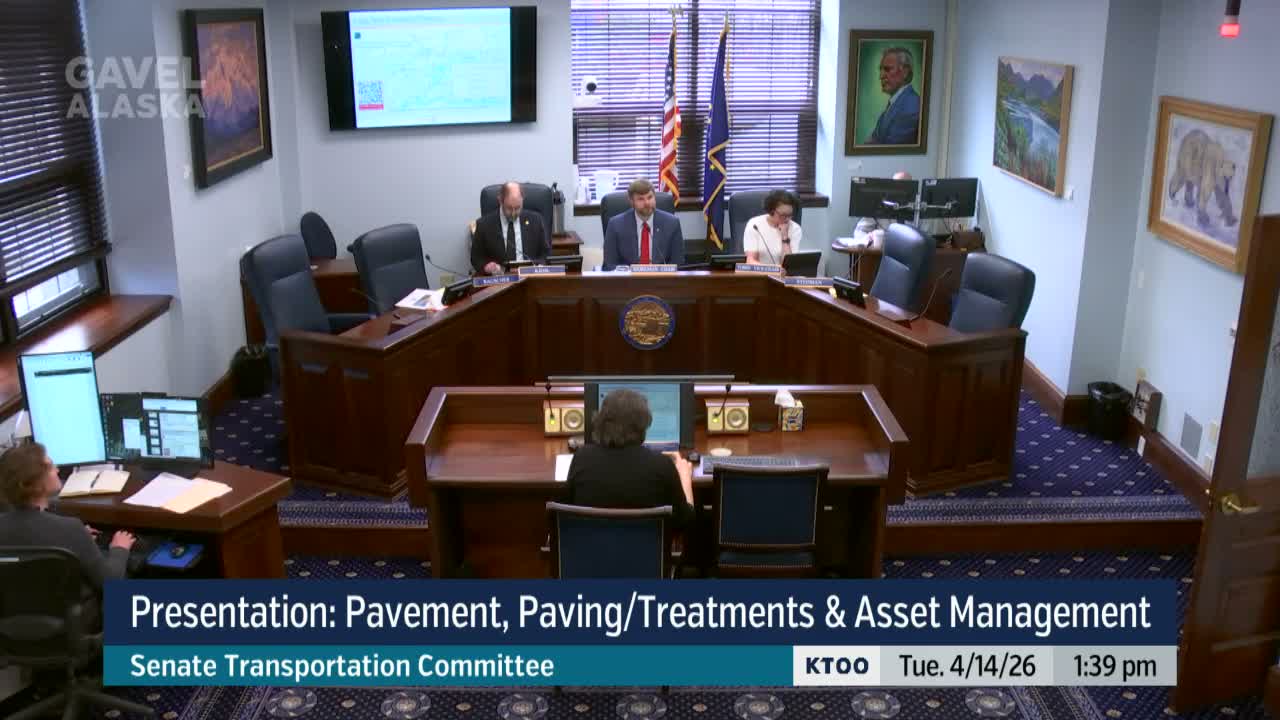
The Alaska Department of Transportation and Public Facilities on Tuesday told the Senate Transportation Committee it is building a 10-year pavement plan that pairs asset-condition data with long-term funding to move the state from reactive repairs to earlier, strategic investments.
"The STIP is a narrow band of both time and funding sources," said Lauren Little, chief engineer and acting northern region director, explaining why the department is expanding planning beyond the Statewide Transportation Improvement Program to a broader decade-long horizon that coordinates pavement, bridge and drainage work across regions.
The department said the 10-year plan will use condition data and revenue forecasts to choose interventions earlier in a roadway's deterioration cycle, avoiding costlier rebuilds. "That is exactly what the 10-year plan is allowing us to do: fitting those needs in now strategically before they occur," Little said.
DOT officials described programmatic changes to pavement materials. Little said a 2014 agency policy now favors harder aggregate on high-volume roads in Anchorage to reduce rutting and the grinding effects of studded tires, while acknowledging higher cost and the likelihood of importing some aggregate. "We moved in 2014 to establishing a policy on hard aggregate for these high volume roads," Little said.
The department also highlighted wider use of polymer-modified asphalt binders to reduce thermal cracking in northern regions. Christine Langley, DOT's data modernization and innovation director, said the department relies heavily on Alaska suppliers: about 90% of asphalt overall comes from Alaska suppliers, roughly 86% of polymer-modified binder supply is Alaska-based, and about 99% of unmodified asphalt is from Alaska refineries. Langley named two Alaska emulsion producers including Denali Materials and one Washington-based supplier for polymer-modified products.
Committee members pressed DOT on performance trade-offs. "I assume that the point of the polymer additive is to increase improve plasticity. Do we have trade-offs for including that other than its price?" asked a senator. DOT replied the polymer modification improves cold-temperature performance and that, if mix designs are not suited to warm temperatures, creep or deformation can occur; the department said it has not observed broad performance issues since adopting polymer modifications.
The committee also reviewed how DOT is collecting asset-condition information. Langley described a multi-pronged effort using mounted cameras, purchased imagery, crowdsourced data and artificial intelligence to extract pavement and roadside features. "We have been installing cameras on our own state equipment fleet vehicles in order to more of that," Langley said, adding that AI algorithms are used to process video feeds and identify assets.
On lidar, Langley told the committee the department uses 3D lidar scans to detect elevation changes, brush encroachment, potholes and roadside hardware, and to assess grades and curves. DOT said it is still expanding 3D coverage: the agency reported about 12,000 lane miles in its inventory and an aim to collect imagery on most lane miles every three years, while noting logistical challenges such as ferry access and newly inventoried gravel roads.
Committee members asked about construction practice and community impacts, including night work and noise ordinances. DOT said night work and mitigation are considered case by case in design, public outreach and bidding, citing a University Avenue project in Fairbanks where construction pacing was coordinated with a school timeline.
Senator Rauscher asked about a previously-discussed reorganization to improve regional coordination. Langley said the effort is ongoing, includes position changes in the department's budget submittal and is intended to coordinate statewide delivery rather than create hard geographic demarcations.
The presentation concluded with DOT emphasizing that pavement projects involve substantial pre- and post-construction asset work, and that the department will roll those data into long-term planning. The committee adjourned at 2:07 p.m.; the chair said the Transportation Committee will not meet again this week and will post its next schedule later in the week.