Lifetime Citizen Portal Access — AI Briefings, Alerts & Unlimited Follows
Beaufort County staff recommend retiree reimbursement and faster shift toward higher employee share of health premiums
Loading...
Summary
County HR proposed a prospective Retiree Health Reimbursement Arrangement (RHRA) for pre‑Medicare retirees, with tiered monthly stipends and modest admin costs, and outlined a plan to move employee contributions toward an 85/15 split over two years (staff had proposed 80/20 over five years). Council signaled support for budgeting the stipend and for a shorter, two‑year phase-in for contribution changes, while asking staff to refine fiscal forecasts.
Beaufort County staff presented two linked proposals at the March 10 council workshop: a prospective Retiree Health Reimbursement Arrangement for pre‑Medicare retirees and a multi‑year plan to change employer/employee health‑premium contribution ratios.
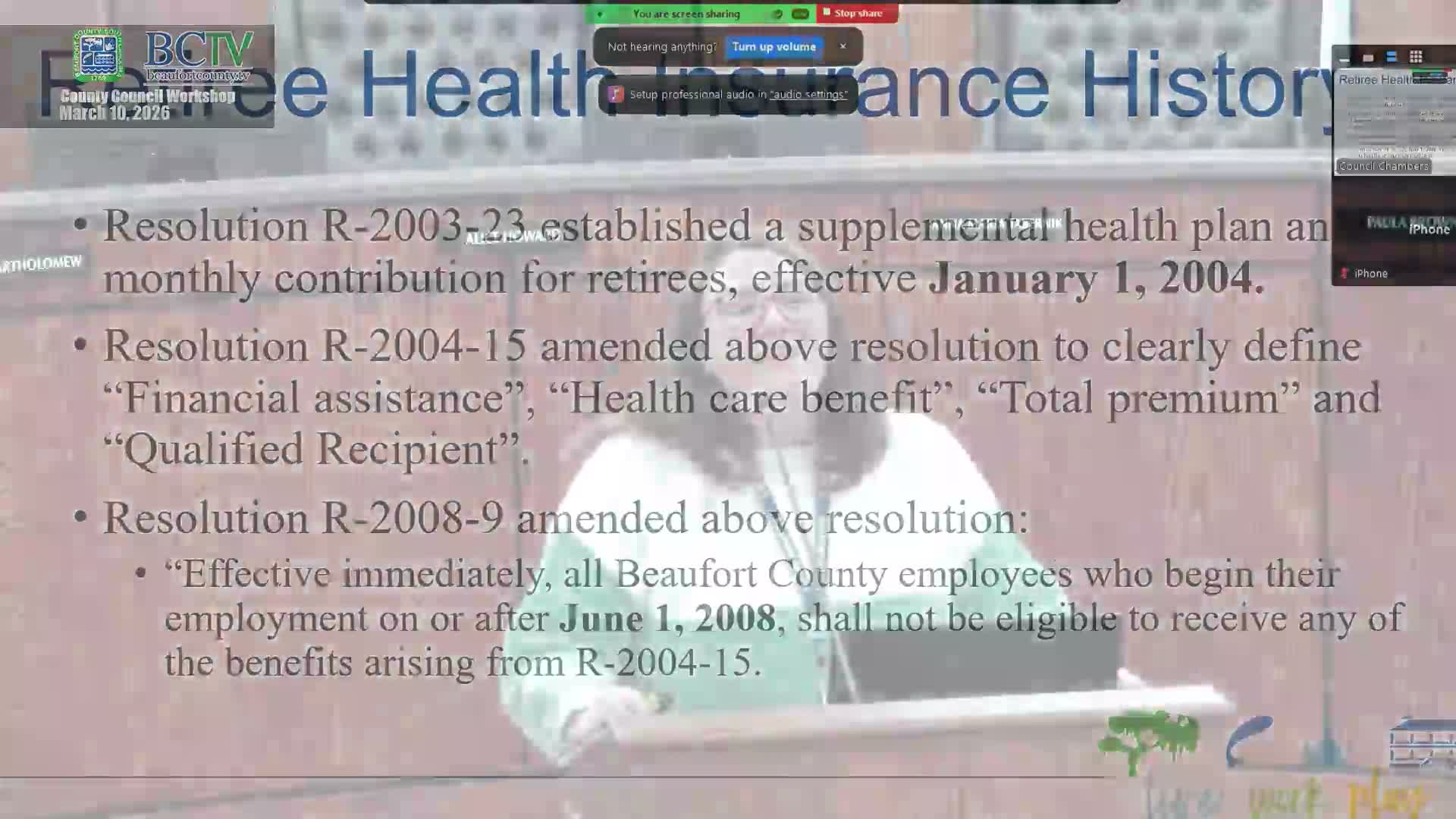
Catherine (HR) told the council that the retiree program adopted in 2004 had been narrowed in 2008 and fully ended in 2016; staff now recommends a defined‑contribution RHRA that would take effect July 1, 2026. Eligibility would require the retiree be under 65, PEBA‑eligible and have at least 15 years of Beaufort County service. Under the staff recommendation, monthly stipends would be $300 for 15–20.99 years, $400 for 21–27.99 years and $500 for 28+ years; a $3.50 per‑participant monthly administrative fee is expected. Catherine said HR's census analysis shows an average of about 12 eligible retirements a year and a mature steady state of roughly 96 participants; the staff first‑year point estimate using the mid tier was about $58,000, and a conservative “high” scenario might be about $108,000.
Council members pressed for clarifications: the stipend would not be paid if a retiree is covered by a spouse or employer plan, and recipients must show proof of private insurance via the third‑party administrator, Catherine said. Several members suggested budgeting the program as part of annual appropriations rather than binding future councils to automatic cost adjustments; staff agreed to include it in the budget process and to work with the county finance team on year‑one sizing.
The retiree proposal was discussed alongside a staff review of the county's workforce health insurance. Catherine said Beaufort County moved from fully insured coverage to a self‑funded model roughly a decade ago and that the county has realized long‑term savings under self‑funding despite some years of high claimant costs. For FY27, staff projected a total plan cost of about $19.2 million. To improve sustainability, HR and the benefits broker recommended a phased move toward a target employer/employee split; staff presented two approaches — an 80/20 target phased over five years, and a more accelerated 85/15 target executed over two years.
Council members voiced differing priorities. Some favored a faster shift to bring the county closer to private‑sector norms; others warned that large near‑term employee contributions could outweigh modest pay increases and asked that the impact on lower‑paid staff be mitigated (for example, by using flat COLA amounts rather than percentage increases). Catherine said staff could rerun the phasing to smooth first‑year impacts if council prefers.
What happens next: staff will include the retiree stipend in the upcoming budget materials and provide more granular cost scenarios. The merit‑pay and step‑scale items (discussed later in the workshop) are being coordinated with the health‑insurance phasing, and HR said any COLA or contribution changes will be brought back to council through the budget process.