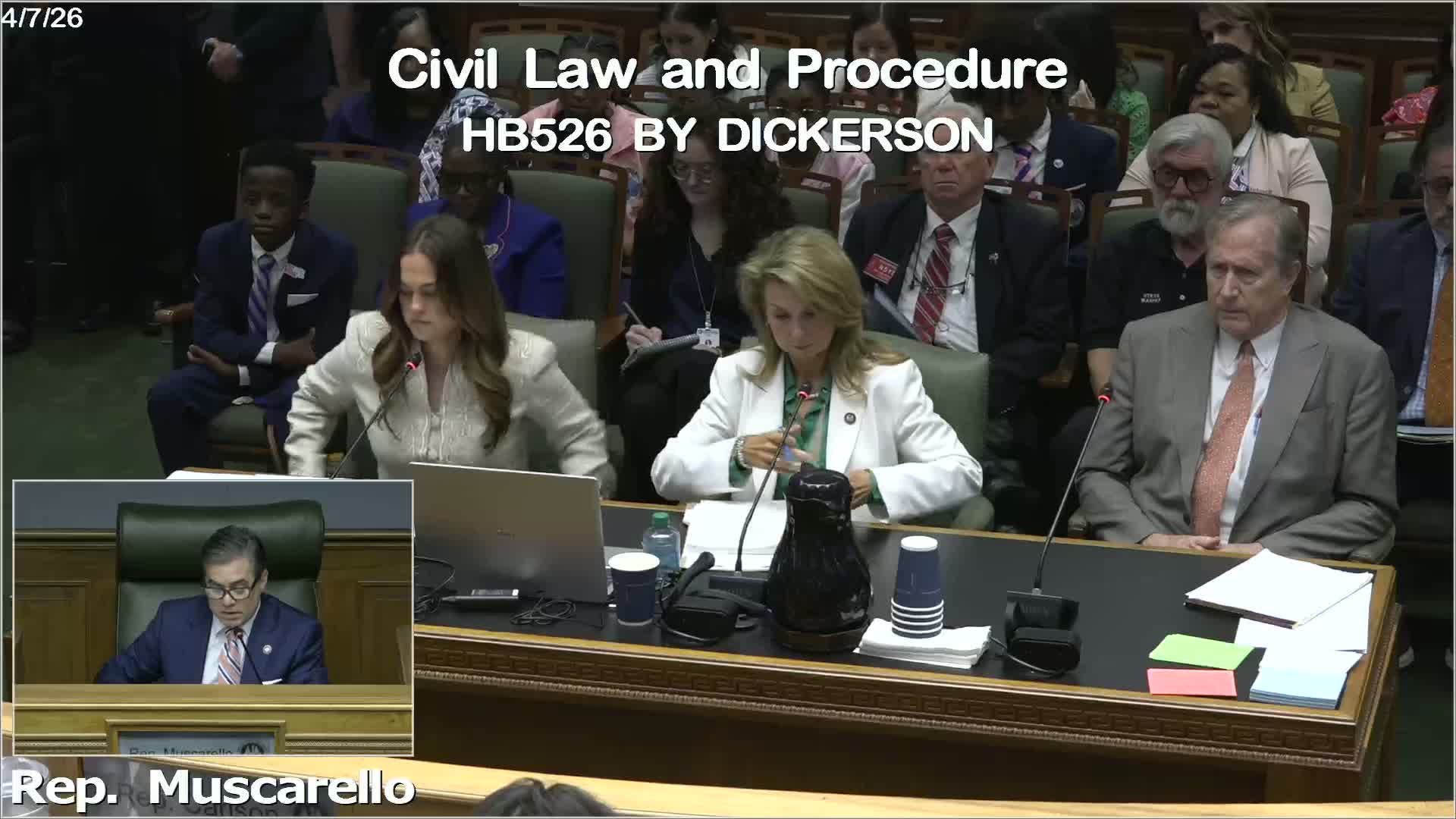
Committee debate turns heated and motion to report HB 5 26 fails after testimony from truckers, businesses and survivors
Loading...
Summary
After hours of testimony from trucking and business groups urging caps to curb "nuclear verdicts" and victims and advocates warning that caps limit recovery for severe harms, a motion to report HB 5 26 with amendments failed on a 4–5 roll call, leaving the bill in committee.
A bipartisan, hour‑long hearing on House Bill 5 26 ended with a roll‑call defeat for a motion to report the bill out of the House Civil Law Committee on April 7.
Representative Wilford Dickerson introduced HB 5 26 as a measure to “bring balance and predictability” to civil litigation by capping general (non‑economic) damages, proposing a typical cap of $500,000 and $1,000,000 for the most severe permanent injuries while explicitly preserving economic damages (medical bills, lost wages) and excluding intentional wrongdoing from protection.
Business and industry witnesses warned that Louisiana’s high commercial premiums and a scarcity of carriers threaten local firms. John McGee, owner of a small North Louisiana trucking firm, told members that his annual premium rose from $388,000 in 2021 to $710,000 last year — an 80% increase — and that small fleets are leaving the state. Tony McAllister of the Louisiana Loggers Association and representatives from the Louisiana Motor Transport Association described per‑truck insurance costs ranging from about $18,000 to $24,000 annually and urged caps to stop companies from moving operations out of state.
Proponents also relied on economic arguments. Roger Giaboni of the U.S. Chamber Institute for Legal Reform said the Chamber’s analysis estimates household savings if general‑damage limits are adopted and cited other states that have chosen some limitations.
Opponents — including survivors’ advocates, family members, and civil‑justice groups — said the bill would arbitrarily cap compensation for catastrophic losses. Katie Derwin, whose family lost three children in a single crash, asked lawmakers “What is their lives worth? $500,000?” and urged them to consider the human consequences of a blanket cap.
A central point of debate was whether a limit should apply per claimant or per action; Representative Carlson successfully offered amendment set 3,174 clarifying that the limitations apply per individual plaintiff instead of per action. The committee then considered a motion to report HB 5 26 with amendments. On the roll call, the motion received 4 yeas and 5 nays and failed to advance the bill out of committee.
Committee members repeatedly emphasized that the legislation would not apply to intentional or malicious acts, but witnesses on both sides said certain language remained subject to litigation and interpretation if enacted. The committee also heard testimony that many recent tort reforms had only recently taken effect and that measurable premium reductions may lag statutory changes by years.
Next steps: with the failed motion to report, HB 5 26 remains in committee; sponsors and stakeholders indicated a willingness to continue negotiations and to return with revised language or further data.