Lifetime Citizen Portal Access — AI Briefings, Alerts & Unlimited Follows
House committee backs CPRA’s $1.54 billion FY27 coastal protection plan
Loading...
Summary
The House Natural Resources Committee heard CPRA’s FY27 annual plan outlining roughly $1.54 billion in spending authority, 143 active projects and a three‑year outlook; members pressed agency officials on nonstructural programs, funding sources and regional impacts before reporting HR 1 favorable by unanimous consent.
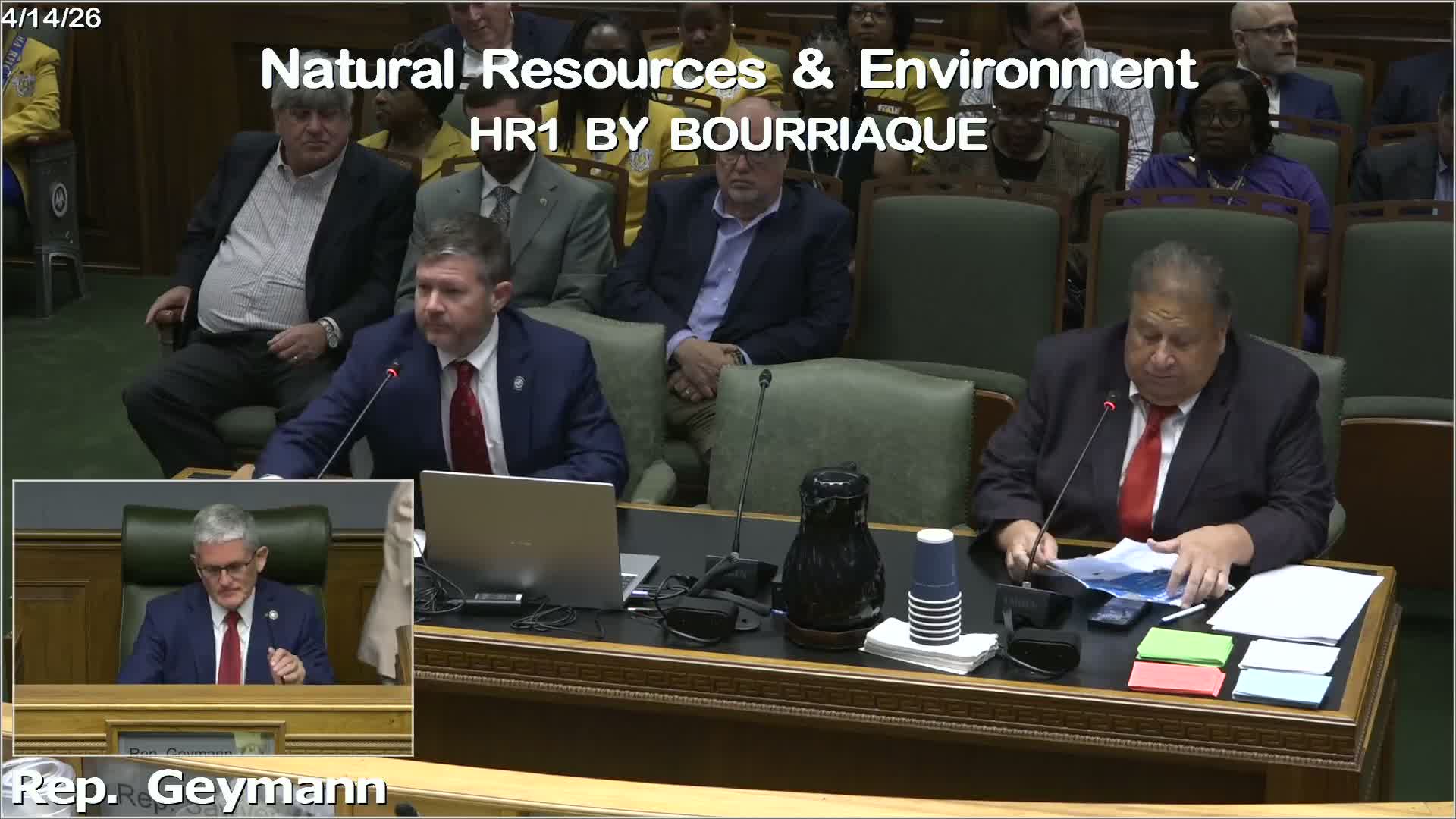
The House Natural Resources Committee on April 14 advanced House Resolution 1, the annual state integrated coastal protection plan, after a detailed presentation by the Coastal Protection and Restoration Authority (CPRA).
Michael Haire, CPRA’s executive director, told the committee the plan represents authority to spend about $1.54 billion across restoration and protection programs and provides a three‑year outlook for projects now in design or construction. He said the plan includes roughly 18 large dredge projects that would restore about 12,000 acres when completed and that 93% of the plan’s dollars are directed to project implementation (engineering and design, construction, or operations and maintenance). Haire identified multiple regional priorities including the Calcasieu Sabine hydraulic restoration, Cameron shoreline protection, Terrebonne land‑bridge work, Barataria projects and the Birds Foot Delta restoration.
Gordon Dove, chairman of the Governor’s Office of Coastal Activities and chair of the state coastal board, said the administration and CPRA worked across parishes to assemble 143 projects and emphasized that most of the $1.54 billion is construction funding. He also told the committee the previously proposed Mid‑Barataria sediment diversion project has been defunded and that permits and certain contracts related to that project have been terminated or settled.
Members used the presentation to probe details. Representative Sawyer asked whether nonstructural measures such as home elevations had been contemplated in previous iterations of the master plan; CPRA planning chief Brian Lazine said the master plan has included nonstructural measures (flood risk reduction programs) and that the 2023 plan treats them programmatically and with an associated dollar amount—roughly half of CPRA’s envisioned investments compared with structural protection in some basins. Lazine said the state is cost‑sharing with the Army Corps on a Southwest pilot and that the corps has set aside funding for initial work.
Other members raised concerns about potential North Shore impacts tied to some levee work and asked about modeling; CPRA said it is coordinating studies with the Corps of Engineers and will follow up with briefings on localized modeling. Representatives also asked how deauthorized diversion dollars will be tracked; CPRA said new restoration plans (NRDA/NFWF) will be publicly vetted and that programmatic tracking will accompany any reallocation of previously authorized funds.
CPRA officials described funding sources that feed the plan, including Gulf of Mexico Energy Security Act (GOMESA) receipts, RESTORE and Deepwater Horizon‑related buckets, and a new category CPRA described as coastal settlements (litigation settlements directed to restoration). Haire cautioned that plan “authority” is not the same as cash on hand for a fiscal year and pointed to carry‑forward and multi‑year project phasing as reasons the plan total differs from immediate-year revenues.
Committee members listed cards of support from levee districts, conservation groups and parish governments and the chair waived closing remarks. Representative Kerner made a motion to move HR 1 favorable; there was no objection and HR 1 was reported favorable.
The committee did not take a roll‑call vote; the motion advanced by unanimous consent. CPRA said it will publish restoration plan materials and expects its next large restoration plan to be posted in coming months.