Get Full Government Meeting Transcripts, Videos, & Alerts Forever!
Get email alerts on the Transportation topic
No spam. Unsubscribe anytime.
Rep. Brett Bagley’s plan to replace brake-tags with QR ‘LA VIP’ sticker passes Louisiana House after extended debate
Summary
The Louisiana House on April 7 passed House Bill 10 85, sponsored by Rep. Brett Bagley, to eliminate the traditional vehicle inspection (brake) sticker and implement a QR-based LA VIP sticker tied to VIN/make/model, with an annual consumer fee and new windshield standards. The measure passed 84–7 after questions about fees, privacy and enforcement.
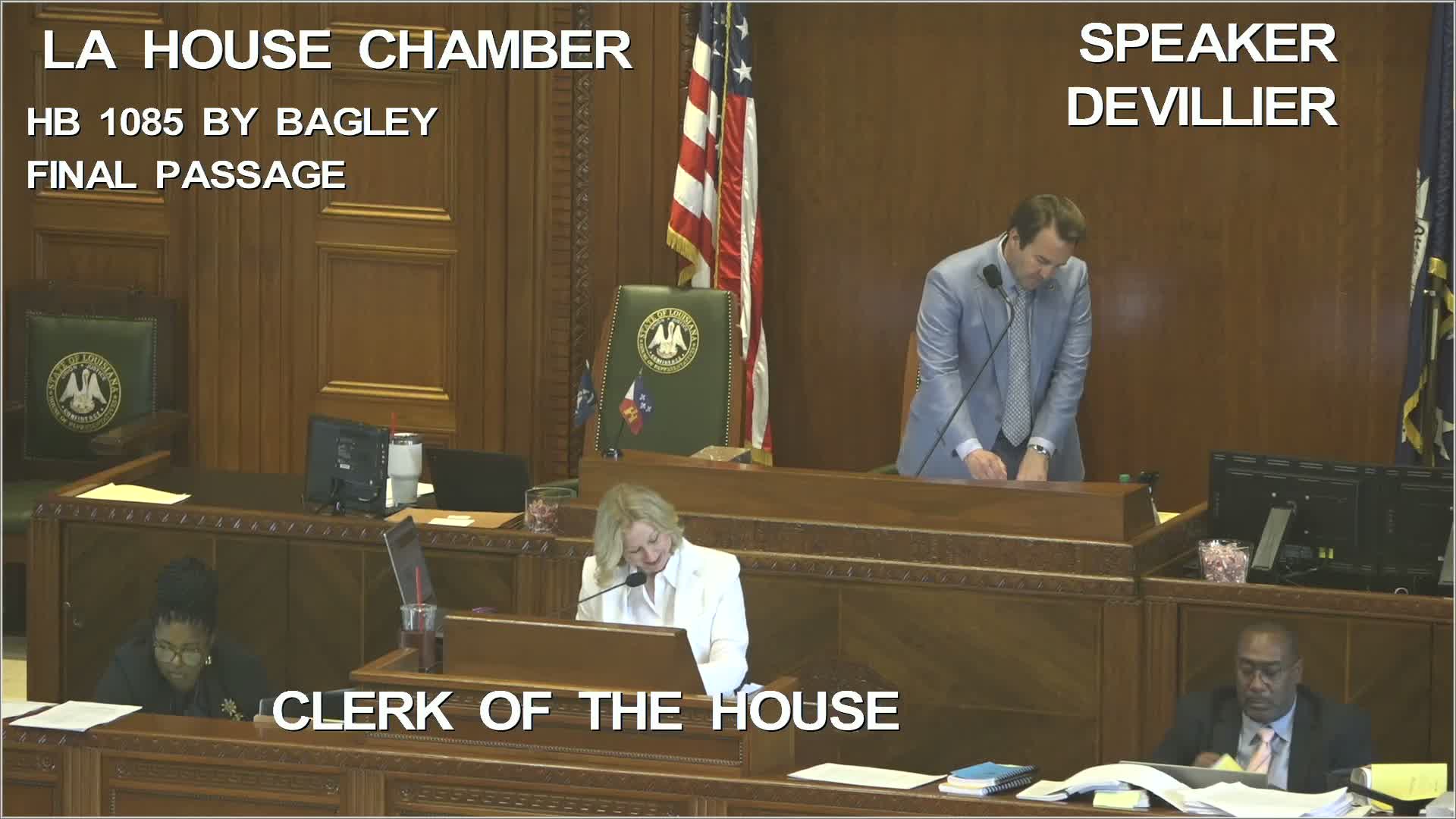
Rep. Brett Bagley, R, secured final House approval on April 7 for a bill that would end Louisiana’s traditional vehicle inspection “brake tag” system and replace it with a Louisiana Vehicle Inspection Program (LA VIP) sticker containing a QR code linked to a vehicle’s VIN, make and model. The House voted 84–7 to pass House Bill 10 85.
Bagley told colleagues the measure is the result of years of work. “This bill… I think the sixth time I brought it,” he said on the floor, arguing the change would modernize the system, reduce trips to inspection centers and lower some inspection-related fees. He said the new program will send the QR sticker to vehicle owners with registration renewal and that enforcement will rely on data embedded in the code rather than a physical inspection sticker displayed on the windshield.
Why it matters: supporters said the bill simplifies a longstanding, paper-based inspection process and reduces burden on citizens who must physically take vehicles to inspection stations. Opponents and questioners pressed the sponsor for details about fees, interactions with federal Clean Air nonattainment rules, data privacy and whether local inspection regimes would be duplicated.
Key provisions and sponsor responses - Sticker content and cost: Bagley said the QR code will carry the VIN and easily visible vehicle details. “The only thing that’s gonna be on that sticker or the barcode is your VIN number, make and model of your car,” he said. He repeatedly described an annual consumer-facing fee lower than the current amount, saying the bill would “take away the $10 that you pay yearly and change that to $6.” - Program fee language in the bill: during floor debate Bagley also referred to the program text and a fee figure described in the bill as “$56 per sticker” when outlining administrative requirements; the transcript records both numbers, prompting questions about which fees apply to which users and contexts (see clarifying details below). - Implementation and timeline: the sponsor said the program’s effective operation would be tied to Department of Public Safety and Corrections and Office of Motor Vehicles rulemaking; he said motorists would not be required to visit inspection stations after passage and that, if approved, full implementation would require a transition period with enforcement changes beginning January 1, 2027. - Nonattainment and local inspections: members asked whether municipalities or parishes in federal Clean Air Act nonattainment zones would still require separate inspections. Bagley said local ordinances remain in effect and that some parishes would likely operate both programs during a transition; he acknowledged the risk of double payments in five parishes subject to air-quality inspection rules but said staff were working to reconcile the requirements. - Privacy and enforcement: members asked whether QR codes could be scanned by private actors and whether local law enforcement would have the scanners and capacity to read codes. Bagley said the code contains limited vehicle details (VIN, make, model, color) and that law enforcement would be equipped once the program is implemented.
Concerns raised on the floor - Fee clarity and fiscal note: several members pressed for clarity on how much motorists will pay and how revenue is used. The sponsor said the consumer-facing change reduces an annual charge to $6 but also referenced a $56 figure in the bill text; lawmakers expressed concern about the potential for conflicting fees or double-charging in some parishes. - Data scanning and misuse: members asked whether the QR codes might be scanned by bad actors in neighborhoods; Bagley acknowledged potential misuse but argued the code carries limited information and that existing counterfeiting and misuse risks persist under the current sticker system. - Clean Air Act and dual compliance: in federally designated attainment/nonattainment areas, lawmakers worried residents might pay both the LA VIP fee and existing local inspection fees. Bagley said coordination with local authorities was ongoing and that the sponsor’s office would seek alignment.
Floor vote and next steps The bill passed final passage on a recorded vote, 84 yeas to 7 nays. Bagley moved to adopt title and the motion was ordered without objection. The bill will move to the Senate for consideration of the House-passed version and implementing rules will be developed by the Office of Motor Vehicles and Department of Public Safety and Corrections if the measure becomes law.
Clarifying details and uncertainties from the transcript: the sponsor stated multiple numeric figures on the floor — he said the consumer-facing annual change reduces a prior $10 charge to $6, and he also read language referring to a $56 per-sticker fee in the program description. The transcript does not reconcile those figures; the sponsor described the $6 as the household-facing amount and said program administration and rulemaking would detail costs and distribution of revenue.
What to watch: whether the Senate adopts the House language, what the implementing rules require (including whether the QR code includes owner-identifying data), how state and local authorities coordinate in Clean Air Act nonattainment parishes, and the final consumer fee structure and effective dates.