Professor: NAEP ''proficient'' is aspirational; media headlines risk misrepresenting test results
Loading...
Summary
Paul Thomas, a Furman University education professor, told Alaska's task force NAEP is a sampled national measure where 'proficient' is an aspirational cut (roughly the 70th percentile), cautioned that test revisions often lower scores, and emphasized poverty and family context as strong drivers of test performance.
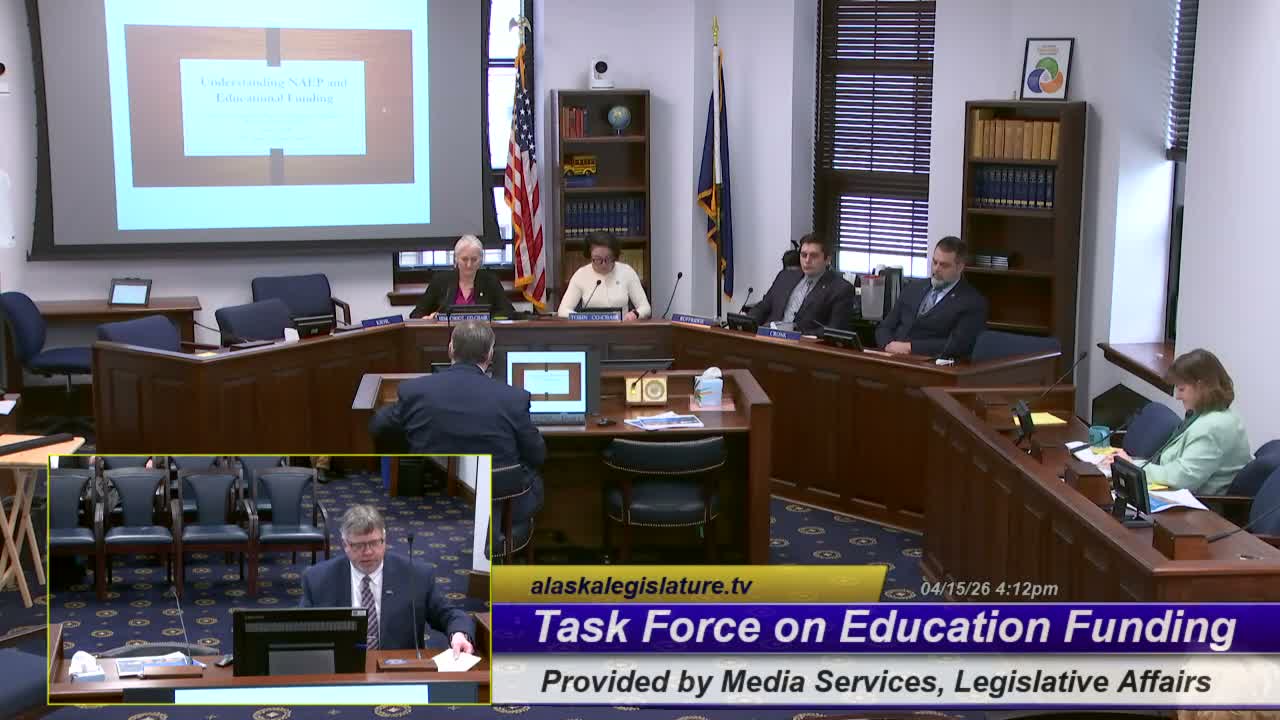
Paul Thomas, an education professor at Furman University, told the joint legislative task force that the National Assessment of Educational Progress (NAEP) is a sampled, national comparison tool and that policymakers should be cautious about overinterpreting headline proficiency figures.
"In NAEP, 'proficient' is a very high standard," Thomas said, adding that NAEP proficiency aligns near the 70th percentile and was designed as an aspirational benchmark rather than a literal grade-level expectation. He warned that test revisions often produce score declines and that media coverage sometimes misrepresents what NAEP proficiency means for classroom-level instruction.
Thomas described NAEP as a random-sample assessment that focuses primarily on grades 4 and 8 in math and reading and noted major changes slated for the 2026 NAEP administration. He urged the task force to treat NAEP as one indicator among many and to consider socioeconomic context when using test results for policy decisions.
"Family income variables are immutable by schools," Thomas said, noting research indicating that a substantial share of test-performance differences is linked to community and family conditions rather than school inputs. He pointed to research showing about 63% of test-performance correlation with home and community factors in a recent study he cited during the presentation.
Members asked about Title I supports and the Department of Defense Education Activity (DoDEA) schools; Thomas said DoDEA schools score highly on NAEP and that stable social supports, teacher pay and consistent structures are factors in their performance.
Thomas offered to share sources and additional materials with the committee staff. The task force did not take formal votes during this presentation.