Get AI Briefings, Transcripts & Alerts on Local & National Government Meetings — Forever.
NCSL adviser briefs Alaska task force on ESSA testing rules, waivers and Title I set-aside
Summary
Austin Reed of the National Conference of State Legislatures told Alaska's education funding task force that ESSA requires annual math and ELA testing in grades 3'8, disaggregation of results by subgroups, and a 7% Title I set-aside for school improvement; states retain flexibility on weights, interventions and waivers.
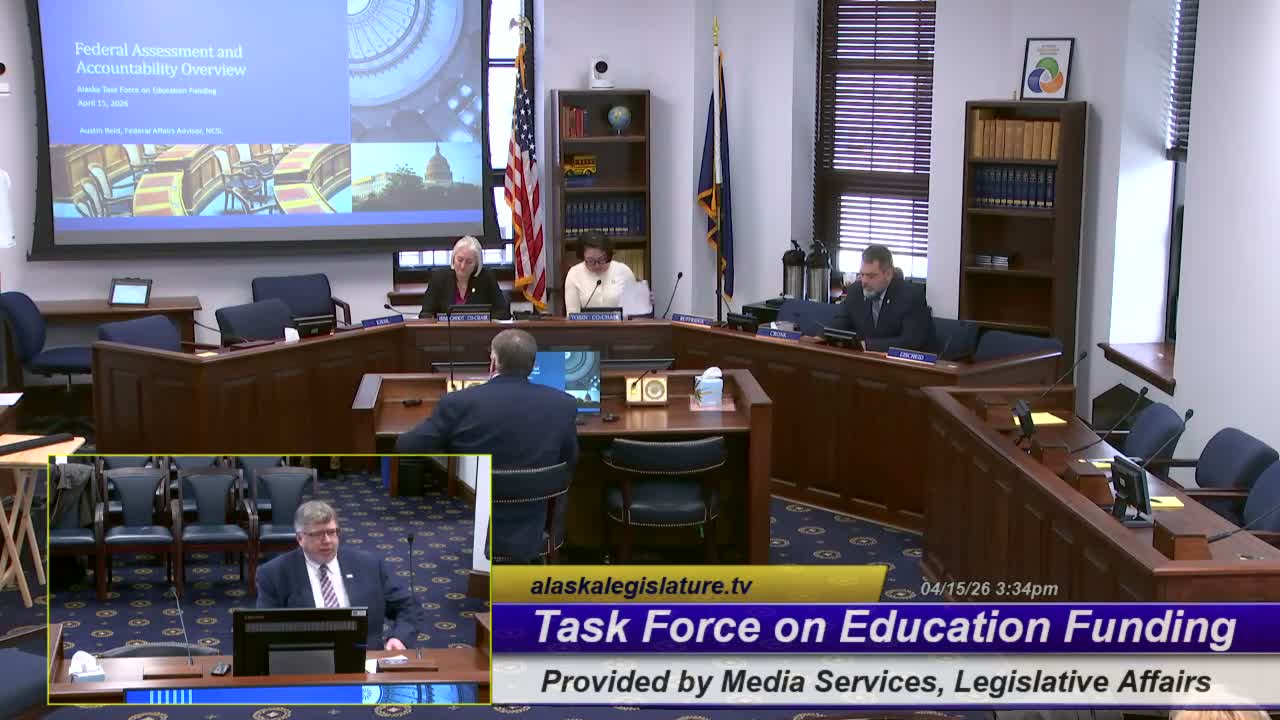
Austin Reed, a federal affairs adviser for the National Conference of State Legislatures, told Alaska's joint legislative task force on April 15 in Juneau that federal law sets the basic structure for state testing, accountability and school improvement but leaves substantial discretion to states.
"States are ultimately given the discretion to choose their assessments," Reed said, summarizing requirements under the Every Student Succeeds Act. He explained that states typically administer about 17 different assessments across grades and subjects (a state-level total), but individual students generally take no more than three tests in a school year and annual math and English-language arts testing is required in grades 3 through 8.
Reed outlined accountability rules: states must meaningfully differentiate school performance, disaggregate results by major student subgroups (economically disadvantaged students, major racial and ethnic groups, students with disabilities and English learners) and base the bulk of school ratings on academic indicators such as proficiency, growth (for elementary schools), the four-year adjusted-cohort graduation rate and English-proficiency progress.
He described federal improvement designations: Comprehensive Support and Improvement (CSI) generally applies to the lowest 5% of Title I schools or to high schools with four-year graduation rates below 67%, while Targeted and Additional Targeted Support classifications apply to persistently underperforming subgroups. States must require evidence-based interventions and schools identified for improvement must create needs-assessment-based plans.
"States have to set aside 7% of all their Title I funding for school improvement activities," Reed said, adding that states determine how to distribute those funds — for example through categorical grants or competitive awards — and may use them to pay for temporary supports such as professional development or outside contractors.
Reed also described options for flexibility: an innovation assessment demonstration authority (limited to a small number of states), use of interim assessments that roll into a summative score, and a waiver process through the U.S. Department of Education for provisions that are eligible to be waived (fiscal and civil-rights requirements generally cannot be waived). He noted the state-plan approval process requires public comment and governor sign-off but amendments do not necessarily require legislative approval.
Representative Refridge asked whether schools that exit improvement categories lose funding. Reed replied that supplemental improvement dollars are intended as temporary resources to support interventions and that distribution is a state decision; he also cautioned that COVID-era disruptions (such as waived assessments and rolled-over identifications) complicated recent trend analysis.
The task force did not take formal action on these items. Reed offered to provide additional state-by-state examples of plan amendments and waiver usage to staff on request.