House Education Committee hears SB 143 to let municipalities set school-board terms, allow small cities smaller councils
Loading...
Summary
The House Education Committee heard testimony on SB 143, which would give municipalities the option to change municipal school board term lengths and allow cities with populations under 1,000 to reduce city council size from seven to three members; testimony emphasized local control, potential election-cost savings and trade-offs for voter accountability.
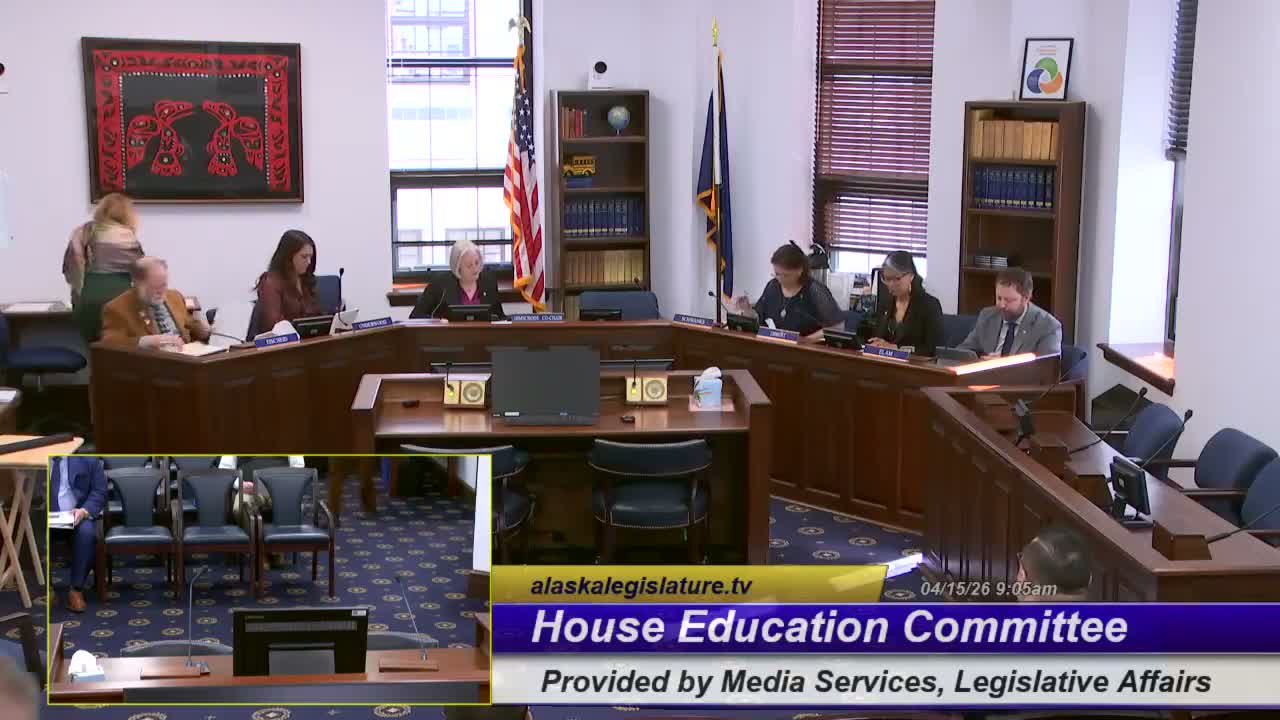
Co-chair Himshut presided over a House Education Committee hearing on April 15, 2026, where committee staff and witnesses discussed Senate Bill 143, a measure that would let municipalities and boroughs set term lengths for municipal school board members and permit some small cities to reduce city council membership.
Ryan McKee, staff to Senator Yount, told the committee that SB 143 would ‘‘grant municipalities and boroughs those abilities’’ to adjust school board term lengths and that any change would remain subject to voter approval. McKee used the Matanuska-Susitna Borough’s move of assembly seats to four-year terms as an example of how aligning election cycles can reduce costs and increase turnout; he said the borough saw savings and estimated roughly "$1,000,000" in savings but said he would confirm the figure for the committee.
Lon Garrison, executive director of the Association of Alaska School Boards, testified in support, telling the committee that SB 143 ‘‘aligns strongly with ASB’s long standing beliefs and resolutions supporting local control and local governance.’’ Garrison said the bill preserves local accountability because any change would require voter approval, and he noted trade-offs such as the potential for reduced frequency of voter input if communities adopt longer terms.
Committee members pressed staff and witnesses for additional information about election costs, examples of small communities struggling to fill seven council seats and whether other states offer similar flexibility. Ryan McKee said the reduction in council size was added to the bill at the request of AML (the Alaska Municipal League) and offered to provide specific examples and comparative information to the committee. Representative Underwood described firsthand that aligning school board elections with higher-turnout years increased voter participation in the Mat Su.
No formal vote on SB 143 occurred. Co-chair Himshut said the committee would hold the bill over and set an amendment deadline for Friday, April 17 at 3:00 p.m. The chair also reminded members of an education task-force meeting at 3:30 p.m. and adjourned the session at 9:29 a.m.
The committee record shows interest in three core issues for follow-up: (1) verified estimates of election-cost savings when cycles are aligned; (2) examples of small cities that have struggled to fill seven-member councils and how a reduced minimum might affect governance; and (3) comparative practice in other states on school-board term lengths. Staff offered to provide the requested data and state comparisons before further action.