Committee hears broad support to reclassify emergency dispatchers as first responders in PERS
Loading...
Summary
HB234 would classify emergency dispatchers as first responders and add certain dispatchers to the peace officer/firefighter PERS category, potentially enabling earlier retirement and access to medical coverage after 25 years; dispatchers testified about high stress, PTSD risk and training requirements, and stakeholders asked the Division of Retirement and Benefits for actuarial detail.
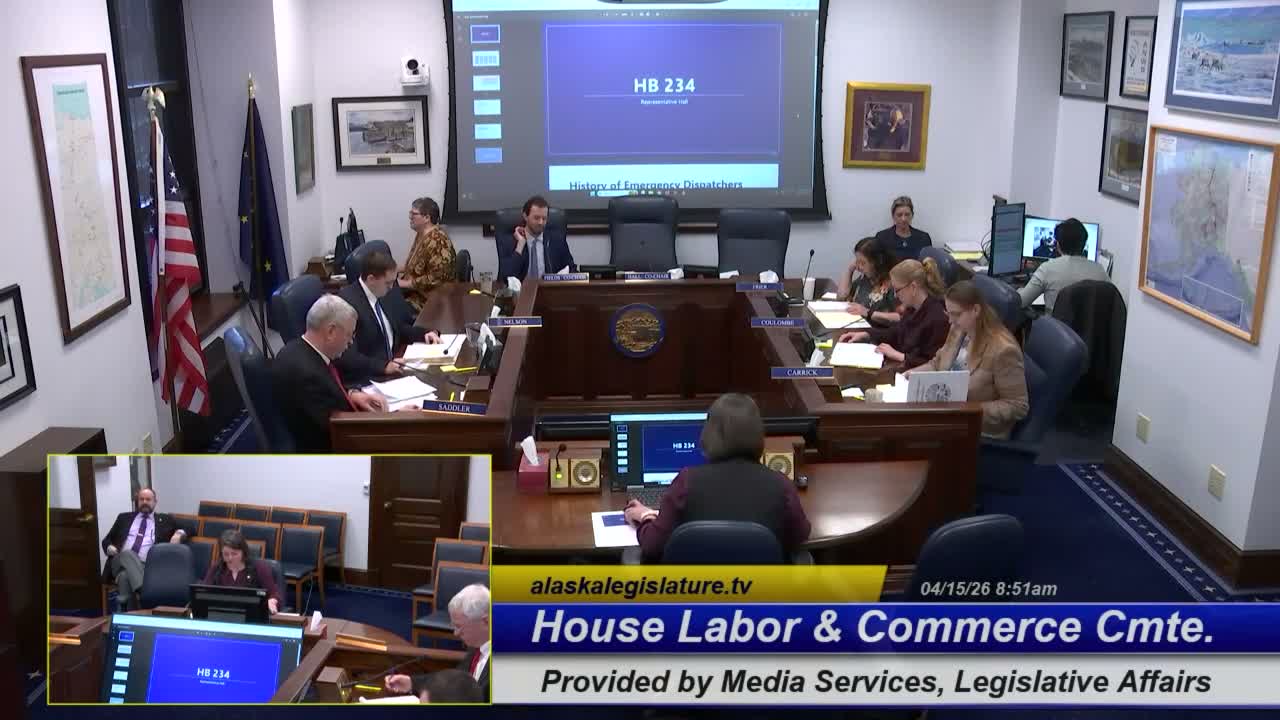
Representative Carolyn Hall presented House Bill 234 to the Labor and Commerce Committee as a two-part change: defining emergency medical dispatchers as first responders in statute and moving dispatchers who work in police, fire or state trooper offices into the peace officer/firefighter category of the Public Employees’ Retirement System (PERS). The sponsor said the change is intended to recognize dispatchers’ role, improve recruitment and retention, and open dispatch centers to federal funding and training opportunities.
Multiple dispatchers gave invited testimony about job stress, turnover and training demands. Suzanne Hall, training supervisor for the Soldotna Public Safety Communications Center, described dispatch work as “dynamic” and said many dispatchers leave within a year; she testified that a typical training pipeline in some centers can take eight to nine months with ongoing certification requirements. Erin Talwara, public safety manager for the Juneau Police Department, described the complexity of modern dispatch systems and the training intensity required.
Stakeholders raised questions about fiscal impacts to the retirement system and the number of dispatchers who would be affected. Shane Westcott of the Alaska Professional Firefighters, citing preliminary DRB discussions, estimated a “few hundred” dispatchers statewide would gain different benefit treatment and suggested fewer than 20 Tier 3 members would see substantial retirement calculation changes. He also argued dispatchers’ repeated traumatic exposure justifies aligning benefits with other public safety roles.
Committee members pressed for a clearer count of affected employees, actuarial analysis and details on how moving from a highest-five to a highest-three calculation could change incentives around overtime near retirement. Sponsors acknowledged outstanding questions and said they are working with the Division of Retirement and Benefits (DRB) to obtain the necessary data and modelling; members asked DRB and Department of Revenue for follow-up.
What’s next: The sponsor will coordinate DRB follow-up and the committee deferred final action pending actuarial estimates and additional information about the number of affected employees and fiscal impact.