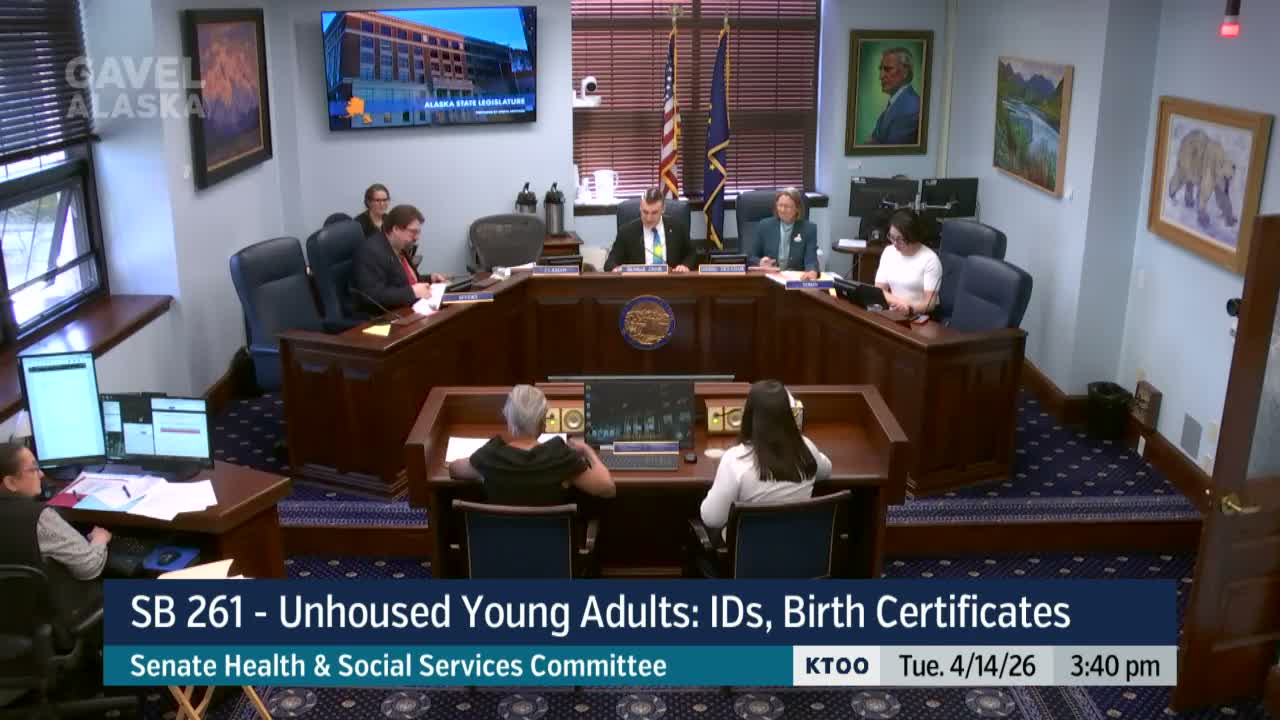
Senate hearing: bill would waive fees and relax ID rules for unhoused young adults; DMV raises fiscal and operational questions
Loading...
Summary
SB 261 would waive fees and expand acceptable documents for 18–25-year-old unhoused Alaskans to obtain birth certificates and state IDs; advocates said the change removes a key barrier, while DMV officials questioned fiscal assumptions and described operational steps for returned mail and claim processes.
Senate Bill 261, introduced at a March 10 hearing in the Senate Health and Social Services Committee, would waive fees and expand acceptable identity documentation to help unhoused Alaskans ages 18–25 obtain certified birth certificates and state identification cards.
Sponsor Senator Grama Jackson told the committee the bill was shaped by work with a national legislators’ youth‑homelessness group and is intended to remove financial and bureaucratic barriers that prevent transition‑age youth from getting IDs required for employment, housing and services.
Jamie Bagley, staff to the sponsor, provided a sectional analysis. Key provisions described in the hearing would: amend AS 18.50.320 to add an alternative verification method for fee‑waiver applicants (allowing expired government photo IDs, school or medical records, affidavits or other documents accepted by the Bureau of Vital Statistics); amend AS 18.50.330 to prohibit charging a certified birth‑certificate fee for qualifying unhoused 18–25‑year‑olds and authorize the Department of Health to prescribe an unhoused‑status verification form; amend AS 18.65.310 to add a misdemeanor for knowingly making a false written statement about unhoused status; and add procedures allowing non‑principal addresses (such as service‑provider addresses) on ID cards and a non‑federally compliant state ID for certain unhoused young adults at no charge.
Advocates testified the bill would remove tangible barriers. Brian Wilson, executive director of the Alaska Coalition on Housing and Homelessness, said many young people cannot access federal housing programs, jobs or education without IDs and described logistical barriers (expired IDs, lack of birth certificates, transportation or work conflicts). He and Josh Lowers of Covenant House Alaska said waiver of modest fees and acceptance of alternative documents can be a cost‑effective prevention strategy that helps youth access services and stability.
DMV officials answered detailed questions about the agency’s fiscal assumptions and operational workload. Division operations manager Lauren Whiteside told the committee the DMV calculated 10,243 ID cards issued to the bill’s target age range in 2025 and that the division’s fiscal note estimated a potential revenue loss of roughly $75,000 if 5,000 IDs were issued at $15 apiece. Whiteside explained that all credentials are mailed and that returned credentials are frequent when mail is sent to addresses that do not include the recipient’s name; the fiscal note includes an additional staff position (PCN) to process returned credentials, mark records, and reach out to individuals so they can claim their cards.
Members questioned several DMV assumptions. Senators asked why the fiscal note used a baseline of 419 qualifying individuals and why the DMV modeled a monthly replacement rate for some people; DMV staff said the office used conservative, worst‑reasonable assumptions because there is no statutory cap in the bill and that historical instances exist of individuals applying for replacement credentials multiple times. Advocates testified that most young people engaged with providers would not need monthly replacements because providers use service‑provider addresses and maintain electronic copies in homeless‑management systems to limit repeated physical‑ID requests.
Senator Tobin asked whether tribal or Bureau of Indian Affairs IDs are explicitly listed among acceptable documents; Jamie Bagley said she did not have that detail at the hearing and would follow up with the committee. Tobin also raised whether IDs issued under SB 261 could enable unhoused people to register and vote; advocates said enabling civic participation is a potential co‑benefit and that the bill aims to remove barriers that can impede voting where lawful.
The committee did not take an immediate vote on SB 261. Chair Dunbar thanked testifiers and said the committee will bring the bill up again, without setting an amendment deadline. The next committee meeting was announced for April 16.