Get Full Government Meeting Transcripts, Videos, & Alerts Forever!
Get email alerts on the Adu Property Tax Exemption topic
No spam. Unsubscribe anytime.
Resident urges clearer local language as town reads notice of ADU property-tax exemption
Summary
At a public hearing notice on a proposed town code change to offer a property-tax exemption for newly created accessory dwelling units (ADUs), a Wainscott resident told the board the draft language is imprecise and risks allowing ineligible properties to claim the exemption, citing New York State guidance and the RP‑421‑P application form.
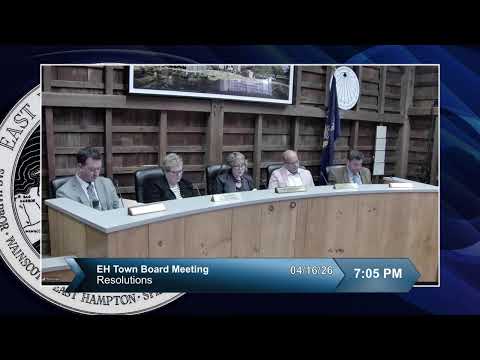
The East Hampton Town Board read a public notice April 16 to consider adding a local property-tax exemption for newly created accessory dwelling units, then heard detailed legal concerns from a remote participant.
A caller who identified himself as David Buddha of the Springs told the board the draft local provision is “incomplete, imprecise, incorrect or otherwise needs to be clarified” so the exemption is not misapplied to properties the state did not intend to benefit. He urged the town attorney to review state language and administrative guidance before adopting the local option.
Buddha cited New York State Real Property Tax Law §421‑p and associated state guidance and forms, noting the state application (Form RP‑421‑P ADU) requires a property owner to affirm that, “prior to the creation of the accessory dwelling unit, the property was a residential building that was designed and occupied exclusively for residential purposes by not more than 2 families.” He said the town’s draft ordinance should explicitly require owner-occupancy and that the preexisting structure be used primarily for residential purposes to match the state statute and guidance.
“The proposed town tax code provision fails to incorporate this aspect of the state real property tax law,” Buddha said, urging the board’s attorneys to review the cited references before the town adopts the exemption in its present form.
Supervisor Kathy Brooke Gonzales acknowledged the comment and explained the process: a resolution on the floor sets a public hearing date and opens the public record; the board then scheduled a public hearing for May 7, when additional submissions will be accepted and recorded. No formal vote to adopt the exemption was taken at the April 16 meeting.
Next steps: the board will hold a public hearing on the proposed ADU tax exemption on May 7; the town clerk and town attorney will receive written comments submitted before that hearing, and members of the public may testify at the May 7 meeting.