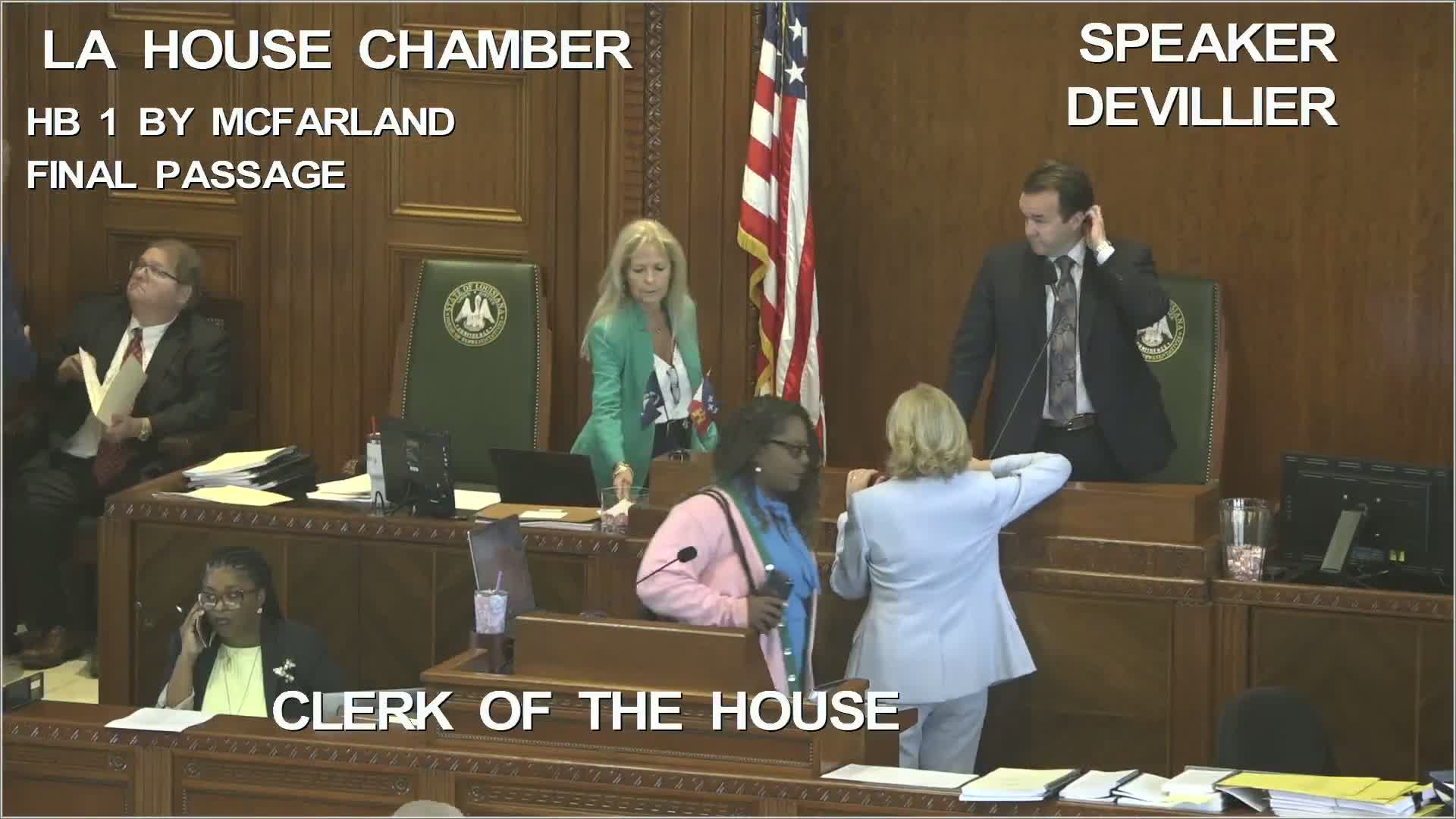
Louisiana House passes $45 billion general appropriations bill and advances capital and bond package
Loading...
Summary
The Louisiana House on April 15 passed House Bill 1, the general appropriations measure for fiscal 2026–27, approving budget allocations including retirement payments to LASERS, early childhood funding, and education and workforce investments; the House also approved companion capital and bond bills.
The Louisiana House of Representatives voted on April 15 to finally pass House Bill 1, the state’s general appropriations bill for fiscal year 2026–27, after resolving the measure in the Committee of the Whole and considering schedules for individual departments. Representative McFarland (the bill sponsor) moved for final passage; the clerk recorded 104 yays and the bill was declared finally passed.
The budget, which the sponsor described as “fiscally responsible,” funds core state operations and includes targeted additions and one-time allocations. Key items the Appropriations Committee highlighted include a constitutionally required deposit of $144,300,000 toward the Louisiana State Employees’ Retirement System (LASERS) to address the unfunded accrued liability; $420,000,000 for early childhood education; $87,000,000 for the LA Gator scholarship program; $75,000,000 for LED’s high‑impact jobs program; and $23,000,000 for FEMA-related hurricane Katrina debt payments. Representative McFarland told colleagues that the LASERS deposit and other amendments generate projected aggregate savings and strengthen the state’s fiscal outlook.
Committee amendments adopted during schedule-by-schedule consideration also adjusted several departments. The Department of Health’s budget was presented at $23.5 billion (a net decrease driven largely by removal of carryforwards) while adding funding for 750 community choice waiver slots and newborn/postpartum home health visits. The Department of Transportation and Development’s budget was reported at $826 million, with committee adjustments to support Cameron Ferry operations. The Department of Veterans Affairs saw an increase tied to disability claims and recruitment/retention efforts.
In explaining the package, Representative McFarland said the committee used a mix of surplus recognition, reallocated capital funds and re‑prioritized existing appropriations to fund member projects and one‑time investments without broad growth in recurring state spending. "When you take all of this into account, this is a fiscally responsible budget," he said during the presentation.
The House also approved related measures sent as special orders alongside HB1: a capital outlay bill (House Bill 2), an omnibus bond authorization (House Bill 3) to fund capital projects, and a suite of supplemental and funds bills that allocate recognized surplus and transfer monies among treasury accounts. Those measures passed on final passage in the same session (see “Votes at a glance” below).
The bills now proceed under the legislative process toward the Senate and any further conference or technical amendments. The House recorded final passage on HB1 at the April 15 session and reported the enacted committee amendments.
Votes at a glance: House Bill 1 (general appropriations) — final passage: 104 yays (final passage reported by the clerk). House Bill 2 (capital outlay) — final passage: 102 yays. House Bill 3 (omnibus bond authorization) — final passage: 104 yays. Other related funds and supplemental bills passed by similar recorded margins during the same session.
What’s next: The measures will continue through the legislative process (Senate consideration and, if necessary, conference). Staff and committee members noted they would circulate amendment lists and follow up on technical items as the bills move forward.