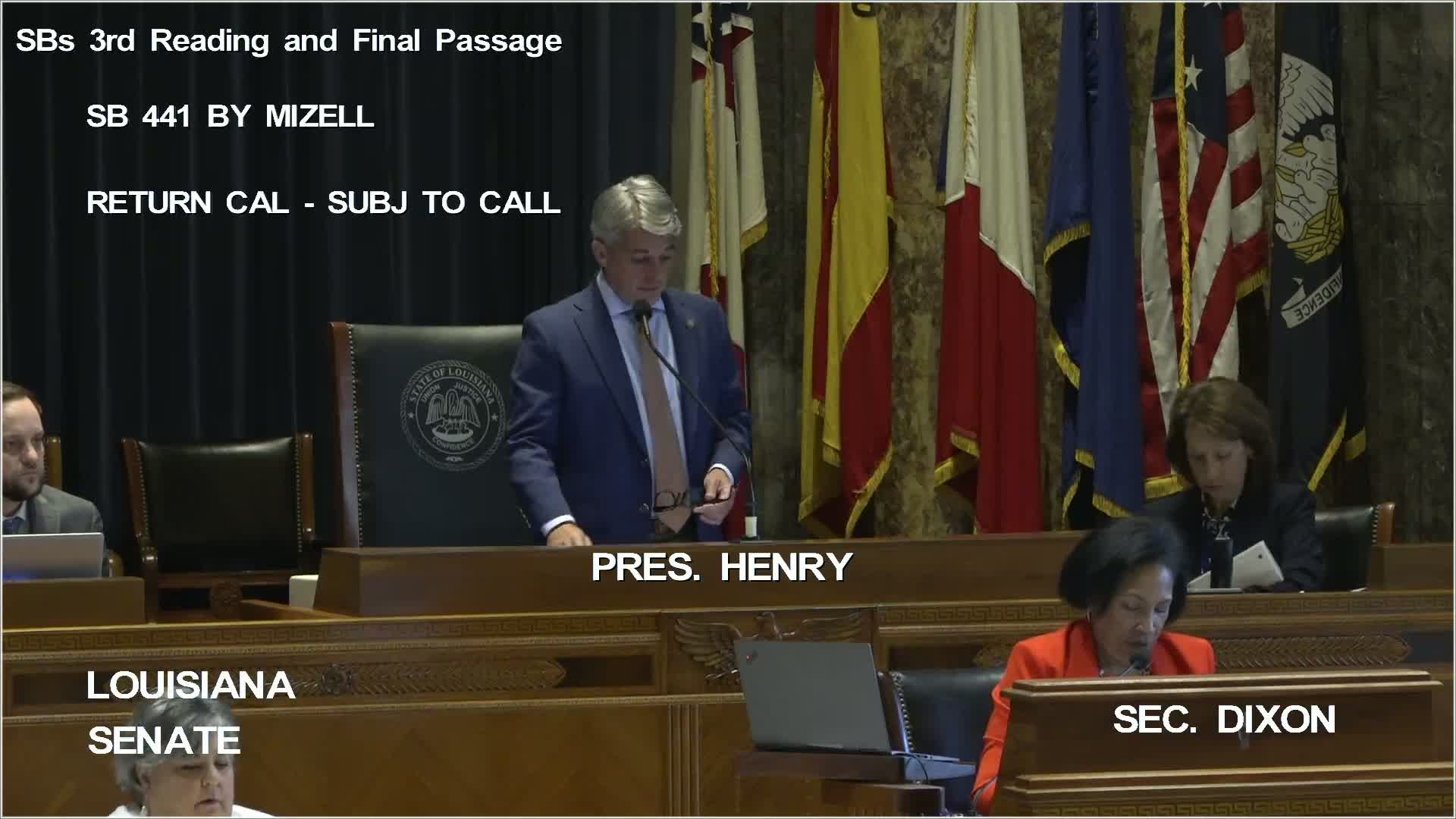
Senate passes bill to consolidate Orleans Parish civil and criminal clerk offices after heated debate
Loading...
Summary
The Louisiana Senate passed Senate Bill 256 to combine Orleans Parish’s civil and criminal district court clerk offices amid a contentious floor debate over timing, local election results and projected savings; the measure passed 25–11.
The Louisiana Senate on April 8 approved Senate Bill 256, a measure to consolidate the civil and criminal district court clerk offices in Orleans Parish into a single clerk, after extended debate and several failed amendments. Sponsor Senator Morris said the bill aligns Orleans with other parishes and could reduce the state and local funding burden.
Senator Morris, the bill’s sponsor, told colleagues: "I think this bill is important to move forward to combine these offices like everybody, everywhere else in the state." He said consolidation would create a single judicial expense fund and allow the combined office to cover criminal-court expenses without the city shouldering as much cost.
Opponents pressed on timing and local democratic choice. Senator Pluss said on the floor, "This is wrong," arguing the change would remove a clerk elected by Orleans voters and risk operational problems without a clear transition plan. Senator Bourgeault, speaking in opposition, said the vote disrespected the choice of Orleans voters and pressed for more deliberation.
The floor considered multiple amendments. An amendment to delay the effective date to allow the newly elected criminal clerk to serve failed on a roll-call vote. A second amendment that would have preserved a 50/50 funding split also failed. Supporters said audits and comparisons with other parishes show operating-cost disparities that consolidation could address; critics said fiscal notes were indeterminate and that savings were not demonstrated.
The bill’s text, as read on the floor, makes the civil district court clerk the surviving officeholder and consolidates related fees and the judicial expense fund. Senators discussed implementation issues including case-management systems and staffing; sponsors said clerks could retain existing systems if needed and could hire staff to manage transitions.
The Senate recorded 25 yeas and 11 nays on final passage. The sponsor moved to re-refer or reconvene as allowed under the rules; the bill moves to the next procedural step per chamber rules.