House committee advances HB 2, adopting amendments and scheduling special order for April 16
Loading...
Summary
A House committee advanced House Bill 2, the comprehensive capital outlay budget, adopting an amendment set and approving a schedule to make the bill special order on April 16; committee leaders described bundling and targeted trims to free funds for member projects.
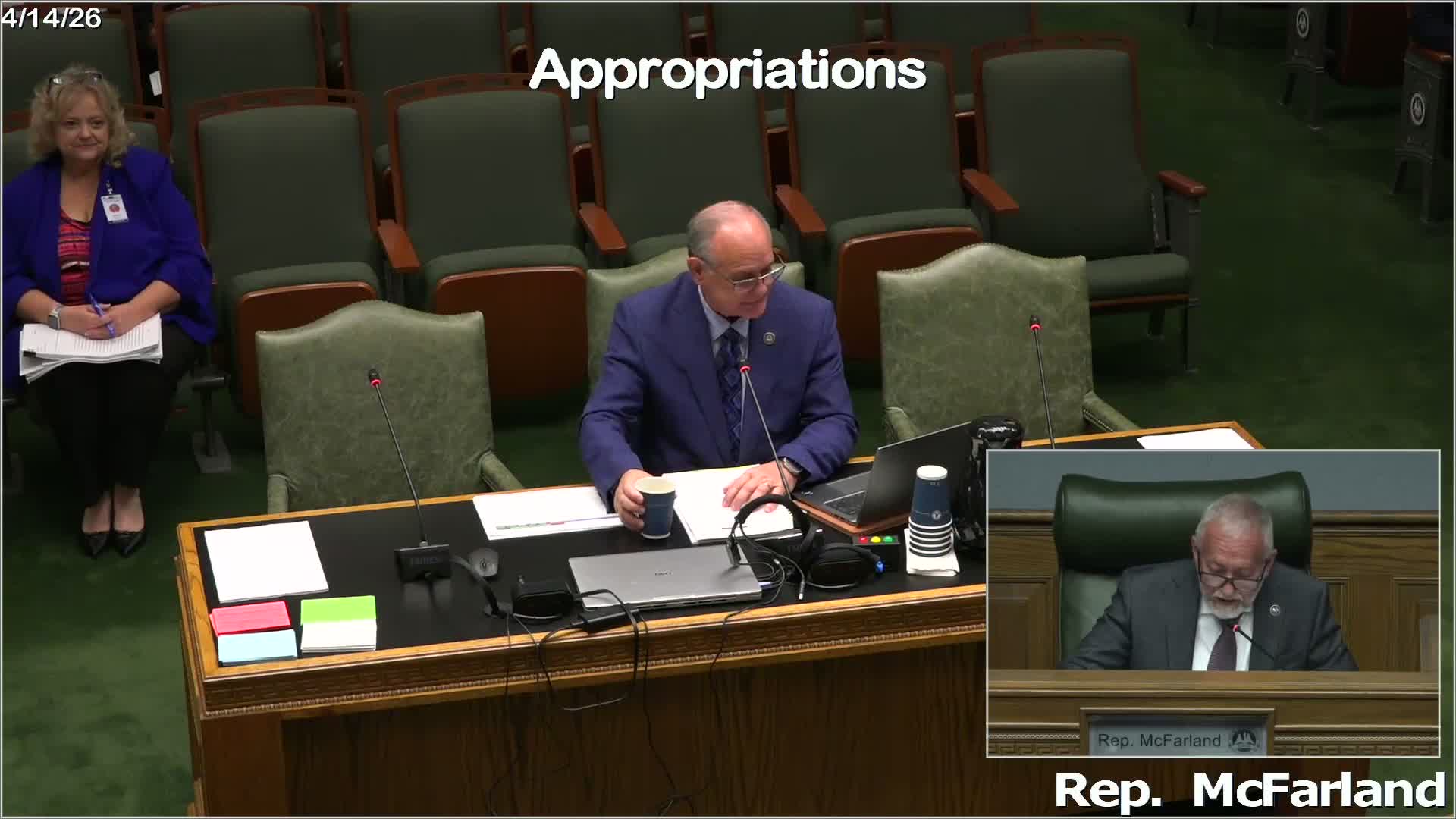
A House committee advanced House Bill 2, the comprehensive capital outlay budget, adopting an amendment set and setting the bill as special order No. 2 for April 16, the chair said.
Chairman Bacalar, author of HB 2, told members the bill combines multiple funding lines — including bond capacity and state general fund nonrecurring (surplus) dollars — and is focused in this session on state general fund direct appropriations. “HB 2 has several lines of funding, the first being the bond capacity, the second being, surplus funds from the or half the surplus funds from last year,” Bacalar said, describing the bill’s structure and the committee’s approach to reallocating one-time dollars.
Bacalar gave headline figures for the package, saying the bond capacity for the year is $574,000,000 and that the state general fund nonrecurring surplus available was about $288,536,935. He said the governor’s executive budget had spent large portions of those sums, leaving “about a little less than $19,000,000 available for us, to add or projects.”
The chairman told the committee the panel scrutinized P1 (first-year) requests and trimmed allocations where projects historically use only a fraction of their first-year allotment. “It looks like typically only about 60% historically has been used in that year,” Bacalar said, explaining why the committee reduced some P1 amounts and reallocated money.
Bacalar also described a bundling strategy for university and other projects to allow partially funded projects to move forward without waiting a full year for reauthorization. He cited examples of campuses included in the approach — LSU Baton Rouge campus, Southern University Baton Rouge campus and UL Lafayette — and DOT project lines. “We’re going to put those all together with 1 funding for the all the projects,” Bacalar said, arguing the change gives projects flexibility and can reduce delays caused by narrowly funded line items.
The chairman said the committee’s work produced roughly $15,000,000 in member projects, about $393,000,000 in bundling that will save money over time, and the use of roughly $65,000,000 in P2 funds and dormant projects to fund moving member requests. “So I'm available to answer any questions. That's just kind of a high level overview,” he said before members considered the amendment set.
The clerk read amendment set 3,727, which the committee packet included along with a parish-sorted spreadsheet that members could use to locate specific changes. Vice Chairman Durang moved to adopt the amendment set; the chair called for objections and, seeing none, declared the amendment adopted.
Representative Barrault asked whether the roughly $1.48 billion in member project requests that Bacalar referenced represented House-only requests or included the Senate. “On the 1.48, I think that you said a member requests, billion in member requests, was that just the house or that was house and senate?” Barrault asked. Bacalar replied the figure referred to House members (he said a few senators crossed over but estimated about 95% was House requests).
A motion to report House Bill 2 favorable with the adopted amendments was made and carried by voice; the committee then voted by voice to make HB 2 special order No. 2 for April 16 and authorized staff to make any necessary technical corrections to adopted amendments. Representative Woods moved to adjourn and, with no objection, the chair adjourned the meeting.
The transcript records these decisions as having passed by unanimous voice (“seeing no objection”); no roll-call vote tallies were recorded in the provided transcript.