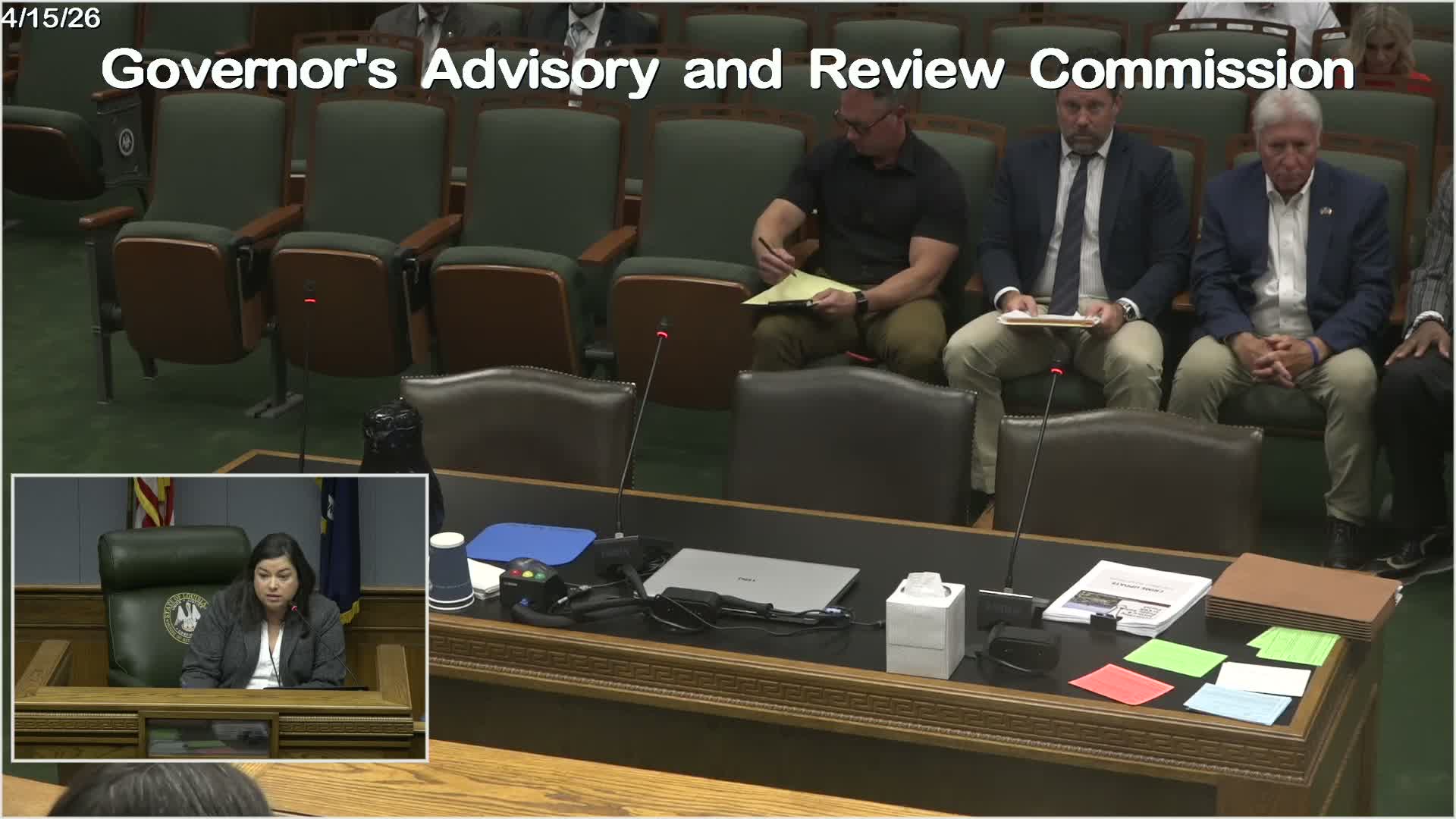
Commission endorses request for 164 state-funded assistant district attorneys
Loading...
Summary
The governor's advisory commission voted unanimously to endorse a Louisiana District Attorneys Association recommendation to request 164 state-funded assistant district attorney warrants, after DAs from St. Tammany, East Baton Rouge and Caddo parishes detailed severe staffing and pay gaps.
The Governor's Advisory and Review Commission on Assistant District Attorneys voted unanimously to endorse a Louisiana District Attorneys Association (LDA) recommendation asking the Legislature to consider 164 additional state-funded assistant district attorney (ADA) warrants.
Zach Daniels, executive director of the Louisiana District Attorneys Association, told the commission the association combined objective metrics and district attorney input to build a formula intended to reflect different jurisdiction sizes and operational needs. "If you take population alone and you use census data, you're ignoring transient population like tourism, temporary workers," Daniels said, urging a blended approach that includes violent-crime caseloads, civil representation and courthouse counts.
Daniels said two charts in the report — one based on data from roughly 60% of offices and a second that added DA-provided context — led to a recommended statewide range "between 120 [and] 164 warrants." He asked the commission to discharge its statutory duty to assess need and forward the recommended request to the Legislature.
Several district attorneys described local pressures that, they said, make additional warrants necessary. Colin Sims, district attorney for the 20th Judicial District (St. Tammany Parish), cited rapid population growth and local funding cuts he said amount to about $3.5 million in reductions (including $1.8 million already taken and at least $1.5 million more scheduled). Sims said his office handles about 3,150 felony defendants annually and had roughly 280 major pending trials at the time of his remarks.
Hilla Moore, East Baton Rouge Parish district attorney, said her office cannot recruit at the current state "warrant" pay level. "To pay for one at $50,000 we had to put up $30,000 additional for health care benefits and other benefits, so it cost us 80," Moore said, describing staff losses to higher-paying state and federal employers and high law-school debt among recent graduates. Moore said the formula called for 23 warrants for her office but she requested 25 because of backlogs and said that, fully staffed, she would need 35 more ADAs.
Moore also asked the commission to consider raising the state warrant amount from $50,000 to $60,000 to improve recruitment and retention. She and other DAs said competing employers — including the U.S. Attorney's Office and an attorney general's office — routinely offer $30,000 to $40,000 more in starting pay.
James Stewart, Caddo Parish district attorney, told the commission his office has been unable to attract applicants and has lost assistants to federal positions paying substantially more; he described heavy trial workloads and increased operational costs for technology and evidence management that squeeze salary budgets.
Commissioners asked practical questions about whether offices still split warrants (part-time or "half" warrants). Responses varied: some offices use split warrants; others do not, and several witnesses said the practice is uncommon but more widely allowed after recent rule changes.
After discussion, a commissioner moved to accept the LDA recommendation as presented in the report's charts; another commissioner seconded. The motion passed unanimously. Chair Orange Lake Friel noted the endorsement allows the Legislature to "entertain this issue" but does not bind legislative discretion.
The commission discussed whether to reconvene and then adjourned. The endorsement sends the association's recommendation — including the LDA's combined objective/subjective formula and the request for 164 warrants — to the Legislature for consideration.