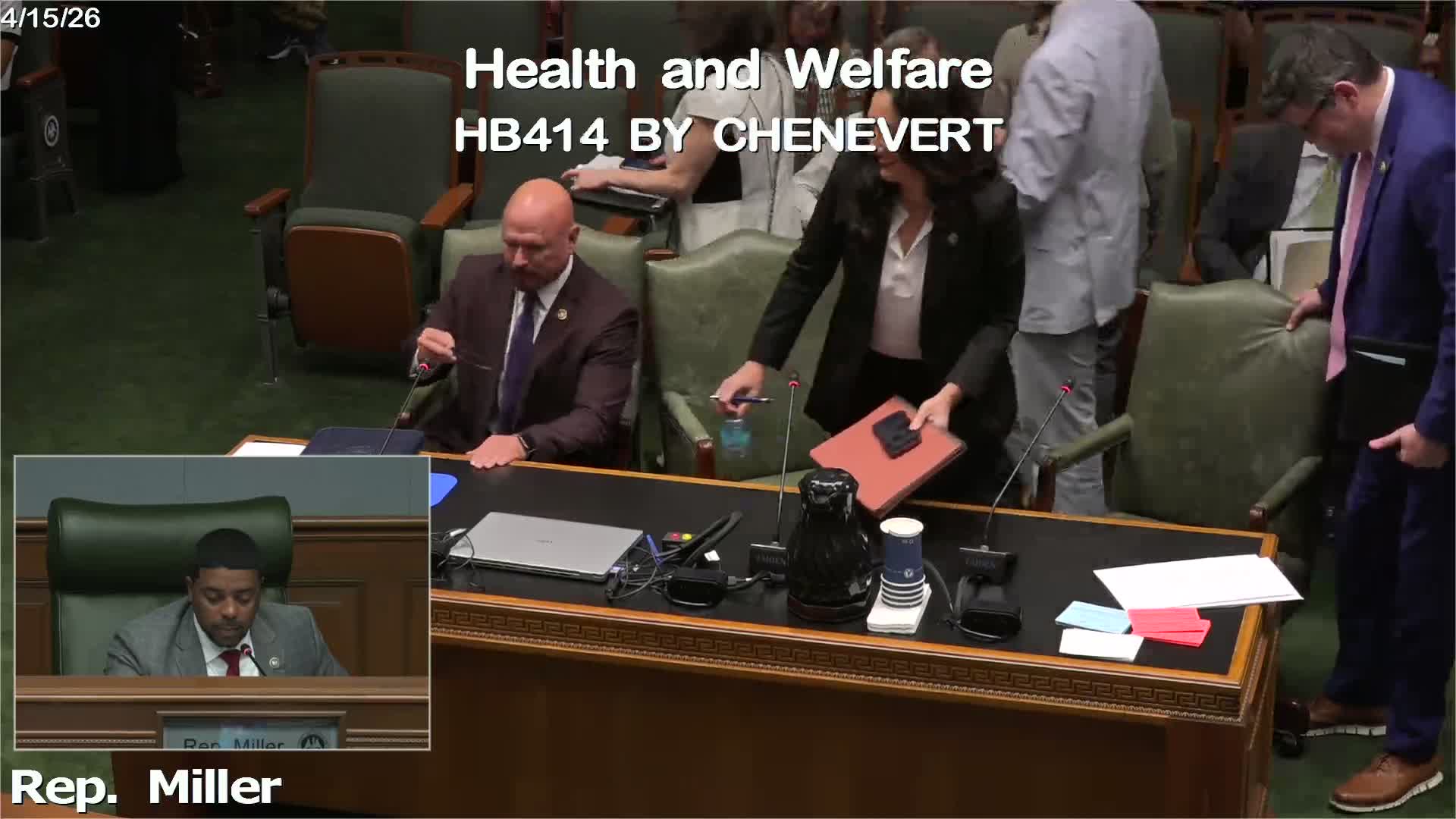
House Health & Welfare advances a package of health bills, including background‑check, audit and child‑protection measures
Loading...
Summary
On April 15 the committee reported several bills favorably with amendments: HB 4 14 (tightened hiring rules for certain health‑care positions), HB 7 86 (prohibiting MCO extrapolation in provider audits), HB 10 52 (confidentiality for Child Advocacy Centers) and HB 11 18 (disclosure of certain hospital–REIT agreements); stakeholders said they will continue to refine language.
The House Health and Welfare Committee advanced multiple bills on April 15 addressing hiring, payment audits, child‑protection record confidentiality and hospital financial transparency.
Background checks and hiring (HB 4 14): Representative Shinnevair presented a bill to clarify that convictions in other states that are substantially similar to listed Louisiana offenses should bar hiring for certain direct‑care roles. Larry Freeman, chief deputy attorney general, said the measure closes a gap that allowed individuals convicted elsewhere to be hired in Louisiana roles that would be prohibited if convicted here; Matthew Stafford (Medicaid Fraud Control Unit) described ongoing prosecutions in which out‑of‑state records created enforcement challenges. The committee adopted amendments narrowing definitions and exempting licensed ambulance personnel; it reported the bill favorably.
Prohibiting extrapolation by MCOs (HB 7 86): Representative Egan asked the committee to bar managed‑care organizations from using statistical extrapolation to estimate audit recoupments from providers; an amendment makes clear LDH and the Attorney General may still use extrapolation in official fraud investigations. Hospitals and providers said they fear unconstrained extrapolation could produce inappropriate large recoupments without proper guardrails; the committee reported the bill favorably with the committee amendment.
Child Advocacy Center confidentiality (HB 10 52): Representative Veil told the committee the bill protects CAC and multidisciplinary team work product — forensic interviews, medical exams, advocacy notes — from broad civil subpoenas while preserving court access when legitimately needed. Kimberly Young (Louisiana Alliance of Children's Advocacy Centers) and Tanya Haas (Baton Rouge CAC) described costly subpoenas that have diverted funds away from services; the committee reported the bill favorably with amendments to preserve court access and constitutional rights.
Hospital–REIT transparency (HB 11 18): Representative Fisher introduced a disclosure measure prompted by problems at a specific hospital (Glenwood). The bill would require reporting of certain lease and REIT arrangements so LDH can identify facilities at risk; proponents cited national research showing higher closure rates at some REIT‑structured deals. Hospital leaders warned that public release of proprietary terms could chill investment, and the author agreed to continue working with stakeholders on narrower, LDH‑only disclosure language before floor consideration. The committee reported the bill favorably with the understanding parties will seek compromise language.
What’s next: All of these bills were reported favorably with amendments; staff and sponsors said they will continue negotiations on language, particularly for the REIT disclosure bill, before floor action.