Get Full Government Meeting Transcripts, Videos, & Alerts Forever!
Get email alerts on the Municipal Budget topic
No spam. Unsubscribe anytime.
First Selectman presents $541 million five-year capital plan and outlines tax, school and safety priorities
Summary
The First Selectman outlined a proposed 2026-27 operating budget and a roughly $541 million five-year capital plan focused on school facilities, public safety equipment and waterfront projects, saying limited state and federal aid pushes more reliance on property tax revenue and private fundraising.
The First Selectman presented the Town of Greenwich's proposed 2026-27 operating and capital budgets and said the administration is proposing about $541,000,000 in capital projects over the next five years to address aging infrastructure.
The presentation, delivered at Greenwich Town Hall, emphasized balancing three funding approaches: pay now (higher tax bills), spread payments (preserve mill rate but higher overall cost) or defer (most expensive long term). "If you spread them out a couple years, you maintain that low mill rate," the First Selectman said, arguing that modest spreading can keep projects on a reasonable timetable while limiting sharp tax increases.
Why it matters: the town faces lower state and federal aid and higher fixed charges (including health-care increases), creating pressure to rely more on property tax revenue or private fundraising to complete capital work.
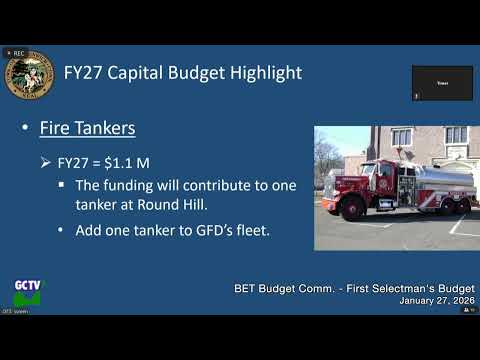
Key projects and costs described by the First Selectman include: $600,000 proposed in FY27 to rehabilitate aging island beach/ferry boats the town operates; a $1,100,000 apparatus purchase split between Round Hill and Banksville and a new town-owned tanker to be stationed at Round Hill; and continued ADA and building upgrades across public works, parks and schools. He said the town has proposed $4,000,000 for design and A&E on a Greenwich High School pool project that could push total construction costs above $55,000,000 and that an administration/Havemeyer building renovation option carries an estimated $26,000,000 construction cost plus $1,800,000 in design.
On the Dorothy Hamill Rink, a committee and task force led by Bill Drake and Matt Deschamps recommended a full flip/rebuild as the most cost-effective option to preserve ice time and improve energy efficiency. The First Selectman said private donors and foundations have signaled interest in helping reduce a $10,000,000 town estimate for that project and described potential naming opportunities.
Budget drivers and personnel: the town noted fixed charges are a major upward pressure (health care up ~13%, insurance up ~8%). The First Selectman said state and federal aid has declined by almost 30% for the town, while property-tax revenue is projected to rise nearly 7%. Proposed personnel changes include adding three full-time positions (finance, library, police), eliminating 2.65 full-time equivalents elsewhere, and adding roughly 5.25 part-time equivalents (about 4.1 of which were identified for Nathaniel Witherell).
Tax impact and next steps: the First Selectman reported the proposal slightly exceeds the BT guideline by roughly 0.17—30.25% and described an overall budget change of approximately $960,000 (about 0.18%). He offered an example: an average taxpayer with a $1,000,000 assessed home may face an estimated $724 increase. The presentation concluded with the reminder that the BET will review the plan and the Board of Education was scheduled to present next.
Quotes: "69% of people are satisfied with the services provided by Greenwich," the First Selectman said, citing the town's contracted resident satisfaction survey. He also warned that "deferring these projects...passes along the obligations and responsibilities to future residents," paraphrasing a point attributed to Port Chester village manager Stuart Rabin.
The board did not take any formal votes during this presentation; the First Selectman turned the meeting to the Board of Education for its capital presentation.