Get Full Government Meeting Transcripts, Videos, & Alerts Forever!
Get email alerts on the Education Budget topic
No spam. Unsubscribe anytime.
Greenwich Board of Education presents FY27 operating budget, flags transportation and contractual cost pressures
Summary
The Greenwich Board of Education presented its FY27 operating budget to the Board of Estimate and Taxation, citing recovery from COVID learning loss, rising special‑education enrollments and $7.5 million in combined pressures from contractual salary increases and transportation costs.
Mike Mercani Anthony, chair of the Greenwich Board of Education, opened a budget presentation to the Board of Estimate and Taxation by saying the board’s Fiscal Year 2027 operating proposal is built to ‘‘support the achievement and potential of every individual student’’ rather than to chase guideline percentages.
Mercani Anthony said Greenwich is among the few districts in the state to ‘‘pretty much eliminate the learning loss’’ from the COVID‑19 pandemic, with test scores at or above pre‑COVID levels in most grades. He credited teachers, staff, students and families for the recovery.
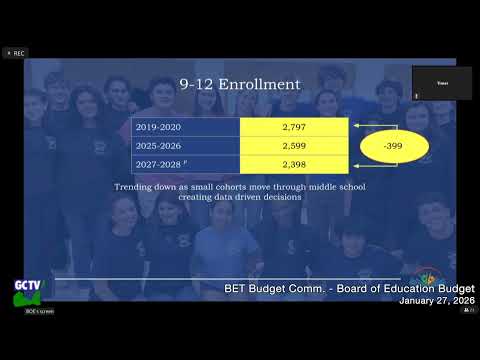
Dr. Jones, introduced by Mercani Anthony as a presenter, provided demographic and enrollment detail, saying roughly 11,000–12,000 children live in Greenwich and about 75% attend public schools. He said district diversity has increased to about 41.2 percent and that kindergarten cohorts are rising while middle‑ and high‑school cohorts have declined. Dr. Jones described enrollment projections prepared by an outside demographer with stated accuracy of about 98.3 percent for short‑term forecasts.
Dr. Jones told the BET that 76 percent of the operating budget is dedicated to salaries and that administration represents approximately 2.9 percent of spending. He highlighted program outcomes: AP exam participation rose by 35 percent even as high‑school enrollment fell, and 97.38 percent of AP exam takers scored a 3, 4 or 5 last year. He also said the district achieved 10 schools of distinction in the most recent reporting period.
Both presenters identified two principal cost pressures for FY27. Dr. Jones said contractual salary increases and higher transportation costs together accounted for about $7.5 million of the budget build; he described transportation expense as having risen by about 18 percent. Dr. Jones attributed a portion of transportation spending to private‑school bus runs, which he said are required under Connecticut law.
The FY27 proposal reduces about 11.5 full‑time equivalent positions overall to reflect declining enrollment, and it trims the summer‑school line by roughly $500,000 due to program and staffing adjustments that district officials said allowed them to serve more students more efficiently. Dr. Jones also described continued investment in special‑education staffing (speech, OT, PT and special‑education teachers) after an action plan that raised identification by about 3.1 percentage points; he said that trend has begun to stabilize.
The board’s approved operating request for submission to the BET was reported as $198,382,430. Mercani Anthony said the board approved its operating proposal in December by a 7‑to‑1 vote and that detailed BET consideration will follow next week, when colleague Sophie Cohen will present for the board.
Next steps: the Board of Education’s FY27 operating proposal will be reviewed in full by the BET at scheduled budget hearings next week.