Get Full Government Meeting Transcripts, Videos, & Alerts Forever!
Get email alerts on the Voter Eligibility topic
No spam. Unsubscribe anytime.
Sponsor says initiative would codify U.S. citizenship as a voting requirement; counsel says it may not change law
Summary
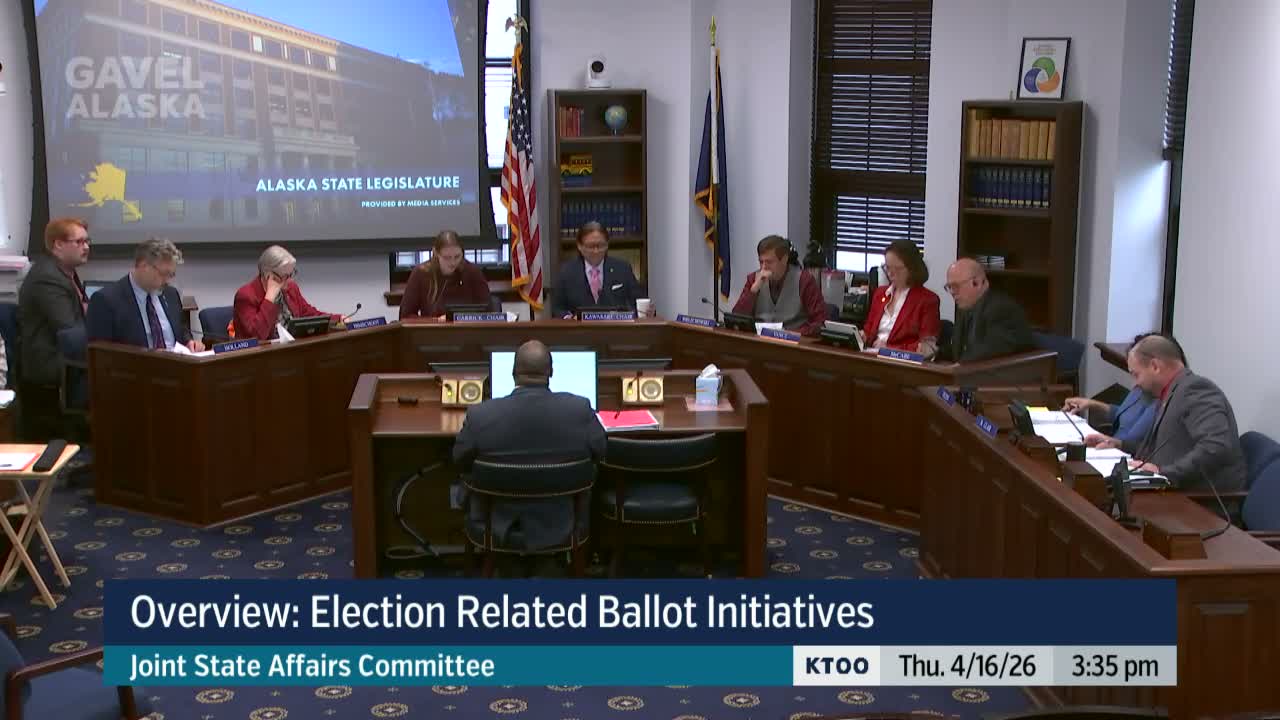
Former Sen. John Coghill told a joint House–Senate State Affairs hearing the "United States Citizen Voting Act" (25 USCV) would close a perceived textual ambiguity so only U.S. citizens may vote; legislative counsel said the measure likely would not alter state law and declined to opine on whether it clarifies the constitution.
Former state senator John Coghill told the Alaska House and Senate State Affairs committees on April 16 that the United States Citizen Voting Act (petition 25 USCV) would clarify that only U.S. citizens may vote in state and local elections.
"The point of 25 USCV is to close that door before it's pushed open," Coghill said, arguing the constitutional language "every citizen of the United States may vote" leaves room for courts to permit local noncitizen voting if the text is read expansively. Coghill cited litigation in other states and a local example involving American Samoan nationals to illustrate his concern and said the measure is intended to make the rule explicit in statute.
Committee members asked whether placing the language in statute would amount to the same effect as a legislative bill. Legislative counsel Alpheus Bullard told the committees he had reviewed the petition and did not believe the initiative would change state law. "I don't think that this initiative would change state law, at all," Bullard said, adding that he could not offer an opinion on whether the statutory wording would be helpful to voters when courts interpret the constitution.
Members pressed on the practical effects for communities such as American Samoan residents who identify as U.S. nationals. Coghill acknowledged those concerns and said he would welcome a way to accommodate community-specific status while still encouraging U.S. citizenship as the default for the franchise.
The hearing was informational; no committee action was taken. The committees heard this presentation as part of a sequence of three separately sponsored ballot initiatives that will appear on the November ballot unless the legislature enacts substantially similar laws beforehand.