Alaska Sustainable Energy Corporation outlines $4.7M DOE-backed loan fund and plans to connect $177M in project demand to capital
Loading...
Summary
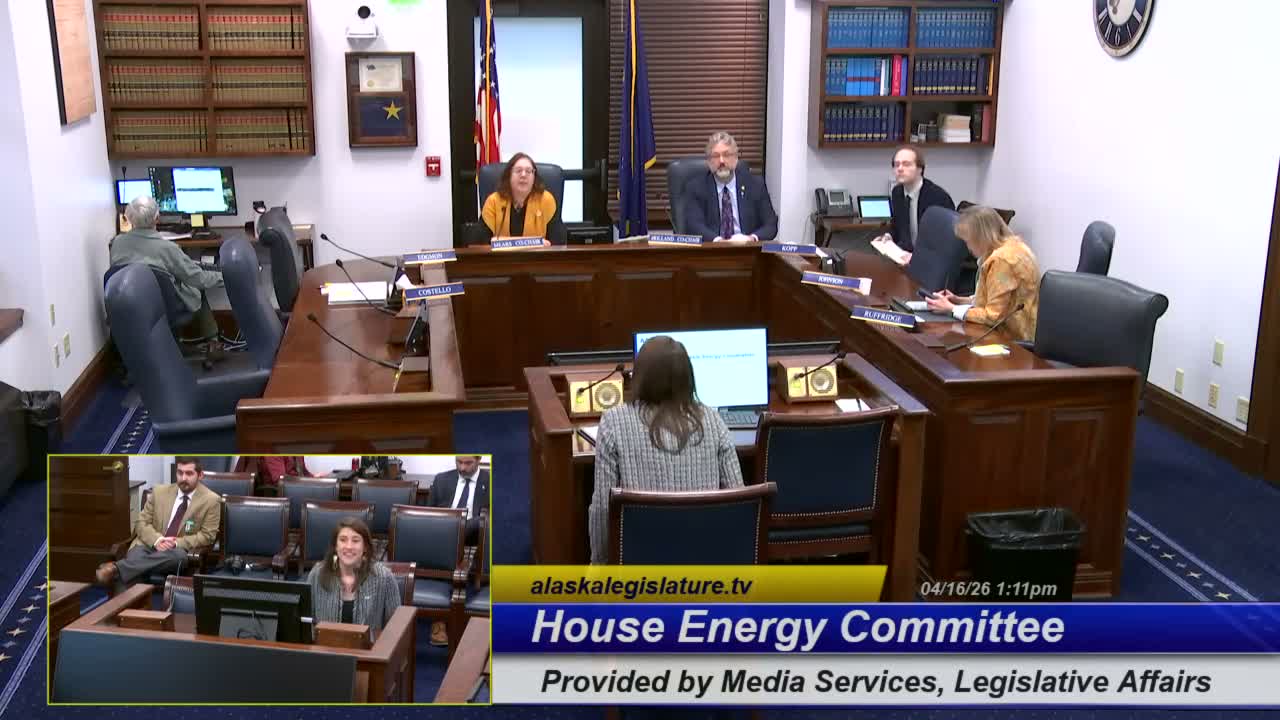
At a House Energy Committee briefing, ASEC director Melanie Lucas Conwell described the corporation’s role as a market connector, detailed an incoming $4.7 million DOE energy-efficiency revolving loan fund targeting residential loans, and cited RFI responses showing about $177 million in financing needs and $434 million in reported project size; lawmakers pressed for seed capital and a path to attract private investment.
The Alaska Sustainable Energy Corporation announced it will administer a $4,700,000 Department of Energy energy-efficiency revolving loan fund for Alaska, and presented RFI results showing roughly $177,000,000 in financing demand across projects totaling about $434,000,000, Director Melanie Lucas Conwell told the House Energy Committee on April 16.
Melanie Lucas Conwell, director of the Alaska Sustainable Energy Corporation (ASEC), told the committee: "We are receiving $4,700,000 to administer the Department of Energy's energy efficiency revolving loan fund program here in Alaska." She said the DOE funds target residential energy-efficiency upgrades identified through audits, with loan terms that "may extend up to 15 years depending on the useful life of those upgrades." Conwell said the program aims for a 2027 launch.
Why it matters: ASEC was created by legislation to close financing gaps for sustainable-energy projects that public or private lenders alone find hard to underwrite. Conwell framed ASEC as a market connector — a thin public actor designed to reduce transaction friction and make projects more financeable so private capital can participate.
At the committee briefing, Conwell summarized ASEC’s statutory authority, noting work under Alaska statute 18.56.086 and that ASEC was incorporated as a nonprofit subsidiary of the Alaska Housing Finance Corporation (AHFC) following House Bill 273, signed 07/31/2024. She recounted incorporation on 11/05/2024, an initial board meeting on 01/29/2025, and staffing milestones including her hire on 10/28/2024.
RFI findings and project types: Conwell said ASEC’s request for information returned limited but meaningful responses across the state. "The RFI showed substantial demand with financing needs reported at approximately $177,000,000 with total project size reported at about $434,000,000," she said. Respondents included tribal entities, community facilities, private developers and local governments. She highlighted examples ranging from solar paired with batteries (expensive in rural areas because of transport and labor), multifamily combined heat and power (CHP) projects, and an unexpected waste-to-energy submission in the Matanuska‑Susitna Valley.
Program design constraints: Committee members asked how ASEC differs from existing state actors such as the Alaska Energy Authority (AEA), AHFC and other lenders. Conwell said statute allows ASEC to support a broad spectrum of sustainable-energy projects but that which projects ASEC can actually finance depends on the restrictions of particular funding sources. She emphasized that the DOE revolving loan fund must operate through local lenders under grant guidelines, and therefore cannot be used directly for on‑bill financing under that program.
On residential PACER-type programs — property-assessed clean energy mechanisms — Conwell warned of consumer-protection concerns observed elsewhere. "I used to run the Anchorage PACER program," she said, and noted national examples where homeowners misunderstood liens, creating resale difficulties; she said no RPACER program currently exists in Alaska.
Lawmakers press on capitalization and strategy: Several legislators pressed ASEC officials about capitalization and ability to attract private-matching capital. Representative Edgemond questioned whether the hybrid model had succeeded in attracting private investment and contrasted ASEC’s progress with what a conventional "green bank" might have achieved. Conwell said that a key missing piece has been seed capital and that the DOE program represents ASEC's first federal seed funding to begin demonstrating a track record.
Asked what could be done with a hypothetical $10,000,000 seed allocation, Conwell said she would return with a detailed plan but suggested that loan guarantees or a loan-loss reserve could leverage public funds (she estimated illustrative leverage ratios of 10:1 or 20:1) by derisking deals for outside lenders rather than building full in-house origination capacity immediately.
Operational limits and next steps: Conwell told the committee ASEC currently operates with two staff members and relies on AHFC shared services for administrative functions; ASEC plans to rely on lenders for origination, underwriting and servicing while it focuses on market-building, deal structuring and education for project owners and capital providers. She said ASEC has been pursuing multiple funding opportunities (including about $21,000,000 in federal grant applications during a period of federal uncertainty) and will collaborate with AEA and project owners once REF/RAF determinations are made to identify additional capital pools.
Committee reaction and follow-up: Lawmakers asked ASEC to analyze RAF/REF project lists and match them with RFI responses to identify near-term projects that could be made investable. Questions also touched on bonding authority, with Conwell saying ASEC is legally separate from AHFC and could issue bonds in the future but would likely need a track record before entering capital markets.
The committee is scheduled to hear from the Regulatory Commission of Alaska next week and to hold a supply-chain and energy discussion the following Thursday. The House Energy Committee adjourned at 02:14PM.