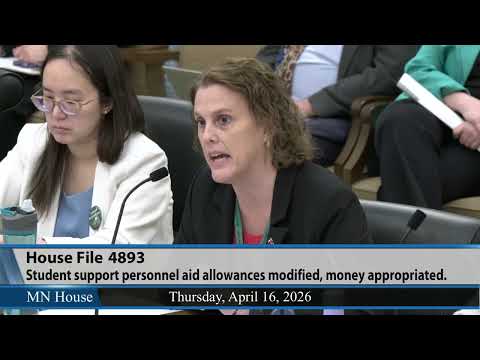
Committee debate over mandates, funding ends with failed bid to move HF 4893 on school safety
Loading...
Summary
House Education Committee members debated House File 4893 — a layered school-safety package that would require anonymous threat-reporting systems, tighten firearm storage rules on school property and boost student-support personnel funding — but the committee failed to secure the 13 votes needed to refer the bill to Ways and Means.
House File 4893, a multi-part school-safety proposal that would require anonymous threat-reporting systems, impose uniform safe-storage requirements for firearms on school property and raise student-support personnel funding, failed to advance out of the House Education Committee after members split over mandates and funding.
The bill’s chief author (for the record identified in the hearing as Chair Joaquin) described HF 4893 as a three-layer approach: increase investments in counselors, social workers and other student-support personnel; require evidence-aligned school-safety plans and anonymous threat-reporting systems; and adopt uniform safe-storage rules for firearms on school property and in vehicles. The sponsor argued these changes are evidence-based and can be implemented without shifting recurring K–12 base funding.
Students and advocacy groups gave testimony in support. Anushka, a senior at Edina High School, told the committee that firearms are frequently stolen from vehicles and that safe storage and reporting requirements would help protect students. Elvie, a senior testifying in support, urged removal of principal exceptions that allow unknown individuals to carry firearms on school grounds and cited research tying safe-storage laws to reductions in gun deaths and thefts. "Safe storage is an essential start," Elvie said.
Education Minnesota’s Caitlin Snyder, speaking also as a representative of the Minnesota School Counselors Association, endorsed the bill and described the proposed increase in the student-support personnel allowance as roughly a 10% per-student rise in the aid rate. Anne Weiss, executive director of the Minnesota Association of Independent Schools, urged changes to section 5 so private schools retain necessary local authority and operational flexibility. Alexandra Fitzsimmons of the Children's Defense Fund Minnesota described HF 4893 as a flexible, evidence-based addition to broader gun-violence prevention work.
Members pressed a mix of concerns. Several legislators said the bill’s mandates could impose unfunded obligations on districts; others said the bill does not go far enough to cover every school and student (including tribal and nonpublic schools) or lacks the larger funding package some members prefer. Representative Bennett and others asked where the money would come from; House fiscal staff provided a cost estimate for the student-support personnel provision of about $2.97 million in fiscal 2027 and a cleanup payment of $330,000 in fiscal 2028.
At the conclusion of the hearing, Chair Joaquin renewed a motion to re-refer HF 4893 to the Committee on Ways and Means. The committee proceeded to a roll-call vote; supporters fell short of the 13 votes needed to move the bill out of committee and the motion failed. The sponsor and several members said discussions would continue as the session proceeds.
The committee hearing record shows robust support among testifiers for layered prevention measures while members remain divided over scope, mandates and funding. The bill’s next steps will depend on whether authors and stakeholders can reach compromises on coverage for nonpublic and tribal schools and on funding sources.