Get Full Government Meeting Transcripts, Videos, & Alerts Forever!
Get email alerts on the Education topic
No spam. Unsubscribe anytime.
Ways and Means advances multiple education and student-record bills; one bill held, one withdrawn
Summary
The House Ways and Means Committee moved several education-related bills forward — including changes to GED pathways, school transcript rules and teacher-screening timing — held one measure and withdrew another. Most measures passed on voice votes after amendments.
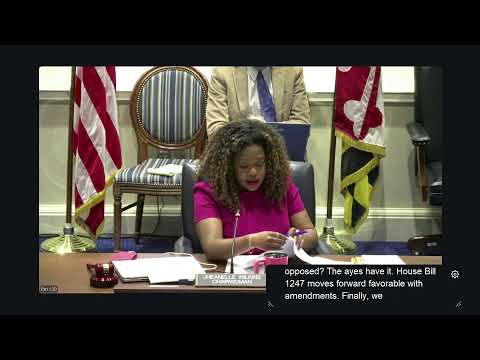
The House Ways and Means Committee convened a voting session chaired by Janelle Wilkins and advanced a slate of education and school-record bills, holding one bill for later consideration and withdrawing another.
Delia Ebersole, speaking during committee debate, said House Bill 297 "establishes two new GED programs" and described the adopted amendment that removes the GED-option pilot and leaves the "MD diploma works" pathway for adults without a high-school diploma. That pathway, as described in committee, allows an adult to earn a GED through industry-recognized credentials, demonstration of foundational academic skills, career-and-technical coursework and on‑the‑job learning. The amendment was adopted by voice vote and HB 297 was moved favorable with amendments.
The committee also unanimously advanced House Bill 355, which requires age-appropriate middle-school instruction on abuse and assault prevention to include material on human and sexual‑trafficking awareness and prevention. Delegate Eversall presented the measure and the committee forwarded it without recorded opposition.
On student records, Ebersole said House Bill 505 would require a receiving public or nonpublic elementary or secondary school to accept unofficial academic records for enrollment when a sending school refuses to provide official records due to a dispute. The amendments narrowed acceptable evidence to an unofficial transcript, a report card provided by the student, relevant standardized-test scores and unofficial AP or IB examination results; the amendment was adopted and the bill moved favorable with amendments.
House Bill 534, introduced to bar nonpublic schools that participate in state-funded programs from refusing to provide transcripts or conditioning transcripts on payment of a debt, moved forward favorable to the floor. The chair recorded several delegates as opposed on the voice vote (delegates Buckle, Miller, Long, Hartman and Griffith), but no roll-call tally appears in the transcript.
House Bill 856 was amended to change the date by which applicants and local systems must use an educator‑identification clearinghouse from Oct. 1 to Aug. 1 and to remove a requirement that an individual hold the appropriate license before interacting with children, instead placing responsibility on local systems to ensure applicants receive the correct license. The amendment passed and HB 856 moved favorable with amendments.
Chair Wilkins held House Bill 288 "without objection," and the committee voted to move House Bill 1328 "unfavorable as it is withdrawn," after which the chair confirmed the bill had been withdrawn.
Why it matters: the package affects pathways for adult learners, the documents schools must accept during student transfers, and the timing and administrative responsibility for educator screening. Several measures advance to the floor with amendments; the transcript does not include numeric roll-call tallies for most votes, only committee voice decisions.
Next steps: bills that moved favorable will be scheduled for further consideration on the House floor; HB 288 remains held and HB 1328 has been withdrawn by motion of the subcommittee.