Get Full Government Meeting Transcripts, Videos, & Alerts Forever!
Get email alerts on the Criminal Justice topic
No spam. Unsubscribe anytime.
Lawmakers debate House Bill 336 amendments that limit when court commissioners can issue arrest warrants
Summary
Legislators at a Judiciary Committee discussion heard that amendments to House Bill 336 would narrow when district court commissioners may issue criminal summonses and arrest warrants, require 72-hour review by a state's attorney for off-hours warrants, and add yearly reporting to the General Assembly; members pressed for more data and proposed a work group to study impacts on victims and wrongful arrests.
Members of the Judiciary Committee on Friday debated amendments to House Bill 336 that would change how and when district court commissioners may issue criminal summonses and arrest warrants.
Claire, who summarized the amended bill for the panel, said the changes would "limit the circumstances under which a district court commissioner may issue a criminal summons or an arrest warrant to an individual other than a police officer or a state's attorney." She told the committee that "if the commissioner issues an arrest warrant when the district court is not open for business, the state's attorney must review the case within 72 hours to determine whether to request that a judge of the district court or the circuit court recall the arrest warrant and issue a summons in its place." The amendments also would require the judiciary to report annually to the General Assembly on applications for statements of charges and arrest warrants and would restore existing law related to the crime of making a false statement to the government.
Lawmakers pressed for more and better data. Delegate Phillips told the committee that, according to the state's attorney in Baltimore City, "out of a a roughly 1,400 warrants that were served in 2025, 1,174 were were null they were not prosecuted." Phillips and others said the committee has not yet received a breakdown of those cases and asked for additional information on time-to-serve metrics and other details that could clarify whether non-prosecution reflects false allegations, procedural timing, or prosecutorial discretion.
Several members urged caution about unintended consequences. Delegate Carden praised the subcommittee's work but said perjury is difficult to prove and argued the system needs structural fixes rather than relying solely on prosecutions; Carden quoted Louis Brandeis, saying, "it's better to have 10 guilty people go free than 1 innocent person go to jail," and voiced support for summonses and on-scene police responses instead of off-hours arrests when possible.
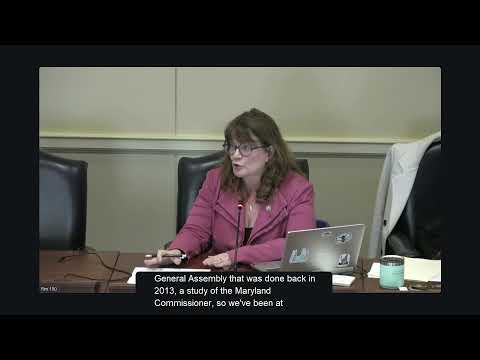
McComas told the committee that the proposal would alter a judicial function and urged a task force or study group to examine the change, noting the need to consult judges and police and to plan education if the change moves forward. Delegate Simpson reminded colleagues of a 2013 legislative study of the Maryland commissioner system and cautioned against focusing only on potentially false reports in cases such as domestic violence, urging safeguards for victims and alternatives to criminalization.
On procedure and timing, members questioned how many hours the off-hours arrest window actually represents given court schedules and weekends; the committee did not settle on a firm calculation during the session. Several lawmakers also asked whether a nonlawyer commissioner's probable-cause determination must be supported by outside evidence rather than by an applicant's allegation alone.
The committee did not take a vote Thursday. The chair said she would provide the committee with information about the training commissioners receive and supported forming a work group to study the issue further using more complete data. The discussion will continue after the legislature returns from the floor session.
The committee's next steps include additional data collection requested from jurisdictions, a possible work group to study commissioner practice and impacts on victims and defendants, and the chair's promised briefing on commissioner training.