Get Full Government Meeting Transcripts, Videos, & Alerts Forever!
Get email alerts on the Fisheries Management topic
No spam. Unsubscribe anytime.
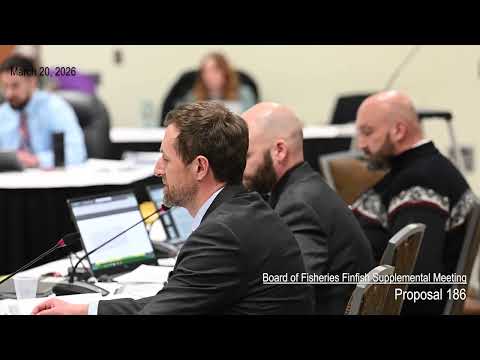
Board adopts RC 161 substitute for Proposal 186 to limit Central District drift gillnet fishing aimed at coho conservation
Summary
The board approved substitute language (RC 161) for Proposal 186 that restricts areas and timing of the Central District drift gillnet fishery, establishes a two‑mile inshore prohibition, sets a 16‑hour daily cap and Tuesday/Friday windows, and applies a temporary 3% trigger Aug. 1–15; the motion passed 4–2 with one recusal.
The board voted to adopt substitute language (RC 161) for Proposal 186 amending the Central District drift gillnet fishery management plan, a move proponents said is intended to improve conservation of northern‑bound coho salmon.
Colton Lipka, Cook Inlet regional management coordinator for commercial fisheries, told the board RC 161 would narrow the areas open to expanded Kenai and expanded Kasilof sections, limit daily fishing to a maximum of 16 hours, establish regular windows (identified in staff comments as Tuesday and Friday), and impose a two‑mile prohibition on drift gillnet fishing within two miles of the Kenai Peninsula shoreline. Lipka said the substitute also would change the late‑summer trigger from a 1% rule to a temporary 3% rule for Aug. 1–15 and tie additional fishing time to a Kenai River run strength threshold of 2,300,000 sockeye.
Why it mattered: staff warned that, if adopted, RC 161 would likely reduce harvest in state waters of the Central District drift gillnet fishery by an uncertain amount and thereby increase the number of salmon moving into the Kenai and Kasilof rivers and other freshwater systems. Lipka said that could, paradoxically, affect the department’s ability to meet certain sockeye escapement and in‑river goals under current management scenarios.
Proponent member Stenson argued the package is primarily conservation‑driven. “We need to get more silvers north in Northern Cook Inlet,” he said, noting long‑term declines in coho abundance and stressing that recent large sockeye runs and federal EEZ management have complicated state planning. Stenson placed nine specific revisions on the record, including eliminating some areas from state regulation, concentrating terminal harvests in high‑productivity sections, prescribing windows and regular fishing periods, increasing the trigger to 3% and combining state/federal catch for that trigger, and restricting gear nearshore to two miles.
Staff and members discussed scale and indicators. Lipka and other staff said the drift fleet’s mix of catches and genetic sampling indicate roughly 90% of coho caught by the drift fleet are northern‐bound stocks; staff estimated, as a rough calculation, that last year’s adoption of RC 161 could have reduced sockeye harvest by on the order of 1,000,000 fish depending on run timing and movement. Director Peyton noted 2024 sport harvest in all of Cook Inlet was about 4,400 coho and that Upper Cook Inlet shoreline harvests were much smaller (roughly 1,500), providing context for relative harvest magnitudes.
Process and concerns: Member Carpenter said he opposed acting on the substitute language at this meeting because the amended text arrived the morning of the hearing, which he said limited meaningful public comment on the substitute. Department of Law counsel advised the board that the substitute, as presented, did not appear to violate notice requirements and that the board could make findings to justify considering allocative effects under the ACR (administrative change request) process.
Amendment: Member Carpenter moved, and member Owen seconded, an amendment to clarify regular fishing periods to read 7 a.m. to 7 p.m. Monday and 7 a.m. to 7 p.m. Thursday (and related adjustments); the chair noted no objection and the amendment was adopted by unanimous consent.
Vote and outcome: On final action as amended the roll call was Godfrey No; Wood (recused and left the table); Chamberlain Yes; Irwin Yes; Carpenter No; Svensson Yes; Carlson Vandoor Yes. The motion carried, 4–2 with one recusal.
What remains unclear or next steps: staff and several commissioners said they would draft clarifying language for future Cook Inlet cycle discussion about how the commissioner could retain authority to remove fishing time from prescribed windows if necessary to meet in‑river or optimal escapement goals during a low run. The board moved on to Proposal 187 following the vote.