Get Full Government Meeting Transcripts, Videos, & Alerts Forever!
Get email alerts on the Legal Licensing topic
No spam. Unsubscribe anytime.
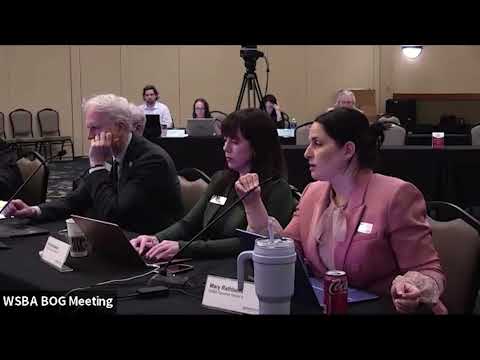
Governors push experiential pathway for bar licensure, set uniform 825‑hour supervision proposal
Summary
Board leaders described a plan to let candidates qualify for bar licensure through supervised practice and portfolio review rather than only the bar exam, proposing a uniform 825‑hour supervised-practice standard, portfolio requirements, and a July 2027 implementation target; questions on retroactivity and public outreach remain.
Governor Jordan Couch told the board that the proposed experiential licensure pathways are on track for implementation for the July 2027 licensing season and would operate as alternatives to, not replacements of, the bar exam. Couch said the board is moving toward a single, uniform supervision model that would require 825 hours of supervised practice across law‑school, APR 6 law‑clerk, and post‑graduation pathways.
The board would review portfolios submitted to the Bar Association as the basis for licensure decisions. Couch outlined portfolio requirements that would include two client interviews or counseling sessions, one negotiation exercise, demonstrated use of legal research tools, and evidence of competence in professional responsibility. Candidates must either pass the MPRE or submit three written responses to prompts developed by the WSBA on ethics; the program also would require CLEs on common stressors, caseload management, client privacy and data‑security issues, and at least 10 client‑facing supervised practice hours with contemporaneous timekeeping.
Couch said the proposal grew from multiple listening sessions and internal work to define nine core competencies the pathways must verify (understanding legal processes and sources of law; threshold concepts across subjects; professional conduct; legal interpretation; issue identification; legal research; applying authority to facts; lawyer communication; and effective client interaction). He framed those competencies as minimum thresholds distinct from broader ‘‘good’’ competencies.
Board members raised questions about fairness and implementation. One participant warned that some clients might perceive non‑bar licensure as inferior; Couch said public surveys showed consumers want a credible regulatory body more than a specific exam, and the board plans to track public‑facing data to evaluate outcomes and public acceptance. Concerns about retroactivity prompted exchanges: a participant reported law clerks upset the proposal was not retroactive for those well into existing programs. Couch clarified that the pathway cannot count retroactive hours completed before implementation but will be available to recent law‑clerk graduates and new law‑school graduates; candidates with long gaps since program completion would need to meet admissions requirements again.
Governor Gordon Bloom asked about the origins of the 825‑hour standard and the 40‑hours‑per‑week accrual limit; Couch said the single standard is intended to avoid rework and administrative burden created by the original three‑pathway proposal and the weekly cap is intended to prevent candidates from “cramming” hours in a short time and to protect health and quality of supervision. Couch said portfolio grading would be performed by the usual WSBA bar examiners.
Kate, who attended multiple listening sessions, summarized stakeholder feedback: broad support for an alternative pathway, interest in a single‑time standard that applies across pathways, and questions about how the proposal will be implemented in practice.
Next steps include open meetings this week to discuss proposed rule changes that would be sent to the court for implementation and continued committee work to refine supervision standards, portfolio details and public‑facing tracking metrics. No formal vote was recorded during the discussion.