Get Full Government Meeting Transcripts, Videos, & Alerts Forever!
Get email alerts on the Public Art topic
No spam. Unsubscribe anytime.
Santa Barbara wins $100,000 Bloomberg grant for State Street asphalt art at State and Carrillo
Summary
City and County arts staff and the lead artist presented a Zapotec-weaving–inspired asphalt-art design for State & Carrillo after receiving a $100,000 Bloomberg Asphalt Art Initiative grant; installation is set for April with temporary lane reductions and post-install safety monitoring.
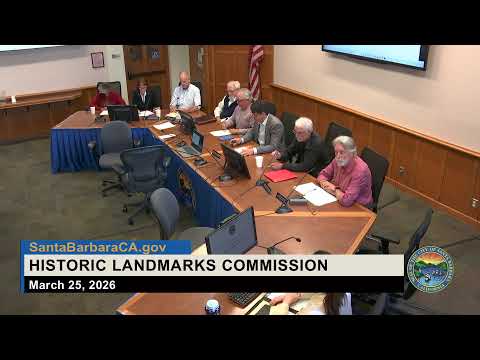
The City of Santa Barbara and the County Office of Arts and Culture will install a temporary asphalt-art treatment at the State and Carrillo intersection after receiving a $100,000 Bloomberg Asphalt Art Initiative grant, presenters told the Historic Landmarks Commission on March 25.
"My name is Sarah York Rubin, and I serve as executive director of the County Office of Arts and Culture," Sarah York Rubin said, introducing the project and the artists. Tess Harris, State Street master planner, and the lead artist, Eddie Jimenez, described a design inspired by Zapotec weaving and community input gathered at the farmers market.
Tess Harris said the project aims to improve pedestrian and cyclist safety while adding a cultural and visual identity to the intersection. "A safety study that was done by Bloomberg back in 2022 found a 50% drop in crashes that involve cyclists and pedestrians, a 27% increase in drivers yielding to pedestrians, a 25% decrease in conflicts between vehicles and pedestrians, and a 38% decrease in pedestrians crossing against the signal," Harris said, citing the program's data as part of the rationale for the pilot.
Presenters said the treatment uses an epoxy street-bond material (rather than ordinary house paint) designed to resist traffic wear; staff expects the artwork to remain for at least two years. Installation is expected to begin the week of April 6 with power washing; painting would occur Tuesdays through Thursdays over about two weeks, with traffic reduced to two lanes during painting days and reopened for weekends and the farmers market. "We will have signage for traffic control and a website to direct people for traffic control," Rubin said.
Commissioners asked about cultural representation and durability. Commissioner (identified in the transcript as) Lundbeck asked whether the design included Chumash imagery; the presenters replied the design intentionally highlights Oaxacan, Mixteco and Zapotec cultural elements developed with community partners and a Mixteco indigenous community organizing project. "We are working with a different indigenous people," Tess Harris said, adding the offices were mindful of not conflating cultures and that other projects might address Chumash representation.
Other questions addressed maintenance if utilities require excavation, planter materials and the artist-selection process. Presenters said the grant does not cover staff time, that city and county staff time is being provided in-kind, and that some local donations and volunteer support supplement the budget. The team said they will collect before-and-after surveys and camera-based traffic counts to measure collisions, pedestrian and cyclist counts, near misses and other metrics.
The commission provided a courtesy review only; no final appealable action was required at the meeting. Installation is slated to conclude in late April with all vertical elements in place by May 1. City staff said they will follow up with multilingual outreach (including Spanish-language channels) and neighborhood notifications ahead of work.
What’s next: installation is scheduled to start the week of April 6; staff will collect safety and usage data after installation to evaluate whether the treatment should be extended or adjusted.