Get Full Government Meeting Transcripts, Videos, & Alerts Forever!
Get email alerts on the Ems Budget topic
No spam. Unsubscribe anytime.
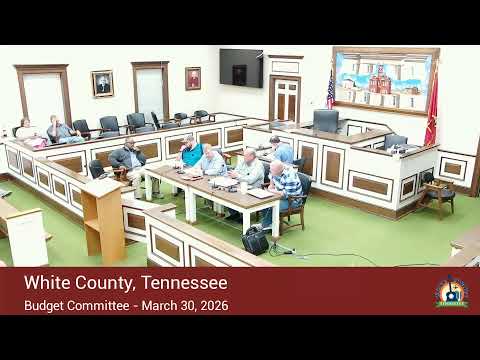
White County budget committee debates EMS staffing, ambulance replacement and tech upgrades as FY2027 planning begins
Summary
County staff described EMS pressures — roughly 7,000 calls a year on 3½ trucks, recruitment challenges, and a choice between remounts and buying new ambulances — and the committee requested an inventory and more precise cost modeling ahead of the next meeting.
White County budget staff and committee members spent the bulk of the meeting examining EMS operations, staffing and vehicle‑replacement strategies as part of initial FY2027 budget discussions. Director Mike Kerr outlined staffing challenges, pay comparisons to a neighboring county and tradeoffs between remounting older ambulance boxes and purchasing new ambulances.
Kerr said his department is running "approximately 7,000 calls a year" on what he described as the equivalent of 3½ trucks in regular service, and that the county struggles to hire enough paramedics. He compared local pay and shift structures to Macon County, noting differences in annual hours, pay scales and staffing models. Kerr described a remount strategy currently budgeted in FY26 (two remounts budgeted at $210,000 each, $420,000 total) and said replacing those with two new ambulances would add roughly $100,000–$180,000 depending on options and assumptions.
Committee members pressed staff for more exact data. One member suggested buying one new ambulance per year to smooth replacement costs and free money for employee pay, an idea Kerr and others discussed as a possible avenue to improve fleet reliability while managing cash flow. Staff agreed to provide a complete vehicle inventory with model years and mileages so the committee could model the long‑term costs and rotation impacts of different procurement cadences.
The committee also discussed equipment and software priorities that would affect operations, including mobile CAD, pursuit alerts and the Paradigm Live tool (which staff said would allow 911 to receive a caller’s live phone camera feed). Kerr and staff emphasized personnel costs (COLA requests for some officials and unspecified salary adjustments) and noted several items that lacked dollar amounts at this stage; they expect to have revenue projections and more detailed figures by the next meeting.
Political context constrains options: one committee member stated they would not support a tax increase this year, and members discussed finding funds within the budget and seeking department carryforwards rather than raising rates. The committee agreed to ask the sheriff’s office and fire rescue to present at the next meeting and tentatively scheduled the next session for April 13 at 6 p.m.
Public comment: A resident asked whether a local high school was offering an EMS course to help recruitment; staff confirmed a class is being offered and Kerr said the department currently had two open positions.
What happens next: Staff will supply a vehicle inventory and refined cost estimates for remounts vs. new ambulances, plus prioritized lists for IT and equipment requests, ahead of the committee’s next meeting so members can consider precise budget tradeoffs.