Lifetime Citizen Portal Access — AI Briefings, Alerts & Unlimited Follows
SBMH webinar: competition manager outlines pre‑award costs, carryover and administrative actions
Loading...
Summary
Amy Banks, competition manager for the School Based Mental Health Services Grant Program, explained expanded authorities available to SBMH discretionary grantees: pre‑award costs (up to 90 days), carryover procedures, budget‑transfer limits, and when administrative changes require FPO approval and G5/GAN updates.
Amy Banks, competition manager for the School Based Mental Health Services Grant Program (SBMH), told grantees on the program’s grant management webinar that ‘‘pre‑award costs’’ may be reimbursed for allowable expenses incurred up to 90 days before the start of a project’s budget or performance period.
Banks said those expenditures are made ‘‘at your own risk’’ because funds are not available until the budget period begins and cannot be used to cover cost overruns from prior years. She advised grantees that costs incurred more than 90 days before the start of the budget or performance period require departmental approval.
Banks outlined carryover rules for unexpended funds, saying recipients may generally forward unspent money into the next grant year for allowable costs ‘‘within the approved project scope’’ to complete unfinished activities, but that carryover is not guaranteed. To request carryover, grantees should send a written statement—typically an email—to their federal project officer (FPO) explaining how the funds will be used, the amount, and an expected exhaustion date. She cautioned that repeatedly carrying forward large amounts could reduce continuation funding in a subsequent grant year.
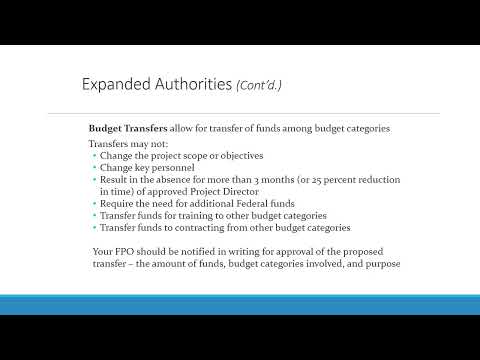
On budget transfers, Banks said grantees may move funds between budget categories when unforeseen circumstances arise (for example, delayed hiring), but transfers cannot change the project’s scope or objectives, cannot be used to change key personnel, and cannot be used to obtain additional federal funds. She noted training funds are generally not allowed to move to other categories and that a project director may not be absent for more than three months without approval.
Banks described administrative actions as post‑award changes to the original grant documentation that typically require FPO approval. She used the example of naming a permanent project director after award as a change completed in G5 that triggers an updated Grant Award Notification (GAN). Banks said the G5 system generates a new GAN for the project director and usually the certifying official listed on the grant file whenever an administrative action is made.
She listed specific administrative changes that require FPO approval, including a 25% reduction in the project director’s time, transferring substantive work to a third party, revisions to grantee cost sharing, or transferring a grant to another entity. Banks referenced applicable OMB circulars as the guiding standards for approvals and allowable costs.
Banks also emphasized the program’s commitment to fairness: grantees may not change a project’s approved scope after award in a way that would give an advantage over applicants who competed under the original peer‑reviewed criteria.
The webinar segment concluded with procedural guidance to contact the FPO by email with the details and rationale for any proposed carryover or budget transfer so the FPO can process administrative actions in G5 and issue the appropriate GAN.