Get Full Government Meeting Transcripts, Videos, & Alerts Forever!
Get email alerts on the Metro Nashville Accountability topic
No spam. Unsubscribe anytime.
State committee recommends corrective action plan for Metro Nashville Public Schools after accountability hearing
Summary
The State Board subcommittee recommended that Metro Nashville Public Schools enter a corrective action plan with the State Department of Education after questioning district leaders about six underperforming schools and the district’s leadership, budgeting and intervention strategies.
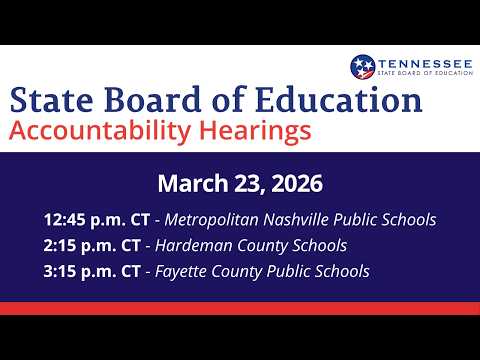
The State Board of Education’s Accountability Hearings Committee recommended that Metro Nashville Public Schools enter a corrective action plan with the Tennessee Department of Education following a 75‑minute hearing on district plans for six underperforming schools.
Chair (speaker 1) opened the hearing by noting the district had six schools on the accountability list — Antioch Middle, Cane Ridge High, Chadwell Elementary, Donaldson Middle, Glenview Elementary and Paragon Mills Elementary — representing roughly 4,692 students for the 2024–25 school year. The committee asked the district to explain root causes and remediation steps.
Dr. Battle (speaker 11), who led the district team, said leadership, fidelity of instruction and targeted supports were the primary root causes and pointed to a set of ten “impact strategies” the system is intensifying, including high‑dosage tutoring, principal coaching, and student‑based budgeting. “We are clear that leadership matters,” Dr. Battle said, adding the district had moved to a support‑hub model to free principals to focus on instruction.
Chief Financial Officer Jorge Robles (speaker 12) described the student‑based budgeting process and said TISA funding represents roughly 18% of district funding; the district is braiding state, local and federal funds to sustain interventions. Renita Perry (speaker 15) described a principal‑development pipeline and expanded, real‑time coaching for teachers in impact schools.
Committee members pressed the district on principal tenure, fidelity of interventions, and whether the budget and staffing processes guaranteed continuity for these targeted investments. Members repeatedly emphasized the need to ‘‘know where you are, but don’t stay there’’ and asked the district to produce concrete, timely benchmarks. After discussion, the committee concluded a corrective action plan — which would formalize the district’s existing strategies and align them with the Department of Education for monitoring — was the appropriate next step and approved the recommendation without objection.
The committee’s recommendation will be transmitted to the full State Board of Education for consideration at its May meeting, and if the board affirms, the district will collaborate with the State Department of Education on a codified corrective action plan.